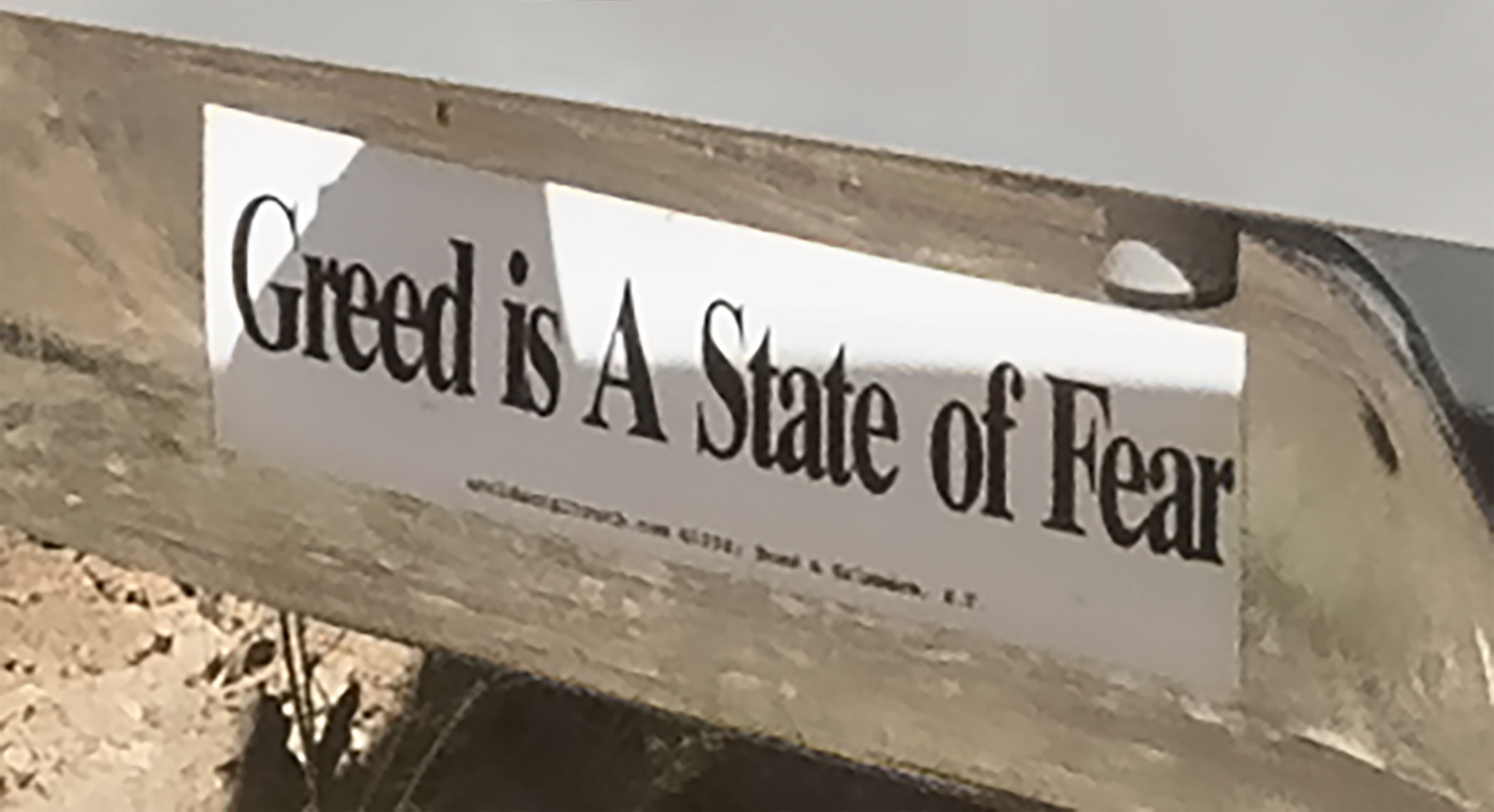
“Greed is a state of fear” read the bumper sticker on the back of the van parked at the Strawberry Music Festival: An idea linking two concepts, neither of which it had occurred to me previously were related in such a manner. I had long puzzled on why certain people have such an appetite for wealth, possessions and the like. I like my creature comforts but I don’t need to drive a Beamer or an Lexus in order to haul myself around. It would be nice, but I don’t need a beach house or a mountain house to alternate between. I just need a roof over my head, heat in the winter and the basic necessities plus a few toys to play with and I’m fine.
It’s long been a gripe of mine that the economics of our society are so tilted toward the wealthy that the poor have to go without. It’s a problem with no easy answers and millennia of history that suggests it’s been that way far back into time. No matter how advanced we become technologically, it seems we’re still in the stone age when it comes to how to treat our fellow human beings. Religions tout charitable behavior but simultaneously offer salvation to sinners and things stay pretty much the same, which is to say when pressed, most folks will look out for their bottom line first.
So when presented with the idea that greed is fear-based, it set my (thinking) wheels to spinning. Many of us, myself included, had parents who lived through the great Depression. They learned from that experience that it was a good idea to keep your pantry stocked with foods in case there was an interruption in the food supply. My parents had these notions further reinforced during the second World War, when gasoline, milk, butter and other essentials were rationed. They made deals with friends so I had enough baby formula as an infant. These measures were prudent in their context and, rather than being driven by greed, were functional and adaptive given the state of things at that point in time.
But there’s real need and perceived need, and it’s important to distinguish between the two. While taking steps to insure one doesn’t suffer from outages of essential goods is functional and warranted in situations where interruptions in supply are a real possibility, it does not follow that amassing huge amounts of cash and goods can be justified based on the notion of “saving for a rainy day.” There comes a point where one must ask, how much is enough?
The answer to this question will vary widely, I suppose, depending on who it is directed to, but, generally speaking, if you look at resources as a finite quantity, then it follows, as I see it, that if someone over here has amassed sufficient resources to sustain, say, X number of people, then there will be X number of people somewhere over there who will have to go without in order for this person to have their (inflated) share of the pie. Not very democratic, and it flies in the face of charity, but there, in essence, is one way in which greed may be said to be fear-based, since amassing a fortune is a popular means of insuring against loss, need and want. It’s like, to upend the words of JFK, “Ask not what you can do for your country, ask what your country can do for you.”
This seems to be the mantra of a sizeable portion of the Republican Party these days–at least the ones who see (erroneously, I sincerely hope) some personal gain to be had by supporting Trump for president.
When viewed in this way, the fear underlying peoples’ greed goes right along with the fear-based agenda of the Trump campaign, Fox News, and the views of all the folks who believe the country’s in terrible shape and only Donald Trump can fix it.
Ultimately, however, and somewhat ironically at that, when we reach the ends of our lives on this earth, it will be the folks with the most stuff–property, goods, cash, etc.–who will struggle the most with having to leave it all behind! As the saying goes, “you can’t take it with you.”
Petaluma, CA
14 Semptember, 2016
Tim Konrad
 sonora2sonoma
Leave a comment