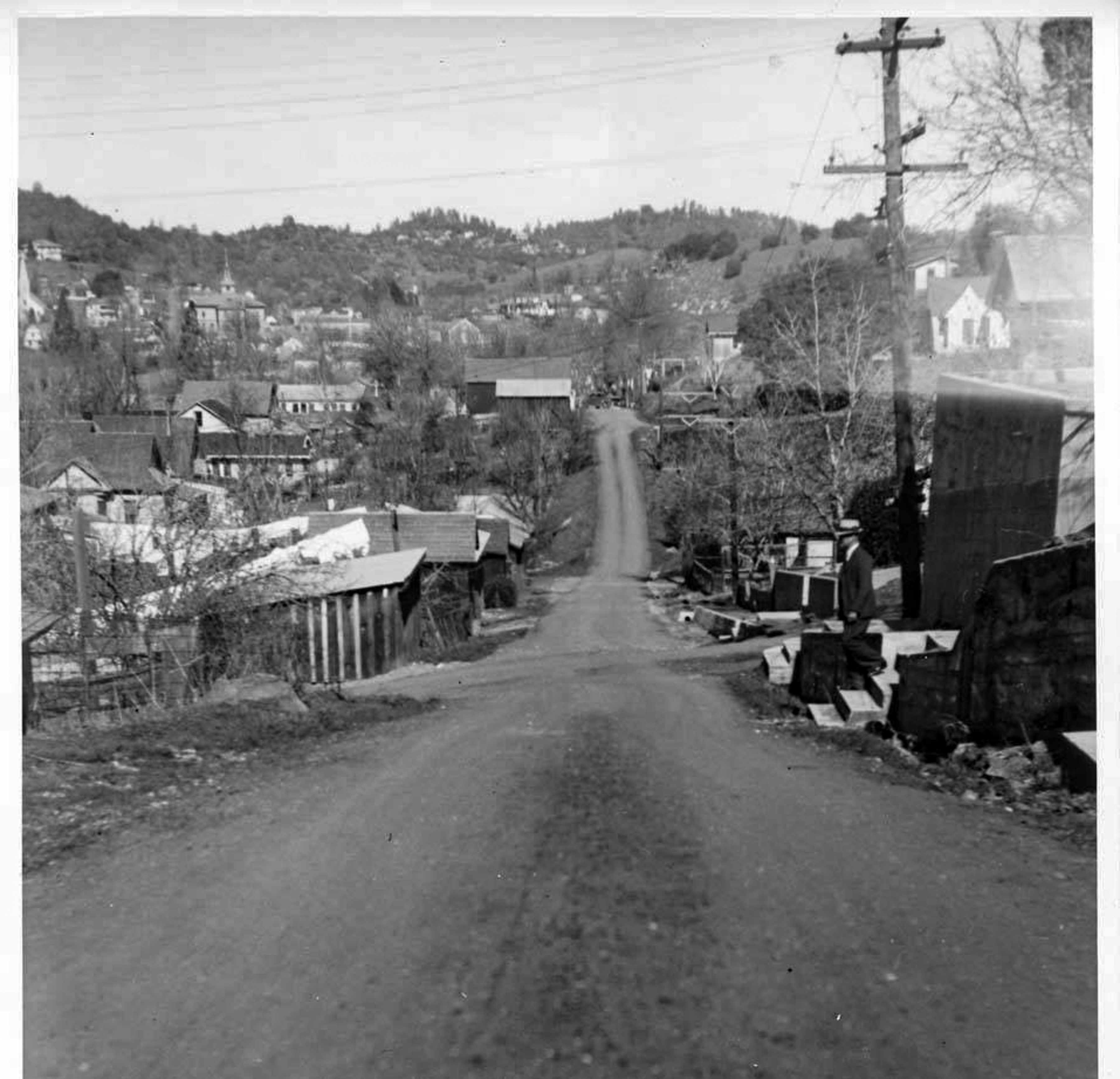
My neighborhood around 1936
By Tim Konrad
Chapter One
While mystics may speak of living in the eternal present moment, or the “now,” for most of us, says Hank Steuver, “there is only this sort of present-tense past that we all live in, full of remakes and revivals and constant nostalgia.”*
In this space of which Steuver speaks, the clamor of the present competes for attention with the intrusion of recollections of unfulfilled dreams and memories, of plans thwarted and regrets borne of hopes unrealized, any of which can be triggered by the most surprising and seemingly insignificant phenomena. Any attempt to impose order over the resulting chaos appears at first blush as an invitation to fail, when it is just a manifestation of the cosmic dance between order and chaos that has gone on uninterrupted for time immemorial.
In recognition of Steuver’s “present-tense past” and by way of acknowledging the fact that this is a state in which I frequently find myself, I have decided to surrender to its reality and do something useful with the material thus exposed by exploring it via the medium of writing.
***
Since my formative years were spent in a small town in the Sierra foothills of northern California, a substantial part of the “constant nostalgia” that spins around in my head can be traced to the area in one way or another. Thus it seems perfectly natural that I choose Sonora as a focal point of my exploration, a place to begin my journey, since, owing to the decades-long tenure of my association with the place, I have much to share about it.
To quote from Orhan Pamuk, in his tribute article in the November 1, 2018 edition of the New York Times, honoring the late Turkish photographer, Ara Guler, “For those who, like me, have spent (a long time) in the same city, the landscapes of the city eventually turn into a kind of index for our emotional life. A street might remind us of the sting of getting fired from a job . . A city square might recall the bliss of a love affair . . An old coffeehouse might evoke the memory of our friends” long since gone.
Such is my experience when I return to the town in which I grew up–now much different than it was then, but loaded nonetheless with memories waiting to be resurrected at the slightest provocation.
Having grown up in the same house and lived in it until I married and moved out afforded me a longitudinal view of how a neighborhood can change over decades.
The neighborhood in which I was raised has changed much and yet looks much the same as it did in the fifties. Yes, there is the small apartment building sitting on a corner lot once dominated by a single-family dwelling, the parking lot illumination of which now intrudes upon the serenity once afforded by the twilight of evening. That spot was occupied by an old wooden garage when I was a child—a structure with no signs it had ever seen a paint brush except for the message scrawled across one of its doors, an artifact from WWII that stated “Kilroy Was Here.” One day when I was eight or nine I chanced to lean against a wall of that structure long enough to receive a wasp sting, the experience of which is probably the reason I still recall the building these many decades later.
The other houses in the immediate vicinity remain intact save the one across the street, which caught fire after the inhabitant at the time, recently widowed and on oxygen, lit a cigarette too close to her oxygen tank. She survived the fire but the house did not. The people who rebuilt had the good taste to construct a dwelling that retained the architectural spirit of the original building, which was a boon to the neighborhood.
The one house in the area whose destruction would be beneficial remains undisturbed, uninhabited and unsightly, as it is literally falling down. A big barn of a building, unimaginative in conception and ponderous in stature, its two stories unapologetically built right out to the street on the back side of a half lot, its front stairs long since gone, its paint peeling generously, stands as a seemingly open invitation to the shelterless, in defiance of the law of gravity, and as an opportunity for the fire department to teach new recruits how to put out residential fires.
While the neighborhood structures are mostly intact, none of the original inhabitants remain, all having either moved on to other parts or other realms– mostly, due to the dictates of time, the latter.
***
It all seems so far away as I sit drinking a beer on this unseasonably warm November afternoon one hundred thirty-eight miles and a lifetime away in the spoiled and crowded wilds of Sonoma County. Twenty plus years living here haven’t touched the deep sense of familiarity I still feel toward the place where I spent my formative years. Some of the issues remain the same wherever one lives–traffic density, the disappearance of open spaces, over commercialization and the myriad problems resulting from the overemphasis on money that characterizes our culture. I suppose every generation has felt some of the same things about the ways in which “progress” diminishes and cheapens our experience–the manner in which we interact with and relate to our surroundings. Every innovation seems to have its drawbacks and for every gain, something is lost. Usually, it’s issues pertaining to quality of life that suffer the most.
Yet, it’s in our nature as a species to want to reinvent the wheel, it seems, and each generation has its own take on how to go about it. The only constants are that change will occur and money will be involved. Precedent is eyed with suspicion in this enterprise, and history is almost universally ignored or disregarded, followed eventually by the usual (but certainly not in all cases) homage to the wisdom of hindsight.
So it has come to pass, for instance, that in the Sonora of my youth, one needed only pick up the telephone and dial “O” to get another human being on the phone. These days, one needs experience, luck and oftentimes also specific knowledge of phone codes before one can reach an actual person.
The fruits of this so called “progress” are both large and small and can be seen in a variety of places. There was a time, for instance, when the shopping carts in the supermarkets were gathered inside the stores where they were more conveniently accessible to shoppers. I remember this being the case at my local Save Mart in Sonora where I used to shop. One day, presumably after the folks at the corporate office realized they could make more room for product by moving the carts outside, the shopping carts were relocated outside the building with the explanation that the move was made “for your convenience.”
A much larger, and more egregious bit of commercial propaganda was pulled off successfully by the oil and gas industry during the so-called gas shortages of the 1970s. Before the gas shortage, people were accustomed to getting their tanks filled with no appreciable wait time at the pumps–it was literally taken for granted that all one needed do was drive up to the pumps and fill their tank. Then, OPEC held us hostage (or, at least, that’s what we were told) and the next thing you knew, people were waiting in long lines for their turn at the gas pumps and, rather than feeling resentful at the inconvenience, they were actually grateful they were able to get gas at all. And at an inflated price to boot! A fancy bit of social engineering, that!
Not one to miss a beat, Madison Avenue took notice of the power achievable through the regulation of supply. Couple that with the advantages to be exploited by preying on the naïveté of the young, and add in the diminishing supply, thanks to attrition, of older folks who knew better, and, before you knew it, it became nigh on impossible to reach an actual person on a corporate phone call anymore. What had once been taken for granted had now become outside of common experience and, hence, mostly a thing of the past. And for whose convenience???
***
Sonora was a quieter place back then–nothing like the bustle and fuss of the traffic generated today by being the regional hub of commerce for a three-county area. Where once the loudest sounds to be heard were the noon blast of the fire alarm at city hall or the Jacob’s brakes of logging trucks slowing down on Washington Street as they entered town from the mountains, now there’s the much-too-frequent intrusion of sirens–police and fire–as respondents’ race to administer their services to those in need. In reflecting on these ‘Sireneers,’ as I’ve come to call them, I remember the time as a small child when I saw the Sons of the Pioneers (I love wordplay) appear in a Roundup Parade on Washington Street. As I said, memories lie in wait in profusion in such places.
The Sonora of my youth was a town of 2500 souls, many of them second and third generation Italians whose progenitors emigrated during the latter half of the Nineteenth Century lured by the prospect of opportunities denied them for whatever reason in the “Old Country.” It was not uncommon in those early days, when accompanying my mother on shopping excursions, to recognize practically everyone one encountered. My father was, like his father before him, affiliated with several of the fraternal organizations that formed the backbone of social life in rural America at the time. My parents shared bonds with their friends that went back decades; the resulting connections ran deep.
I would hear stories as I grew older about how the local Elks Club used to host an annual fund raising event, called “49er Night,” where members would retrieve old slot machines and roulette tables from storage (all of which was illegal since gambling was outlawed in the state) and set up, for one night only, a casino at the Fairgrounds. An extremely popular event, this went on for years until, one year, when Edmund G. “Pat” Brown (Jerry’s father, later to become governor of California) visited Tuolumne County when he was state attorney general. The local folks wined and dined him and told him about their event, after which Brown, upon returning to Sacramento, took steps to shut down the enterprise. My father, not a vindictive man, felt a sense of betrayal at Brown’s actions and never forgave him for it.
I also heard tales as a child about how Sonora used to be more “wide open.” From illegal distilleries during prohibition, to prostitution, the place sounded like it used to be much more lawless and unencumbered than it was in the Sonora of my memory. My father told tales of how he and his friends used to go to outdoor dances in Columbia on Saturday nights. The dance floor was behind the Fallon Theater parking lot where the effects of earlier hydraulic mining had created a natural amphitheater, still visible today. They would park their Model T cars in the fashion of modern tailgate parties and serve up moonshine whiskey to the revelers.
My dad’s former business partner, Ralph Denton, a man who described himself as possessed of “the gift of gab,” used to tell a story about a Mr. Nicolini, (father of the then County Recorder) from Chinese Camp, who was a producer of bootleg whiskey during Prohibition. The local constable, as the story goes, was an amiable person who, if he knew you, would extend you the courtesy of alerting you when the Feds planned to conduct raids on distilleries, in exchange, of course, for some product. Prior to the onset of one such raid, the constable warned Mr. Nicolini to conceal his operation, which, for reasons never made clear, but probably involving pride or stupidity, he neglected to do. As a result, he was cited and subsequently made to appear in Court. When he had his day in Court, the judge told Mr. Nicolini his fine would be $20, to which the man replied “That’s nothin’! I’ve got that in my ass pocket.” The judge continued, “and a week in jail. Do you have that in your ass pocket too?”
In the prostitution department, one notorious “house of ill repute” was at Yosemite Junction, where Highway 120 veers south from Highway 108 below Jamestown. It was managed by one Dave Bonavia, a man well known for such enterprise in the Mother Lode of that time. Bonavia was implicated in a couple of scandals that came to public light while I was living in Sonora. One involved gambling and was the downfall of a business collaboration between Bonavia and a fellow named Russ Rolfe, who at the time owned the Sullivan’s Creek Restaurant at the site of what is now the Peppery Gar & Brill. At issue was a smaller building uphill and behind the restaurant itself and which was attached to the restaurant by a covered walkway. This building housed a gambling enterprise, run by Bonavia, and, by virtue of it’s being physically attached to the restaurant building by the covered walkway, it led to the shuttering of the entire operation once it came to the attention of law enforcement.
The other bit of scandal involved Bonavia and the sheriff at the time, a former Highway Patrolman named Mervin Mullins. Mullins was said by some to have been fond of forgiving truckers’ citations in exchange for a bit of cargo—say, a case of whiskey, etc., back in his state trooper days. When he was sheriff, Mullins was secretly tape-recorded having a clandestine meeting with Dave Bonavia on top of Myers Hill. While I can’t recall the subject of the conversation, its revelation caused a controversy that ultimately proved damaging to the sheriff and led to the end of his career.
*Hank Steuver, Washington Post, 11/27/18

 sonora2sonoma
Leave a comment