By Tim Konrad
Chapter Two
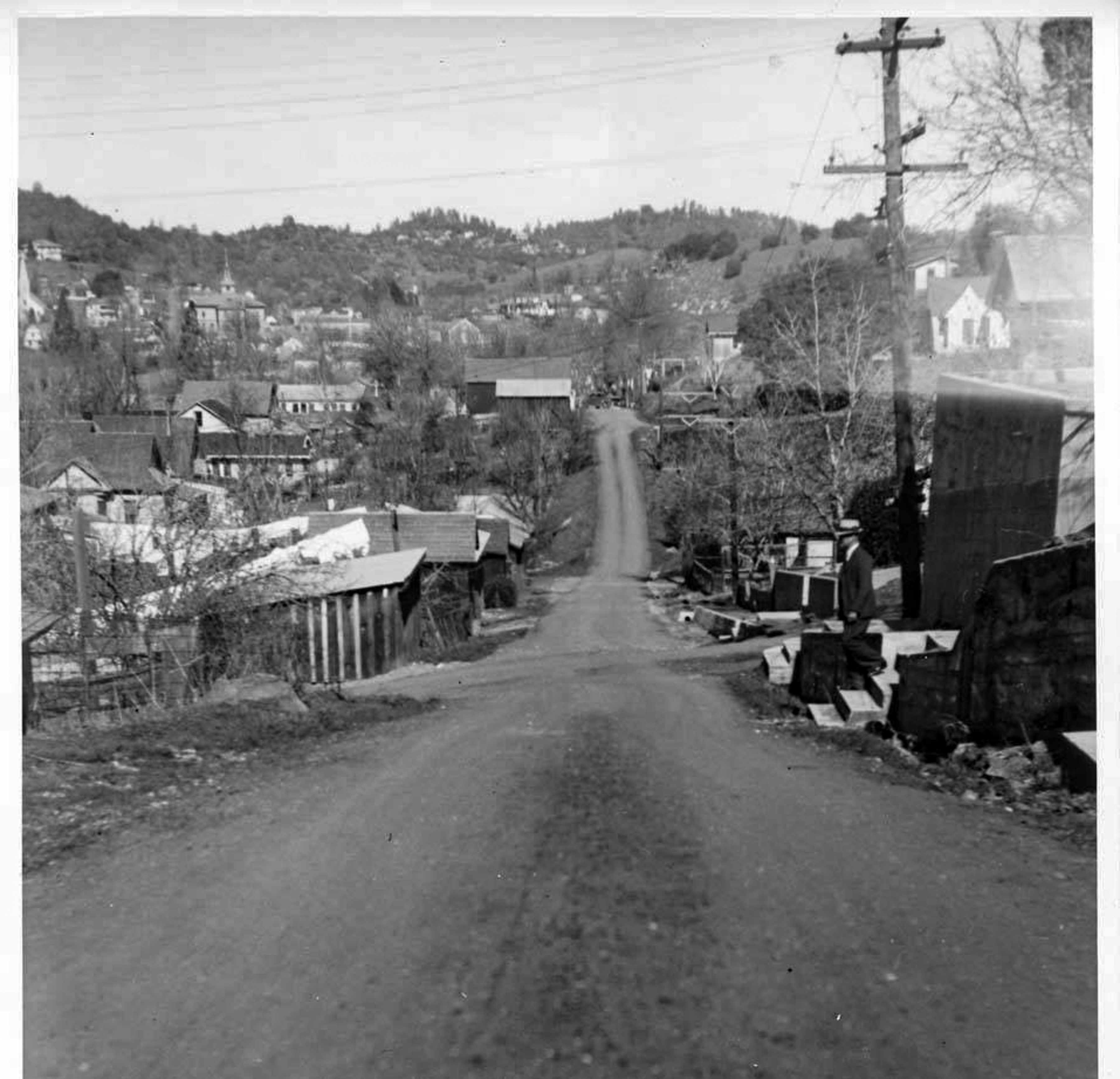
Sonora was, to my young eyes, a more genteel place. A place of safety, of security, where kids could play outside at night, go to the movies downtown by themselves, and never worry about any of the kinds of things children fall prey to in this day and age. The same was true of the schools, although the threat of bullying by older and bigger kids was ever present, much as it appears to be today. In that regard, once I grew big enough that bullying became less of a problem, I was happy to leave my childhood behind me. Children, being unencumbered by the suppression of their basest impulses, can be exceptionally cruel!
Tuolumne County in the 1950s offered many opportunities to swim in rivers, as the stretches of the Stanislaus and Tuolumne Rivers that are now inundated by reservoirs were then free and wild. One of my favorite memories from childhood involved going swimming at Mountain River Lodge on the Tuolumne River. There was a long stretch of calm and deep water lined with beach sand and overhung with large trees in which were strung ropes with which one could swing far out into the river to plunge in to the cold depths. The lodge, situated next to the river, had an outdoor deck equipped with speakers that would broadcast whatever was on the bar’s jukebox, where it would filter across the river and into my psyche. I can still recall, almost as if it were yesterday, hearing the strains of Hank Williams “Jambalaya” drift across the river on a lazy summer’s afternoon. Another summer the prevalent song was “A White Sports Coat” by Marty Robbins. There is no better way to recall such moments than when one’s recollections include the taste and feel of place in conjunction with the tune that accompanied it! The multiple modalities of such recollections strengthen and enrich them in ways unachievable through one modality alone.
The rivers’ swimming holes are no longer accessible, thanks to people whose priorities ranked agriculture over aesthetics, a tilting of nature that will be corrected in the fullness of time. But not in our time, however. While I remain grateful that I was afforded the opportunity to experience these wonderful places that are no more, I lament that the kids of today have no chance to experience them as I did.
In the midst of berating ‘progress,’ a word or two are in order concerning what it has meant for our lives, in spite of what it is doing to our planet, I am not unmindful of the sense of wonder I feel when I reflect on the fact that we live in an age in which we have the ability to step inside a car and drive pretty much anywhere we choose, crossing territorial divides with little cognizance of the fact that, in other times, if possible at all, such activities would have been fraught with peril. We have the ability to traverse great distances, mostly without restrictions, and can do so at speeds that our ancestors would have found impossible to comprehend. And we do so as if it were our birthright, which of course it is not, as by doing we are passing the buck to our descendents, in the forms of depleted finite resources and carbon pollution, fouled air and polluted groundwater. A sense of wonder indeed, but one tinged with more than a little regret plus a sizeable portion of guilt.
We find ourselves part of a body politic in which we are at once participants and spectators, joined in something larger than ourselves that embraces self-defeating principals as a survival mechanism. How are we supposed to respond to such ridiculousness? Stick to your principles, they say? Not so easy if doing so will affect your bottom line, you say? What to do? What to do?
I personally like swimming holes! Just sayin’!
***
It’s tempting to think of the 50s as that idyllic time, immortalized in Norman Rockwell paintings, that used to be touted by Republicans, back when they acted like Republicans, as the birthplace of “traditional family values.” While Rockwell skillfully chronicled the spirit of the time, his work only represented the experience of one segment of society. America was anything but egalitarian back then, but the injustice was less obvious and kept hidden, as much as possible, from public scrutiny. Before the dawn of the internet age, information was not as readily available as it is today. The myth of traditional family values was an easy thing to swallow for a White kid growing up in a middle-class home in 1950s small-town California—a place relatively free of crime and the other social ills that vex more urban areas. Life seemed simpler because it was simpler. The pace was slower so it allowed time for a person to reflect on his or her actions. Fewer distractions and diversions meant there was more time to develop a deeper appreciation for the little things in life that bring joy. The fact that this version of reality did not describe the experience of minorities, the mentally ill and the economically disadvantaged was lost on me back then. I was insulated from exposure to such realities by age, culture, location and circumstance. Later, as these conditions changed, my world view would change as well.
By the time I entered high school, my interests had taken me in a different direction than that of many of my classmates. I quickly discovered, for instance, that many of the reference materials I sought at the high school library were only available on order from other locations. I became fascinated with the writings of the Beat poets in North Beach. I read Kerouac for days on end, hoping by so doing I would find meaning in his work. But I never did! He seemed always on a quest, for what, I couldn’t figure out. I blamed myself for my apparent inability to understand this celebrated writer’s work. It was only years later, after a few encounters with lsd, that I understood that it was through no fault of my own that I couldn’t make sense of Kerouac’s work—he never found whatever it was he was so desperately looking for, so how could I have?. I remember the thought crossing my mind when that realization dawned on me that, maybe, if Kerouac had taken acid, he would have found what he was looking for.
In a similar vein, I never understood the paintings of Van Gogh until I dropped acid. The bold lines in his paintings are evocative of the lines of motion perceived in psychedelic experiences. The same may be said for the paintings of esteemed Columbia artist Charles Surendorf.
But, though I wouldn’t understand the term “cognitive dissonance” for another 23 years, I soon discovered a striking cognitive dissonance between life in Sonora and life in Sonora on lysergic acid diethylamide. To be able to see—to be shown—on a Saturday night, how our entire culture is based on fundamental assumptions that bear little resemblance to reality, and then to have to get up early Monday morning and go sand sheetrock for 8 hours gave me a lot of time with nothing to do with my mind but mull over what just happened.
 sonora2sonoma
Leave a comment