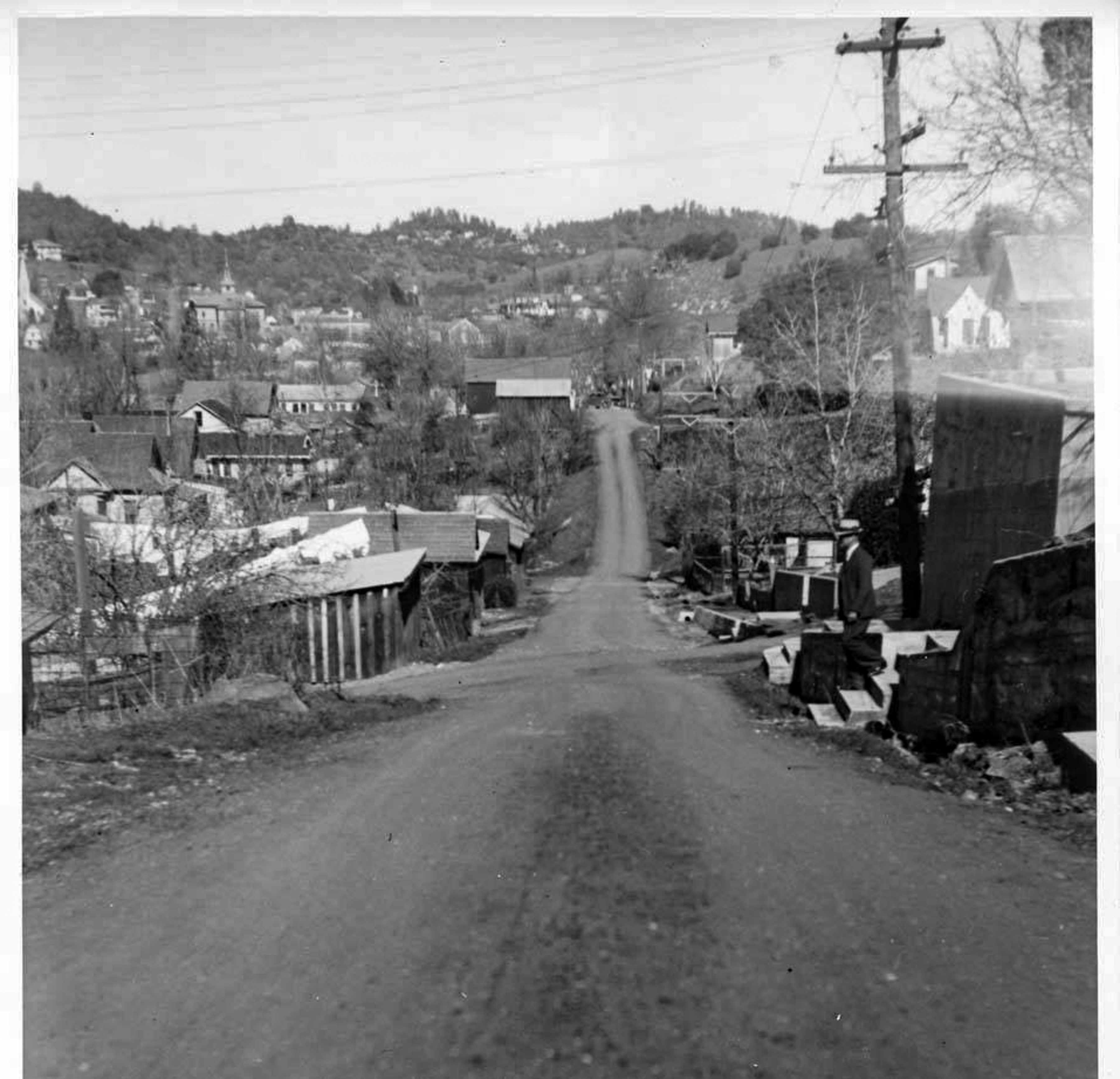
by Tim Konrad
Chapter Four
My father moved to Tuolumne County, with his father, brother and sister, in 1923, prior to the paving of the road from Oakdale to Sonora. Having lost his wife to a ruptured appendix in 1913 when they were living in San Mateo, my grandfather, Timothy “Pop” Konrad, took in a roommate—my mother’s Aunt Veda—to help out with the children; their association continued until Veda’s death around 1951 despite her cycling through several husbands along the way. My father was seven when his mother died; he never warmed to Veda.
His mother having died birthing him, my grandfather was orphaned at the tender age of three months when his father succumbed to an aneurysm; he was raised by family friends in Covington, Kentucky. As a youth, he longed to be a railroad engineer but he suffered from a partial hearing loss that rendered that dream unattainable. He became a machinist instead, but, longing for more, he took to adventuring in Mexico, where he searched for buried Spanish gold in the state of Colima on Mexico’s Pacific coast. This was during the period in which Pancho Villa was stirring up trouble in the region, but his return to the states was hastened after learning he was being sought by people who were bent on avenging the honor of some Mexican senorita.
Eventually landing in San Mateo, Pop became by turns a blacksmith, an auto mechanic and an inventor. In 1913 he invented a motorized airplane that he had patented in 6 different countries. Twenty-nine feet in length, it consisted of a long cylindrical fuselage, open on each end with propellers affixed front and aft, and with wings that were bi-plane by design but extending out the front and back rather than to the sides. The prototype he constructed was not designed to carry passengers and was piloted remotely with controls he operated while riding ahead of the contraption on a motorcycle. He used to fly it down the main street of San Mateo on Sunday mornings. Ironically, his other invention consisted of a new design for an anti-aircraft gun-sight that he donated to the US Navy for use in WW II.
In 1917 the country and the world were ravaged by the Spanish Flu pandemic. Among its casualties was my maternal grandfather, Bert Cartwright. My mother and her brother, Jack, also contracted the illness but survived. My maternal grandmother told me how, during the early days of the epidemic, friends and neighbors would come to her window, wearing paper masks, to bring them food. As the days turned into weeks, she recounted, fewer and fewer of them appeared. My grandmother said they learned afterward that many of them—one third of the population of their little Utah town, in fact–had perished from the flu. My grandmother, newly widowed, sent my mother and uncle to live with her sister Veda in California and my extended birth family was born.
Although the dust had settled from the bustle of the Gold Rush decades earlier, it was the promise of gold that brought my grandfather to the hills outside of Columbia where he and a small group of stock holders had purchased a working gold mine on the banks of the south side of the Stanislaus River not far upstream from Parrott’s Ferry. Known as the Republic Mine, the venture never turned out to be the source of riches “Pop” had hoped for but provided a stable base for him and his family to weather the depths of the Great Depression. The venture turned out to be unprofitable for the stock holders; what earnings the mine produced were expended to keep the home fires burning; the occasional poached deer kept food on the table. My father told stories about how he and his friends would gather firewood upstream and construct rafts out of driftwood to transport the wood down to where their cabin was located. This was a happy time, as evidenced by the wide smile my father displayed when recounting those adventures.
My grandmother eventually followed her children to California. After some time, she met and married her second husband, Ernest Wolfe, with whom she bore her third child, who became my Uncle Bob. During this time she brought my mother and Uncle Jack to live with her and Ernest. My mother was a teenager by then, and she and Ernest didn’t get along. After an incident in which Ernest physically abused my mother, my grandmother sent her to Tuolumne County to live with Veda and my father’s family.
Owing to these unusual and tragic developments, my mother and father essentially grew up together, largely in the same household. The early mining venture at the Republic Mine was abandoned in favor of another opportunity and the family moved upstream and took over the operation of the Von Tromp Mine on a hillside adjacent to the road to the Experimental Mine out Italian Bar Road from Columbia. My father and his brother, also named Jack, worked this mine with my grandfather and assorted others, among whom was Lyle Schoettgen, who in later years became Columbia’s constable. My father and Lyle bunked together and drilled and blasted their way into the mountainside without air filtration, as was the custom in those days. As a result, both exhibited signs of respiratory distress in later life, accompanied by a frightening-sounding cough. Lyle’s cough sounded tubercular. I was told that Lyle suffered from silicosis, and it likely figured significantly in his eventual demise.
During this time, my family became acquainted with the Ponce family who lived at a ranch just up the road from them. This friendship endured into the 1950s and beyond.
At some point in the latter part of the 20s, my father became disillusioned with gold mining and got a job working as a house painter in Sonora. He had apprenticed as a teen under a Hungarian house painter in San Mateo, where he had learned everything from how to make paint from lead paste and linseed oil to applying antique finishes to hanging fancy wallpaper. The new job in Sonora afforded him the opportunity to put his skills to use. As he was still living at the mine, he gave his earnings to Veda, who handled the money for the family. He resented how she would, in his mind, “spend all the money on chocolates” instead of using it for things he considered more essential. When, after he’d been on the job for a while, he received a raise, he didn’t share the news at home, instead saving the extra funds until he had enough money to elope with my mother and establish a residence in Sonora.
 sonora2sonoma
Leave a comment