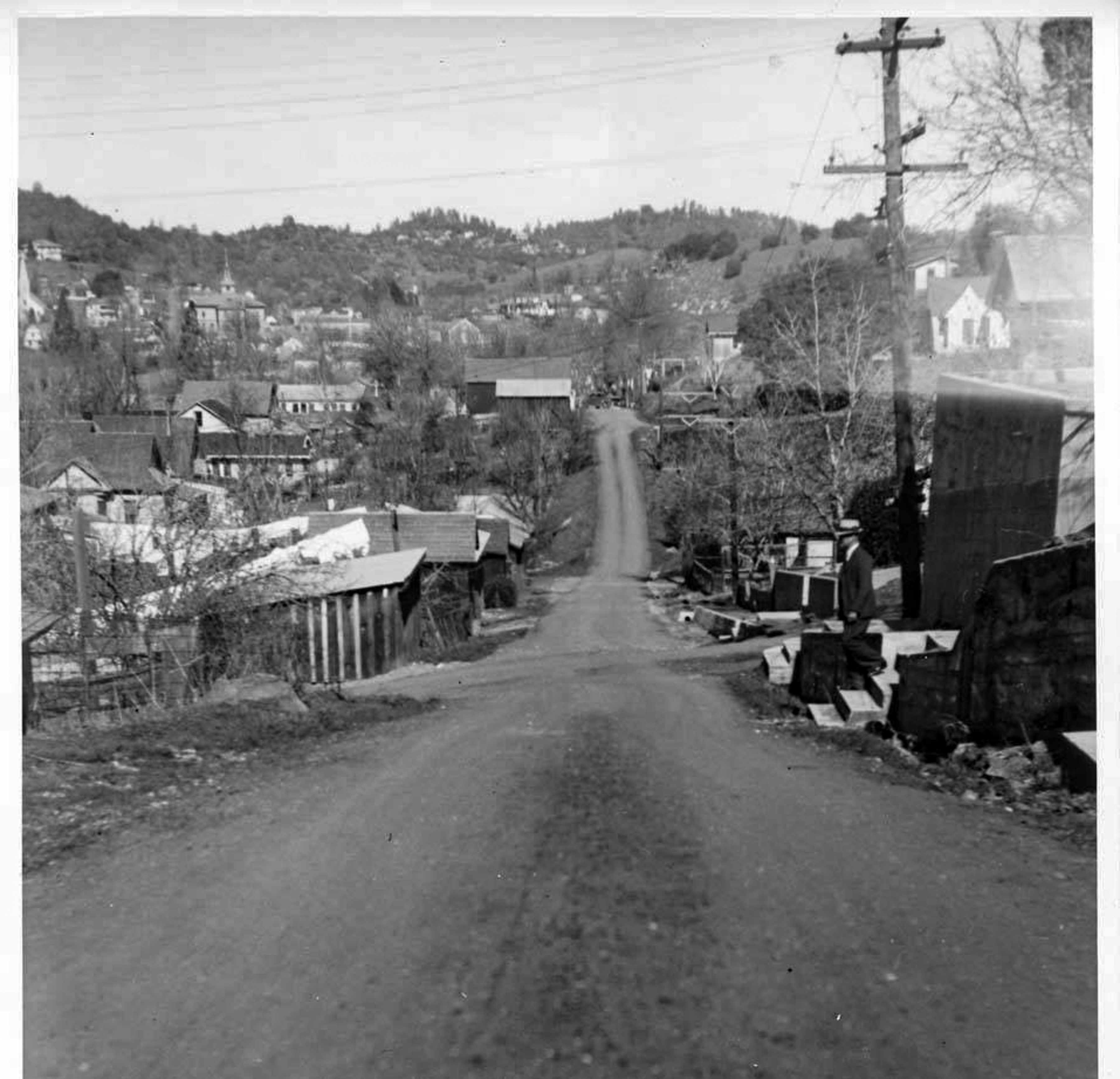
by Tim Konrad
Chapter Six
One of the more outsized, and fascinating, personalities I encountered growing up in Sonora was the former Tuolumne County sheriff, Miller Sardella. A shrewd lawman and an insightful politician who was always campaigning for re-election, no matter the season, Miller was a force to be reckoned with. He used to stop by and visit with me and my friends at the local coffeeshop, The Europa, where he would tell us stories about the shenanigans he and his friends got involved in back when he was a youth in Sonora. His stories, while varied in content, all shared certain thematic details—the foolhardy ideas young people come up with, the inevitability of consequences, the difference in how the laws were prosecuted then versus back when he was a kid, and the importance of 1) knowing the difference between misdemeanors and felonies and 2) the importance of avoiding the latter. Miller never forgot what it felt like to be an impressionable teenager, which gave him an accurate take on where we were coming from that, in turn, commanded our respect and made us open to his counsel.
Two of Miller’s stories aptly illustrate the skill with which he ingratiated himself into our insular world. He told us how he, his brother Curley and a few friends decided one night to raid a local farmer’s watermelon patch. The farmer caught them in the act and routed them with the aid of his shotgun, which he had loaded with shotgun shells in which he had removed the pellets and replaced them with rock salt. While the salt hurt when it hit, it did no serious damage and law enforcement involvement was not necessary in the redress of his grievance.
The other parable was more ambitious and necessitated a more nuanced solution. Miller and some friends had come upon the idea of pilfering a large barrel of wine from a local Italian’s wine cellar. Making off with their haul under cover of night, they planned to re-group the following morning at the spot where they had stashed the barrel and where they intended to drain as much of it as possible. To their dismay, when they arrived at the appointed location, they were met by the local constable, who had somehow gotten wind of the operation and was prepared to teach them a lesson they would not soon forget. After “giving them a good licking,” as Miller recounted, he made them return the barrel to its rightful home, at midday, by pushing it right up main street where all could see. He would always end such accounts by pointing out that, while in his day the consequences were immediate, they did not normally involve the filing of charges and the compilation of police records that could follow a person throughout their lives like they could in later days. His motto was “don’t worry about the misdemeanors but avoid the felonies.”
Miller was known to look after those who ran afoul of the law in much the same manner. He was more apt to drive a drunk person home than to take them to jail. He even put his life at risk in order to de-escalate dangerous situations, something practically unheard of nowadays. There was a situation in which an armed and disgruntled man of Italian heritage had barricaded himself in his house and was refusing to surrender to police. Miller showed up, sized up the situation, and announced that he was going in. A half-hour passed, then another, and finally, after a couple of hours with no sign of Miller, one of the officers in charge snuck up to the house and peered inside, where he saw Miller and the other fellow drinking wine at the kitchen table. The situation was resolved when the man surrendered. Miller’s “main concept,” said former sheriff’s deputy Ray Antonini, “was to keep people out of jail if it was at all within (his) means. He (would) just as soon go out at 3 or 4 in the morning as any other time to settle family arguments and mediate their problems.”
Ever the politician, Miller was perpetually running for office. In those days, one of the local restaurants had an attached bar sitting beside it. Miller, sitting in the bar one afternoon, noticed that one of his rivals in the upcoming election for sheriff was in the restaurant next door. Excusing himself from his friends at the bar, he announced to them that he was going next door to get them all a free drink. He then went into the restaurant and announced to his rival that there was ”a bar full of thirsty patrons next door wondering who to vote for.” The fellow jumped up and went into the bar and ordered a round of drinks. Miller followed him and told the gathering “see, I told you I’d get you a free drink.”
Though not an “old-timer” in the sense his family hadn’t been in the area for generations (he was born in Italy), Miller’s status as an old timer was defined , as described in his obituary by Russell Frank in the Union Democrat in 1988, by “a system of values based on an ideal of neighborliness.” “We knew everybody,” Miller said during a 1985 interview just prior to a party in his honor. “When I was sheriff, every time a new house would go up, if I didn’t know ‘em, I’d go and visit,” he said. “Talking to people, telling them stories,” said his wife Mary, “was his whole life.” “He could start in the morning and tell stories ‘til the end of the night,” said his sister, Leona Kisling. While mostly true, Frank said, “his friends would tell you he wasn’t above an occasional embellishment if it made for a livelier tale.”It was his “gift for gab, for taking the time to talk to people,“ Frank said, “that made him such a popular figure.”
Miller was elected sheriff four times in all, making him the recipient of more total votes than any other elected official in the history of Tuolumne County. Former Groveland area supervisor Ralph Thiel had this to say about Miller: “The thing that impressed me the most about Miller was he knew people so well. He had a way to cause a crime to be downscoped so it could be easily handled instead of making a federal case out of it.” Thiel also spoke of Sardella’s courage and compassion. “He was shot once by a boy with a pistol on the railroad grade near Sonora. The poor kid in his nervousness shot Miller in the stomach. But Miller never pressed charges because he knew the boy had no intention of shooting him. It had just happened because he was so nervous.” Former county clerk Carlo de Ferrari added, “although he was injured in the line of duty several times, he never brought charges against the people who injured him. He just didn’t see the sense in wrecking somebody’s life by bringing charges against him.”
Former sheriff Jack Litteral called Miller a “peacemaker.” He said Miller didn’t like to write reports and, if he “had two people with conflicts he could get them together and resolve most of the cases out in the field. Of course, as time goes by and the complexion of law enforcement changed, it got tougher and tougher to do that.”
Among Miller’s favorite quotes were, “You can’t be a good sheriff unless you’ve been an outlaw first,” and “All the meanest person needs is a fair deal.” Former county clerk Carlo de Ferrari paid this tribute to Miller “When Miller passed away, it was the end of the era of the old-fashioned, practical, common-sense sheriff.”
And finally, Miller had this to say about how the county has changed: “Everything’s changed. We knew everybody. That was the main battle, see. We lost all that and when we lose all that trust in people, we lost everything. See, now they offer you $50 and you’ll squeal on your mother, see, and it’s no good. And we had a good county then.”
 sonora2sonoma
Leave a comment