by Tim Konrad
Chapter Nine
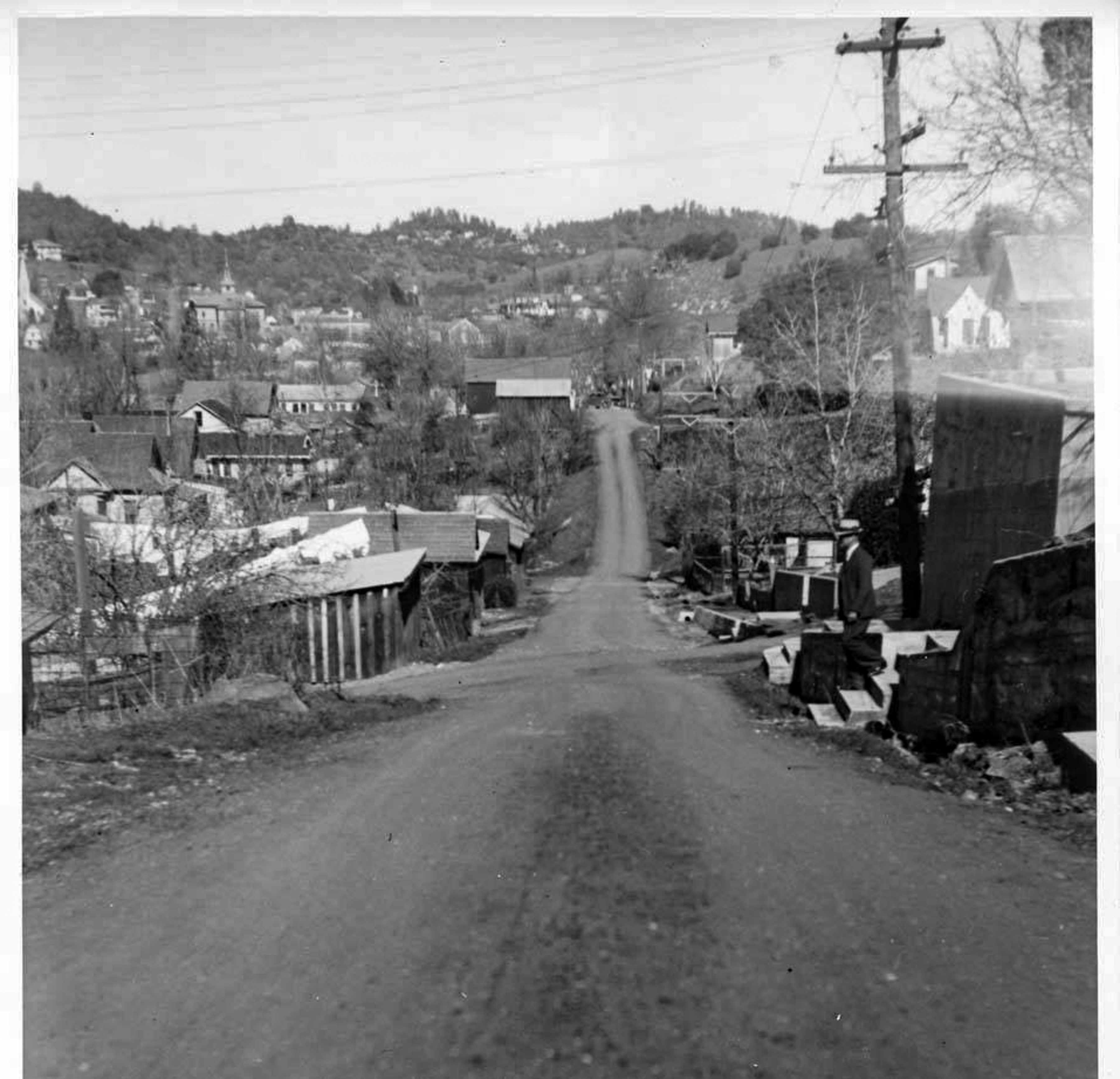
One of the delights of my childhood was the opportunities the area presented to be witness to the filming of some of the many movies and tv shows that were a regular presence in our community in those days. The iconic western “High Noon” was filmed in Tuolumne County when I was nine. I remember some mention in grammar school about the production company casting about for kids to play extras in the movie, and secretly hoped I might be chosen, but, alas, I was not. I knew one boy, a year my senior and the son of the school principal, who did make the cut. The scene in which he, and the lucky others, appeared (for those of you familiar with the film) was in the church when Gary Cooper goes inside to implore the townspeople to support him against the imminent arrival of a gang led by a man he had sent to prison who was bent on his destruction.
Beginning when I was around 13, I began hanging out evenings at the lobby of a local inn when a movie company would be in town filming. Our family had inside information on when movie companies were in town because our next door neighbor, Josie, worked as a housekeeper at an exclusive local motel where the leading ladies and gentlemen, such luminaries as Grace Kelly and Gary Cooper, were routinely housed during their stays. Josie whispered tales about how difficult and demanding Claudette Colbert was, or how agreeable she found Ingrid Bergman.
While strictly admonished never to venture to the motel in search of autographs, I was free to haunt the lobby of the Sonora Inn, where second-tier actors and support staff would pass en route to the restaurant, the bar or to their rooms on the upper floors. I made the acquaintance of a Filipino bellhop, who would signal with an eye gesture when someone with the movie company entered the hotel lobby. That would be my cue to hone in on my subject and ask for their autograph. By this means, I succeeded in meeting and getting autographs from Randolph Scott, Edgar Buchanan, Francis X. Bushman, Barry Sullivan, Dale Robertson, Mala Powers and a host of character actors and others. My bellhop friend was not above a good spoof, as he one time signaled me a target who turned out to be a local rancher. During the tour of one particular production company, I also made the acquaintance of the son of the man in charge of lighting for the movie—Lindsley Parsons—who went on to follow in his father’s footsteps as Lindsley Parsons Jr.
During the summer of 1958 (verify), The Lone Ranger came to town for a couple weeks of filming. It was surreal (though I wouldn’t have thought to describe it that way at the time) to run into Jay Silverheels, the actor who played Tonto, shopping in the local Sprouse-Ritz dime store. Within 3 miles bicycling distance from home, I was able to pedal to a location on a ranch in Shaw’s Flat where I got to spend an afternoon watching the filming of part of an episode of The Lone Ranger. Having grown up watching the show, this was a big deal to a 15-year-old boy such as myself. And a somewhat disillusioning experience, as it turned out!
The kicker had to do with the most iconic scene of the entire series—the one in which the Lone Ranger and Tonto are seen riding off into the sunset at the end, waving to the camera as they depart. It was late in the day when they got to this scene, probably to take advantage of the angular light of late afternoon. It looked much like the familiar version that appeared at the close of each episode, and would have passed unnoticed had I not known that, while Jay Silverheels was riding his horse in the guise of Tonto, the saddle intended for the Lone Ranger was instead filled by a stuntman of similar height and build while Clayton Moore, the actor portraying the real Lone Ranger, sat in his director’s chair by the wayside sipping a drink.
That revelation by itself might not have tipped the scales for me had it not been for the fact, that very morning, I had witnessed the filming of a scene at the
Columbia airport in which, per the script, the Lone Ranger was bound and gagged and laying in the back of a runaway buckboard while Tonto rode up beside the unattended wagon, leaped from his horse into the empty driver’s seat, grabbed the reins and brought the team to a halt, thereby saving the Lone Ranger from some undoubtedly disagreeable fate. It was thrilling to witness Jay Silverheels’s skill in pulling off that stunt by himself, never mind the fact that the LR’s stunt man was in the wagon in his stead. One could hardly escape the conclusion that the only reason Clayton Moore was needed was for the talking scenes, especially since, without his mask, he was not a handsome man.
One more bit of trivia concerns the Lone Ranger and an anecdotal exchange that took place between me, him and another boy: This other boy caught a grasshopper and, bringing it to the LR, asked him, ”Look, Lone Ranger. I caught this grasshopper. What should I do with it?” The LR replied, in his booming baritone voice, “Let it go,” to which, being the smart-mouthed kid I was back then, I said, “Let it Go? You’re this guy who shoots bad guys all the time and you don’t want to see a grasshopper get hurt?,” and he says, again in this voice that likely earned him that role, “the Lone Ranger never kills an outlaw. He only wounds them and brings them to justice.”
 sonora2sonoma
Leave a comment