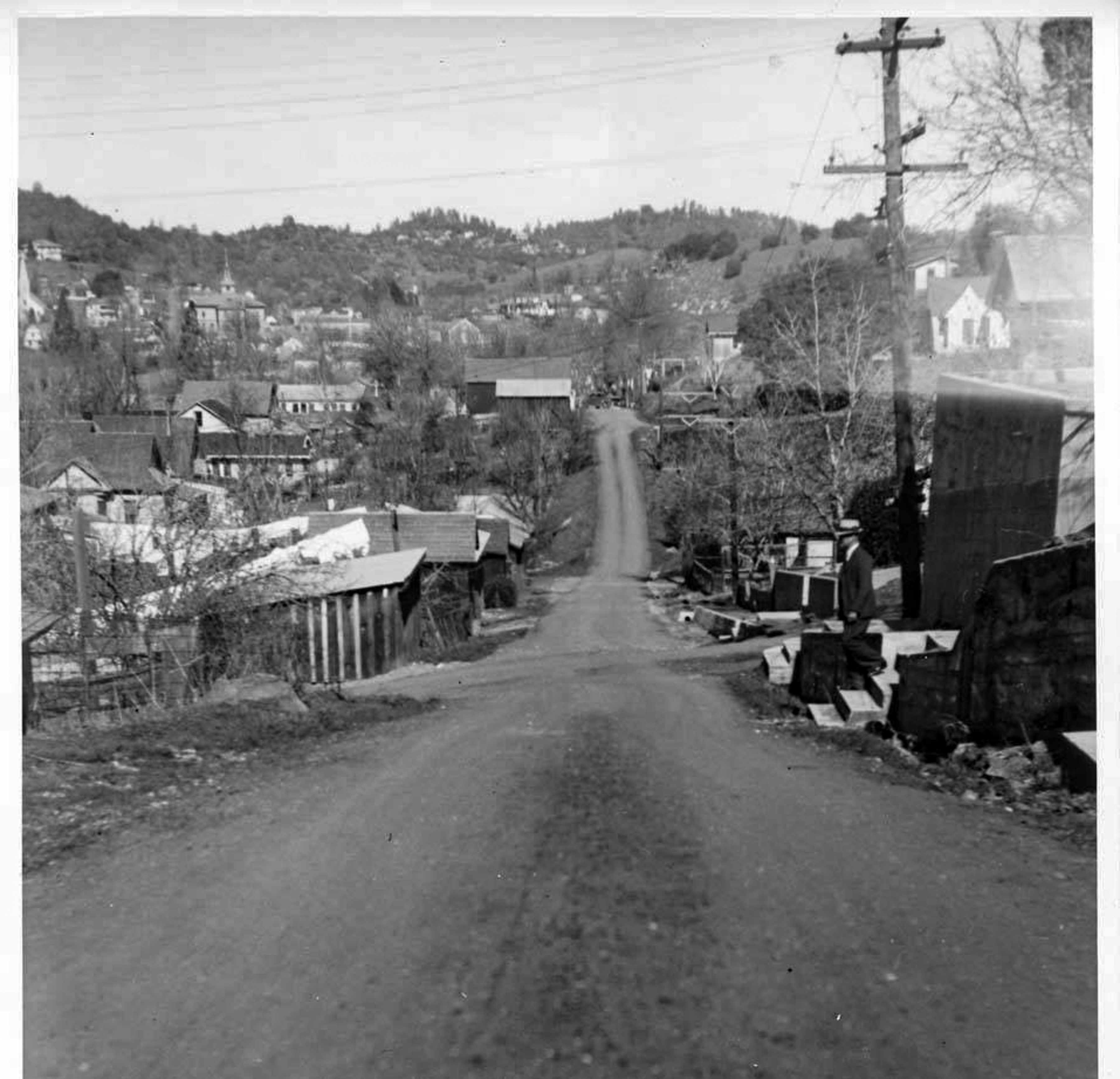
by Tim Konrad
Chapter Seventeen
My parents were fond of gambling and would make the drive to Reno or Carson City for weekend getaways several times a year. To their credit, they would only bring enough money with them that they figured they could lose to gambling each time they went. One time, when I was quite young, they woke me up in the middle of the night and bundled me up and took me along on an all-night drive across the mountains—a spontaneous scenery change in which we awoke to the early morning light parked in a roadside turnout the other side of Ebett’s Pass en route to Carson City. The excitement I felt from the spontaneity of that adventure has remained with me to this day!
More often, my parents would arrange for someone to babysit me when they went off on these trips, although I still seemed to be able to come along once or twice a year on such adventures. None of the later ones were spontaneous, however. I enjoyed getting to come along, because it afforded the opportunity to eat out, which I’ve always loved. There were also other perks—a motel swimming pool in the warmer months, and a movie theater for kids at Harrah’s Club in Reno, where they ran old pirate movies from the 30s, starring Errol Flynn or Lewis Hayward. There was also a movie theater in downtown Reno, where I saw the film Elmer Gantry when I was about ten. Although I was too young to understand the more sophisticated aspects of the film, I wasn’t too young to be able to appreciate Burt Lancaster’s fine acting in the title role, a performance for which he won an Oscar for best actor.
I was also happy when my parents chose to leave me with my Godfather, Selby, who would take me camping sometimes, or fishing, if we stayed at his and his room-mate, Jim’s place. They had a big vegetable garden at their house, with all manner of different vegetable growing. I would roam through the garden marveling at all the wonderful plants, row upon row, that lined the hillside, each plant with its own reservoir beneath it to catch the water that gave it life. Of all the skills my father possessed, the skill of vegetable gardening was not among them. He enjoyed great success with camellias and azaleas, and we had a great rosemary bush in our back yard, but he left the growing of vegetables to others to perfect.
Our next-door neighbor down the hill, a fellow of Italian extraction, grew a garden each summer that was the pride of the neighborhood, with all the usual staples displayed in neat little rows—tomatoes, squash, corn, etc. Where our yard was shaded by large sycamore trees, his was mostly exposed, allowing the sunlight needed to produce the bountiful crops that resulted. I tried my hand one year with a small garden plot, but the only plants that made it to maturity were a couple of anemic-looking radishes. My father theorized the problem was too much shade.
I used to accompany my mother when she would purchase fresh vegetables from an older Italian woman who had a medium-sized commercial vegetable garden behind her house a ways out Highway 108 to the east of town. She had a glorious garden. Walking around it with my mother was, for me, a true inspiration. There was something about seeing big juicy tomatoes on the vine, huge zucchini squash lying about just waiting to be picked, and corn cobs, their tassels glowing in the morning sunlight, that excited me. I envied these peoples’ skills in their ability to produce their own food with such style and grace and thought to myself that, someday, this was something I wanted to learn how to do for myself.
One weekend, in, I believe, it was 1956, my parents went off on one of their gambling junkets and I went camping with Selby and Jim. We found a place to camp on the south shore of the Walker River on the east side of Sonora Pass. It was in a large meadow with a good view to the east where, it was hoped, we might be able to witness the mushroom cloud from an atmospheric nuclear test that was scheduled for the following morning. The primary purpose of the expedition was to go fishing—something that, although I wasn’t very good at, I still loved doing in those days. My bigger hope, however, was that we would be able to see a real-life mushroom cloud. I suspect, looking back, that Selby and Jim knew the odds of that happening from our perspective were slim, and probably for the best, but they allowed that hope to remain alive in me until the facts on the ground proved otherwise. I remember the disappointment I experienced when I realized we weren’t going to be able to see the test, but what I recall most about that trip is a stunt Jim pulled on me early the following morning.
There had been a herd of cattle bedded down across the river the night before when we retired. I had expressed some concern over this since, while Selby & Jim planned to sleep in the bed of Selby’s pickup truck, my sleeping bag was set up on the ground. They reassured me that I would be safe and that the cattle would not cross the river without warning and trample me in my sleep.
Then, before the morning sun lit the hills to the west, I was awakened by Jim’s shouting “Get up! Get up! The cattle are crossing the river!” I leapt out of my sleeping bag and looked around, expecting to have to dodge marauding cows at any moment. Jim was an enigmatic person to me; he took pleasure in maintaining an air of mysteriousness about him that had me always feeling unsure when I was around him. He had been shot by someone as a young man in Canada, and still carried a bullet inside him, the details of which he was always a bit reticent to fully explain. Selby was a safer person for me to be around. A straight shooter, he didn’t play games like Jim did. When I sought reassurance, he was there to supply it. In this instance, however, Selby played along with Jim and lent an air of authenticity to his alert.
Once up, and, thanks to the jolt of adrenaline, fully awake, Jim said “Well, it looks like the cows changed their minds. But since you’re up anyway, you might as well start the fire.”
***
Selby had two brothers. Hailing originally from Mississippi, all three spoke with a southern drawl. The eating habits of Southerners, my father told me, were different than those I was accustomed to in California. Where Selby came from, he explained, squirrels, opossums, and rabbits were fair game.
I won a baby duckling at the carnival one summer when I was eleven or so. For a short while, it had the run of the house, until my parents, tired of its incessant pooping, banished it to a large box. Named Quackie, it never had a chance to grow big enough to actually live up to its name. While I was at summer camp for two weeks, my parents gave Quackie to Selby who, it was reported, lost it under mysterious circumstances. My father later admitted the duckling might have entered the food chain, Mississippi-style.
Of Selby’s two brothers, one of them died as a young man, the victim of a fall during the construction of the second phase of Hetch-Hetchy Dam in the 1930s. The other brother, a general contractor, lived to the ripe age of 102, although he spent the last decade of his life as a paraplegic after falling from his roof while cleaning his gutters. Selby himself lived to be 101.
Jim Covington, the younger brother who perished during the construction of the dam, is buried in my families’ burial plot in Sonora, alongside my older sister, Pearl, who died 18 hours after she was born. My father’s brother’s wife, Verna, once intimated to my ex-wife that Jim and my mother had been lovers back in the 30s. I have no evidence with which to corroborate this claim, everyone who might have known something having passed on years before. Selby had, however, always displayed an almost paternalistic manner toward my mother and continued to do so as long as she lived.
Selby himself might have had his long life cut short were it not for his cigarette lighter, which, tucked in his shirt pocket, had stopped a bullet meant for him during his time in Europe during WWI. I always find it fascinating to learn that, but for the slightest of reasons, one sibling might leave this world early on while another sometimes remains far into advanced old age. This same aunt who had raised the question of my mother’s fidelity also suggested that the death of Jim Covington, who fell about twelve feet off a ladder—officially declared a work accident—might have been a revenge murder perpetrated by friends of my father bent on avenging his honor. But then, this aunt was never fond of my mother for reasons I never fully understood. And her judgment was somewhat suspect for other reasons as well. Once, while catching a ride with them to a restaurant we planned on invading for lunch, I spotted a crumpled copy of the National Enquirer on the back seat floor of their car. Asking Verna if she believed the stuff she read in the Enquirer, she said she believed with it when she agreed with it.
All families have their black sheep, and, for this aunt at least, I fit that description. During a southwest vacation in 1969, my first wife, Jeannie, and I took our infant son, John, to visit Uncle Jack & Aunt Verna at their home in Los Alamos, New Mexico. Jeannie and Verna hit it off surprisingly well, or so it seemed, which made me happy until Jeannie confided that Varna was bashing me and my mother repeatedly with unflattering anecdotes about what a pain I was as a child. She said she had confided to Verna that I used marijuana, which caught me totally off guard, since I had assumed she knew better than to reveal such information without first telling me she was thinking about doing so. That revelation seemed only to Verna more evidence, I imagined, of my shadiness of character and, knowing that she knew that about me increased my sense of unease around her.
After a few days’ visit, we departed for California and home. One day into the journey, however, I received a phone call from Aunt Verna saying that my Uncle Jack was very disappointed with me. Puzzled, I asked why. Because, she said, I stole a fork from them. This floored me, as I had no idea what she was talking about. Apparently, after we left, one of the forks in their silver set—the one that had been in the family for generations and had been given to Jack by his father, etc., etc., and, the one that I had apparently stated an interest in inheriting when I was a child (I have no recollection of this)—went missing. And she was certain I had taken it. My attempted denials fell on deaf ears. I was guilty until proven innocent.
And worst of all, she said she had almost called the police to have us pulled over and searched, which might have proved disastrous, since, while no errant silverware would have been located, they might have accidentally come upon the pot and mescaline concealed in the bottom of the diaper bag. Thank goodness for miracles—big or small. The fork never turned up, I suppose, since I heard no more about it. Things were never the same between us afterward and I always after felt wrongly judged by them. My guess is our son, a toddler at the time, might have knocked the fork into the garbage.
Verna developed Alzheimer’s disease and passed before Jack, who, when he died at 92 left everything, such as he had, to the daughter of one of Verna’s co-workers . And while I’ve never lamented the loss of the silverware, there was one thing I had longed to possess as a child that was long gone by the time he passed. A Springfield single-shot rifle, from somewhere around the Civil War, had been in my grandfather’s possession before he gave it to my father. I used to admire this rifle and loved to pull it out of the cupboard where it rested and look it over and turn it in my hands and wonder at its history. My father assured me one time, after he had given it to Jack, that it would be mine someday. And I believe he believed it too. My father never told me a lie, which meant it was damn difficult to extract a promise from him—if he had any doubt whatsoever whether he could deliver—the answer was “no.” But he had no way of knowing that Jack would one day sell the gun to someone else.
 sonora2sonoma
Leave a comment