From Part Nine, the photo of the dredge that became a different image entirely:
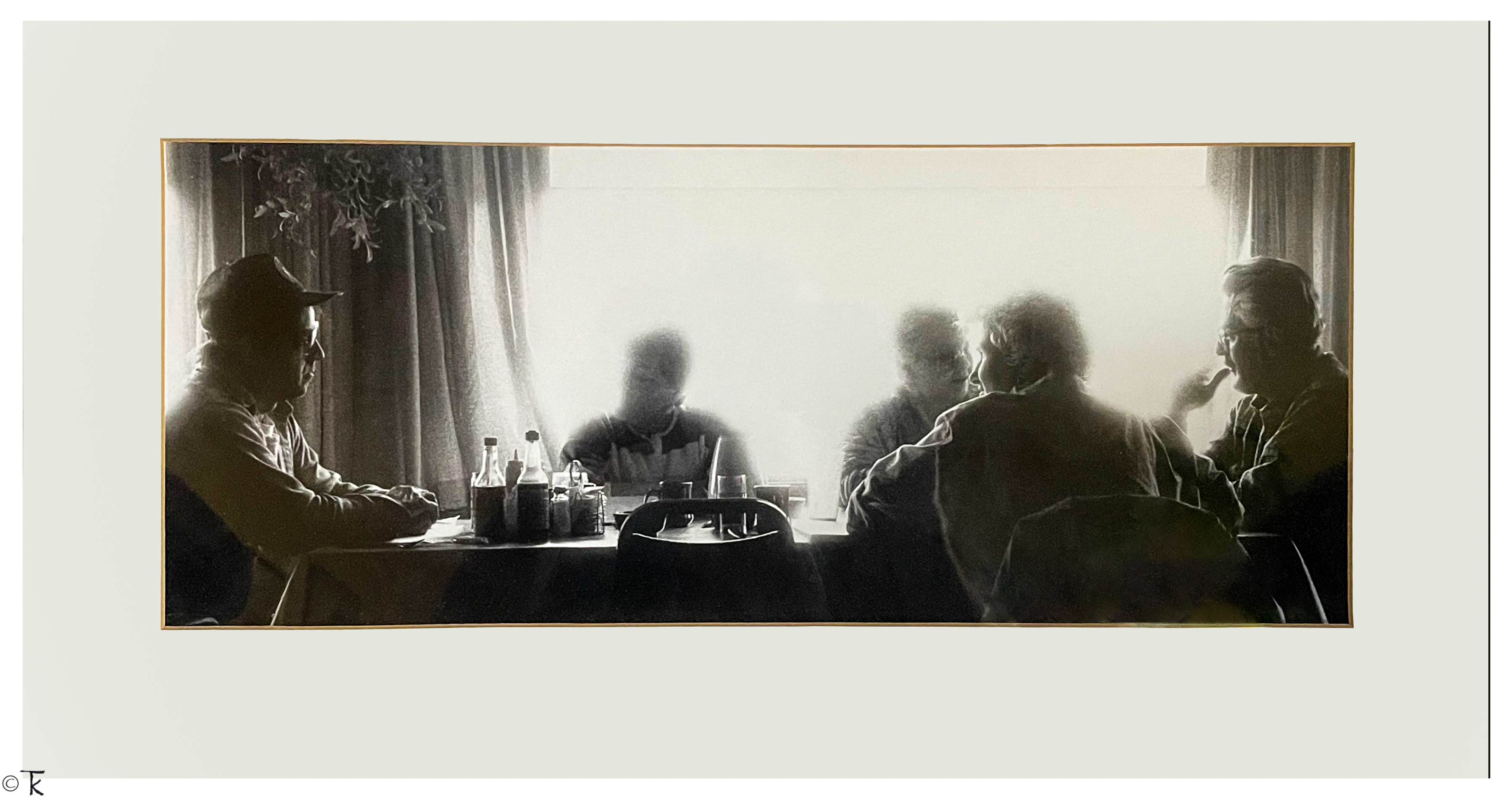
Brunch at Fat Freddie’s ©1981-Tim Konrad Photo
It was common among the men I encountered in Nome for them to sport beards whose mustaches were adorned with icicles hanging, drape-like, beneath them when they were outdoors. The frigid temperatures caused noses to run while simultaneously freezing the resulting runoff. It wasn’t an alluring sight!
I approached the matter with much more understanding, however, the first time I caught a glimpse of myself in a mirror after having been outside. To my dismay, my mustache, too, was glistening with crystallized rivulets cascading beneath it.
Proof of gravity, I mused, taking comfort in having just learned that our commonality of affliction meant my initial shock at the realization I was now “in the club,” so to speak, rendered the whole matter moot.
It’s difficult to be embarrassed over how you look when everyone else looks the same way.
***
Not only does the sea freeze in Nome, and mustaches begin to resemble stalactites, the town sits north of the tree line. Before going there, it never occurred to me to wonder about such things, but it turns out species’ habitable zones are defined not only by altitude, like they are in the Sierras, but also by latitude. As far north as Nome sat, the permafrost proved too dense for the roots of deeper-rooted species to penetrate.
Owing to the permafrost, the tree line in that region of the Seward Peninsula ended a short distance north of White Mountain, about 50 miles south of Nome. Beyond there, the permafrost had an out-sized role to play in determining which plants could survive the harsh climate.
As my visit lengthened and Christmas drew nearer, I was surprised to see Christmas trees being imported for sale. It struck me as ironic, given the millions of evergreens in the state, until I remembered the reason. Thanks to climactic conditions, purchasing a tree just as one might do in Albuquerque or Atlanta was the only means by which a person could come by one.
It struck me as typically American, in a sad sort of way, that the people of Nome had to obtain their Christmas Trees via commerce much as people in big cities acquired theirs.
***
One day, as I was driving around the back streets of Nome, I turned a corner and, without warning, spied, scrawled across the side of a shipping container in huge, crudely crafted, bright yellow letters, an announcement that read “I f***ed Jane Doe.” I can no longer recall the poor girl’s actual name, but wouldn’t use it here if I could. Suffice to say the indelicacy of the update was compounded by the shock value engendered by the ambitious manner in which it was displayed.
More a thing one is likely to find inscribed on a bathroom wall in a sleazy bar than on a shipping container in a residential neighborhood, I wondered how it must have felt for the poor girl’s parents when they first laid eyes on it, for they almost certainly did, since the Nome of 1981 still had, in many ways, a small-town feel about it.
Whether unimpressively boastful, grossly insensitive, childishly stupid, or all three, such adolescent displays are not, it seems, limited to modern times. Whatever yearnings these messages seek to fulfill, that urge existed long before our time. Among the ancient artifacts unearthed by archaeologists probing the ruins of Pompeii was a bit of graffiti scrawled on a wall that read, “I screwed the barmaid.”
Tim Konrad
(To be continued . . )
 sonora2sonoma
Leave a comment