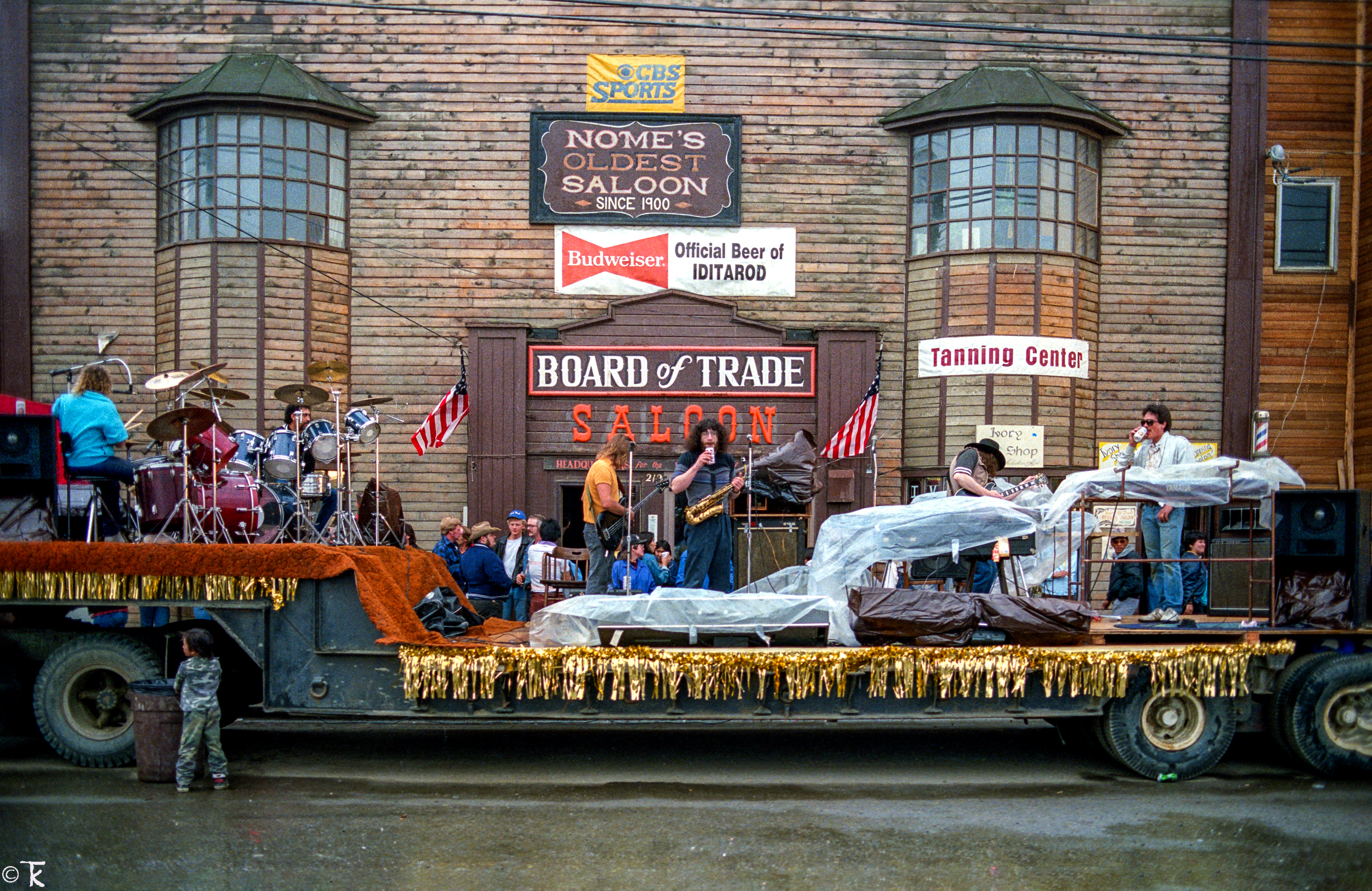
The Board of Trade Saloon, taken in the wee hours during the summer solstice celebration “Midnight Sun” on my second trip to Nome in June of 1987.
Such displays of violence were rare in my experience while in Nome. Dave had told me that the Inupiaq people, in contrast to the native peoples in the lower ’48, were not usually prone to violent acts when inebriated. They would just keep drinking until they fell into a stupor, he said, eventually passing out where they sat.
I saw this play out more than once at the Board of Trade, where Inupiaq men and women could be seen at odd hours slumped over tables totally unconscious.
Sometimes, if the unfortunate person happened to be outside, he or she would simply lie down and fall asleep, occasionally ending up between parked cars where, from time to time, they would be run over when the car’s owners, unaware of the person lying asleep behind their vehicle, would back over them. In other cases, passing out in winter-time resulted in people dying due to exposure.
I thought back to something my uncle had told me years before. My first wife and I had been traveling in New Mexico when the engine in our VW bus had thrown a rod. As luck would have it, even though our vehicle quit in the middle of an Apache reservation many miles from the nearest town, a “trading post,” with a public telephone sat just up the road.
This establishment, part rural convenience store, with additional items such as ammunition and other assorted things one might require to survive in the middle of nowhere, also served as a trading post and pawn shop. Saddles, rifles and other gear could be seen awaiting redemption by their former owners or purchase by new ones for the right price.
The trading post also sold beer. In the two hours we remained there awaiting the tow truck that would tow us back to Farmington and a repair shop, we witnessed one particular group of Native American young men return several times, on each occasion hauling off beer by the caseload.
One engine re-build later, we resumed our trip, heading over to Los Alamos to visit my aunt and uncle. When I told them about our experience at the trading post, my uncle’s response was sardonic, “That’s just one more way the White man is trying to destroy the Indians.”
Sadly, I realized, the same could be said about the Native inhabitants of this far-flung, frozen land.
***
Describing the Inupiaq reaction to alcohol as docile did not mean, as evidenced by the incident recounted in the previous chapter, that everyone responded to alcohol the way Dave had described. Another incident that also occurred at the Board of Trade, or the BOT, as it was known to the locals, showed the folly of making generalities about peoples’ behavior.
Dave and I were seated one evening at a small table bordering a long wall that ran the length of the large main room of the saloon.
A couple of young Inupiaq men were sitting at a nearby table sharing drinks together. After they’d sat there a few minutes, I sensed some commotion from their table and glanced over to see what was happening. A disagreement of some sort had broken out between the men.
Before long, the argument turned into a scuffle as the two men arose from their seats and began pushing and shoving each other. Soon they were exchanging blows.
I found myself thinking about what Dave had just told me about alcohol’s effect on the natives’ constitutions when I noticed the two men, each trying to overpower the other, drifting closer to our table.
As they drew nearer, I signaled to Dave that it might be wise to grab our drinks and move out of their path. He picked up on my cue and we both jumped aside just as the pugilists, totally immersed in their struggle, came crashing into our table.
“Just another night in Nome,” I recall having thought to myself as we moved to another table to finish our drinks.
Tim Konrad
(To be continued . . )
 sonora2sonoma
Leave a comment