The Northern Lights, famed in photos celebrating the splendor of the northern latitudes, might have been a feature about which boasts were made in travel brochures, but they didn’t appear much inclined to spend time trying to impress me. Beyond the single display I was treated to shortly after my arrival, the Lights apparently had more pressing business to attend to elsewhere during the duration of my visit.
The Aurora Borealis, as the Northern Lights are properly called, result from the interaction of Earth’s magnetic field with particles from the sun propelled earthward by the sun’s solar wind. Always present, they fluctuate due to atmospheric conditions that sometimes fling them beyond the magnetic poles into more temperate latitudes. During periods when the sun’s solar activity is higher than normal and the occurrence of sunspots grows more frequent, auroras can occur in the northern hemisphere at even lower latitudes. The same process takes place in the southern hemisphere, only in reverse, where the Aurora Australis can at times reach deep into the higher latitudes.
In 1911, a solar burst caused the northern lights to be visible as far south as Memphis and Atlanta. A phenomenon known as the Carrington Event occurred in 1859 in which the aurora extended even further, reportedly reaching down into Jamaica and Cuba. On that occasion, the lights were visible for three nights, bedeviling telegraph operators whose equipment ceased proper functioning due to the effects of the electromagnetic radiation on their equipment.
***
Dave & Terry had an interesting approach to house-painting. A builder by trade, Dave was skilled in the ways of making the best of whatever resources were available. He constructed his first home in Alaska around a shipping container, supporting a portion of the house with its rigid framing while incorporating the hulking mass as yet another room comprising the structure.
Always out for a bargain, Dave took a novel approach to obtaining the paint he and Terry applied to their home’s exterior. To avoid the higher cost of purchasing new paint at the hardware store, Dave would sort through the store’s stock of bargain-priced paint remnants—gallons whose mis-matched colors had been refused by customers more particular about the shades they sought with which to decorate their homes.
Dave and Terry happily applied the assorted shades one gallon at a time, opening a new can when the current one ran out and proceeding along with that shade until it was used up as well, at which point they would open the following one . . and on and on.
The resulting effect, while not resembling the brightly-colored chaos one might imagine, thanks to or because of, depending on how you view such things, the tendency of paint colors to reduce down to grayish-greenish-brownish shades when combined indiscriminately.
The color scheme they settled on seemed strangely appropriate, determined as it was by circumstance as much as design. The finished product appeared quite at home situated amidst the odd assortment of other sometimes ad hoc seeming structures spread about the town.
During a subsequent visit to Nome a handful of years later, D&T hired me to apply a supercharged shade of industrial orange to one side of a different home they were living in. But that’s a story for another day.
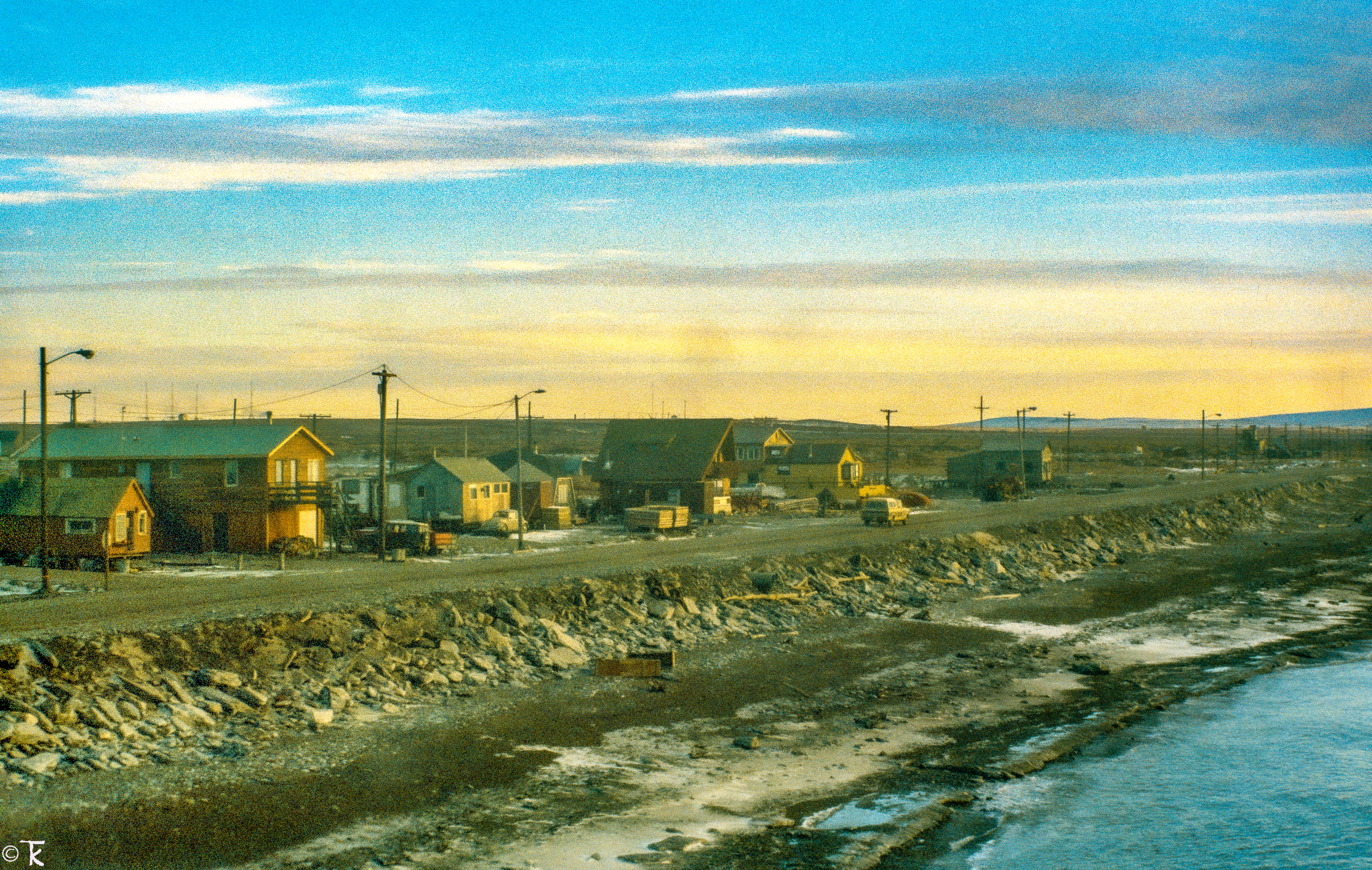
The shoreline two blocks from Dave & Terry’s house
©1981-Tim Konrad Photo
Tim Konrad
(To be continued . . )
 sonora2sonoma
Leave a comment