An unfortunate and extremely sad event occurred while I was visiting Nome. The teen-aged son of the owner of one of Nome’s flying companies went missing while piloting a mail flight to an offshore island. The weather had been dangerous that day and, when the lad hadn’t returned as scheduled, a search party had been organized. Many local flyers had offered to “share their eyes” to the search effort, Dave included. I followed along.
The two of us joined six others in an eight-seater twin engine Piper Navajo piloted by a seasoned flyer named Jim who was the owner of another of the local flying companies that had joined in the search. If Dave’s Cessna 170 was a Volkswagen, Jim’s plane was a Mercedes Benz: Plush by comparison, it hummed along smooth as butter as we headed out into the forbidding sky looming over the Bering Sea, full of trepidation and trying not to imagine the worst.
As the tell-tale beep of the aircraft’s transponder, an emergency signal locater that was required equipment on all planes flying in the region, had not be detected, the work of determining where to focus the search effort was a matter of educated guesswork.
The young man had been on a mission to deliver mail to Savoonga, a village on St. Lawrence Island, situated far out in the Bering Sea 185 miles west of Nome. The weather had been abysmal that day. The young man would have encountered strong tail winds on his flight to the island. Some among those involved in the search effort speculated the wind might have caused the lad to overshoot the village, even, possibly, sending him as far off course as the Siberian coast lying less than 40 additional miles across the Bering Straits.
While our group was, along with a handful of other plane-loads full of volunteers, closing the distance to the island, others were turning to diplomatic channels to obtain authorization to allow us entry into Russian airspace, had the search led in that direction.
When we reached St Lawrence Island, visibility was favorable along the coastline, but the island’s interior was shrouded in a thick fog. We began circling the island, awaiting the arrival of the Coast Guard radar-equipped C-130 transport plane that had been dispatched from Kodiak Island to join in the search mission.
The C-130 crew’s job was to use the plane’s specialized equipment to try to locate a transmission from the downed plane’s signal locater in order to establish a reference point from which they could then, through a process called triangulation, pinpoint the exact location of the downed craft.
As we were circling the island, a temporary break in the clouds revealed a huge cliff hundreds of feet in height looming ahead of us on our starboard side. Just as we were flying beside the cliff, the plane hit an air pocket and suddenly dropped like a rock, plunging several hundred feet downward before resuming normal flight. While our rapid descent took no more than a second or two, it seemed far longer. By chance, I’d been looking at our pilot, Jim, when we’d hit the air pocket. Jim was a flyer with years of service on his record. Watching, for a brief instant, his eyes grow rounder and wider than an October moon had given me pause. Witnessing someone like Jim register the kind of fear I’d also felt when we’d hit the air pocket made me wonder how close we, ourselves, had just come to crashing into the ground.
Quickly recovering, Jim then flew us above the clouds where we resumed circling the island, this time under clear skies. Before long, the C-130 became visible off our starboard side. While peering out at the droning, fortress-like hulk circling in the distance, our craft was struck by an air disturbance that sent it helplessly bobbing up and down like a leaf in the wind.
It turned out we’d flown across the wake of the transport plane. Aircraft the size of a C-130, it was explained to me later, created a wake in their paths that then radiated outward in waves of concentric circles similar to the manner in which waves are created in the sea by the passage of large ocean-going vessels.
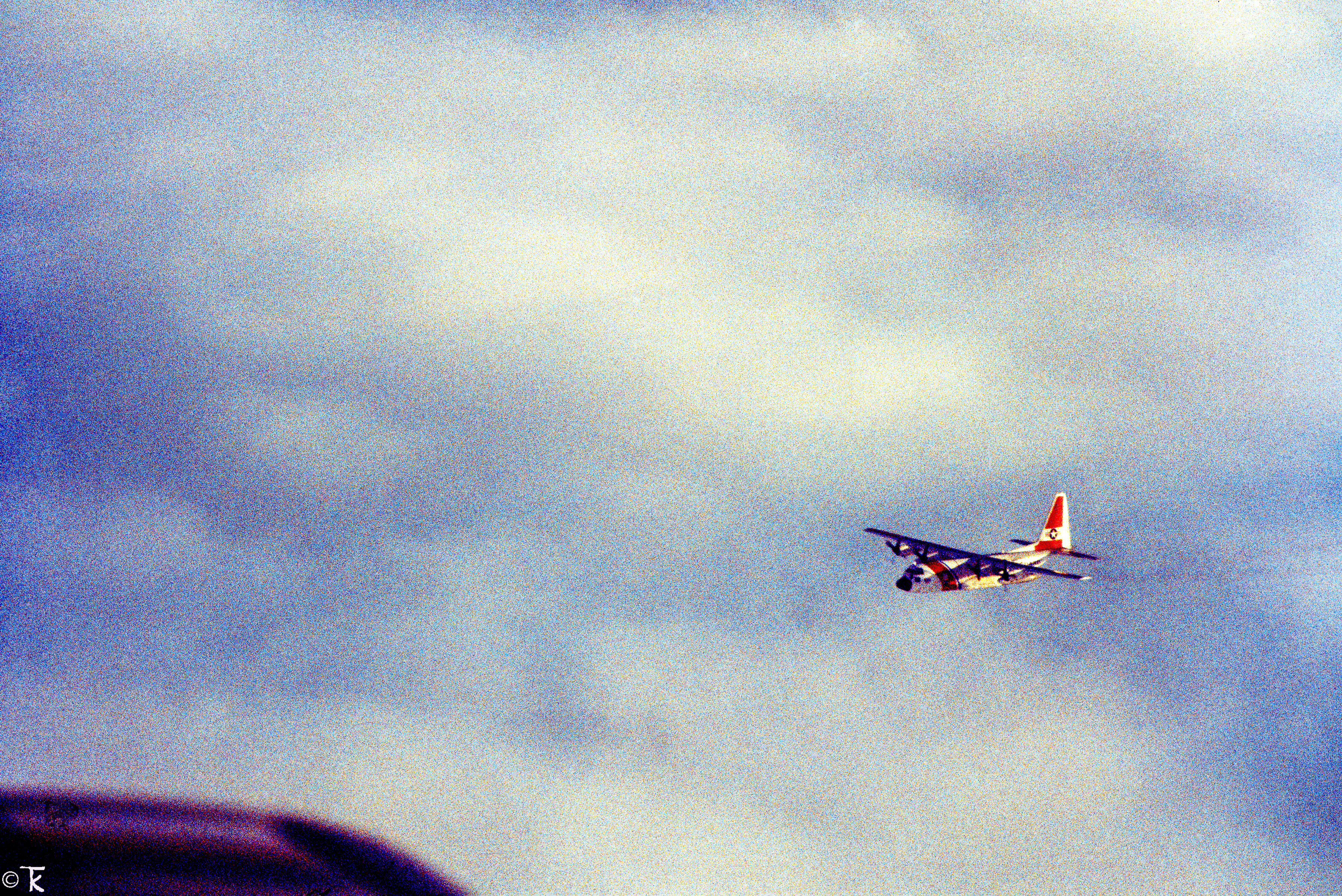
Circling Coast Guard C-130 ©1981-Tim Konrad Photo
The C-130 hadn’t flown ‘round the island for very long when a voice on the radio announced that a signal had been detected from the downed craft’s transponder. All that then remained for the plane’s crew to do was, with the help of geometry, pinpoint and report the location of the downed craft so the rescue crews could begin their work. The crash site located, our work for the day was essentially done. With nothing left for us to do besides await word from the rescue mission, Jim turned the Navajo and aimed it back toward Nome.
Tim Konrad
(To be continued . . )
 sonora2sonoma
Leave a comment