By Tim Konrad
Sonora was, to my young eyes, a simpler place. A place of safety, of security, where kids could play outside at night, walk downtown to the movies by themselves, and never have to worry about any of the kinds of things children fall prey to in this day and age. The same was true of the schools, although the threat of bullying by older and bigger kids was ever present, much as it appears to be today. The best time of year to my young way of thinking, however, was summer, because it always meant warm weather, swimming, and best of all, no school.
Tuolumne County in the 1950s offered many opportunities to swim in rivers. The stretches of the Stanislaus and Tuolumne Rivers that are now inundated by reservoirs were then running mostly free and were easily accessible.
One of my favorite pastimes on a lazy summer afternoon was to go swimming at Mountain River Lodge on the Tuolumne River.
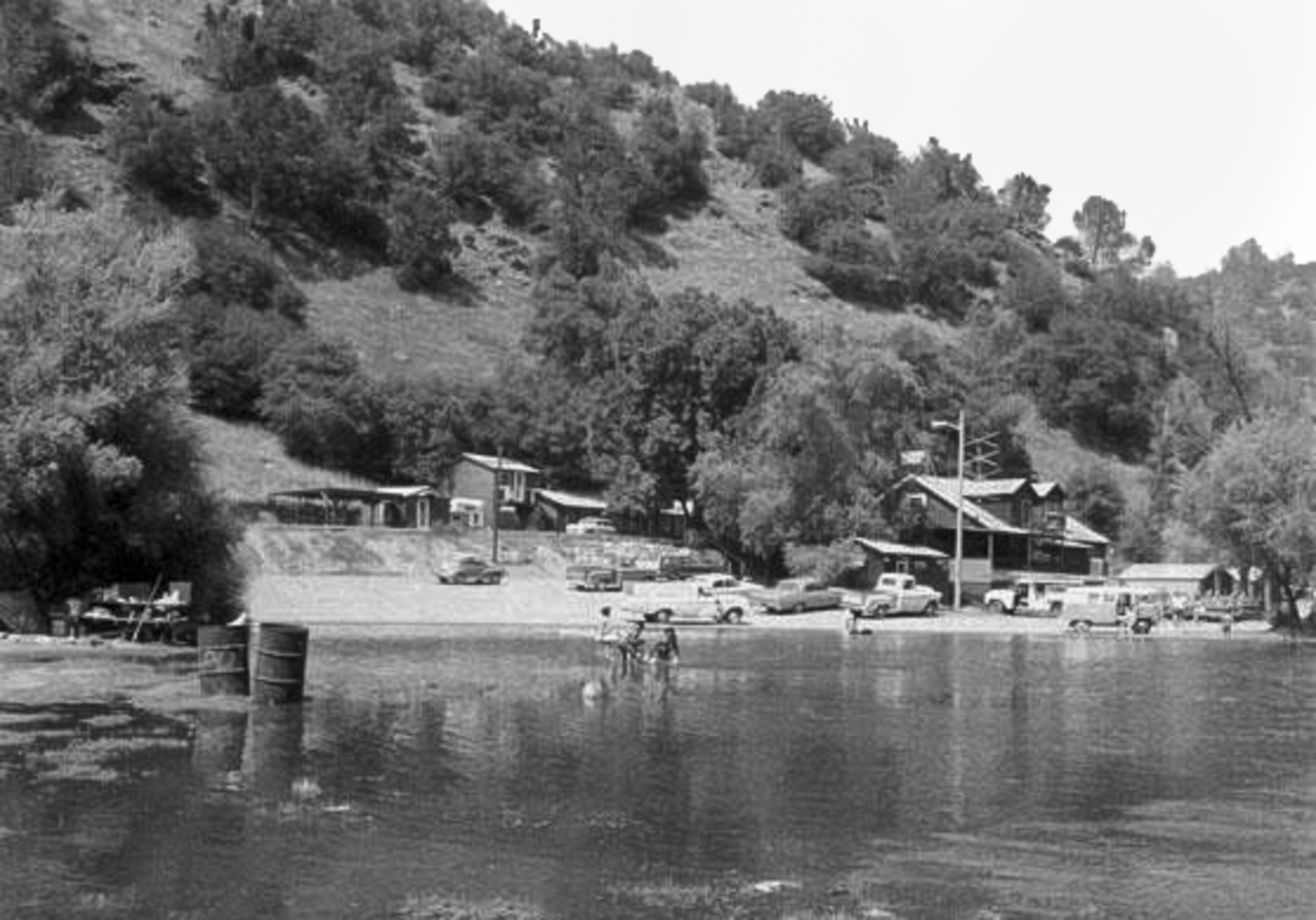
Long since inundated by the higher waters of New Don Pedro reservoir, Mountain River Lodge once sat along a calm and deep stretch of the Tuolumne River, just downstream from the Stevens Bar Bridge where State Highway 120 crossed the river on its way toward Moccasin, Groveland and Yosemite.
Giant cottonwood trees lined the river’s sandy banks, shading the beaches from the blazing summer sun. The “cotton” from the trees covered the ground and, whipped about at the whim of the winds, would pile up against the tree trunks and other vertical objects.
As kids, we would swing far out into the river, dangling off ropes hung from the trees’ branches. Boys being boys, the activity often became a game, the object of which was to see who could swing out the farthest before dropping into the cold water below. Try as I did, it was always someone else who would win that coveted acknowledgment.
One summer, a half-dozen or so very large inflatable pontoon-type flotation devices, shaped like giant black-colored hot dogs—likely old military surplus—were moored under the trees by the riverbank beneath where the rope swing dangled from the branches high above. It was possible, by angling just so, to swing out and craft a landing onto one of those floats.
After taking several turns successfully doing just that, my next attempt went awry. Releasing my grip on the rope at what I believed was the correct moment, I was caught off-guard when, instead of plopping down on the pontoon’s rubbery surface, I slipped unexpectedly between two pontoons. I hadn’t taken in a gulp of air beforehand, not expecting to suddenly find myself under water, needing to breathe . . and SOON! I kept trying to swim out from beneath the massive buoys, but all I could see above me was the black bottoms of the pontoons.
Running out of air, I began to panic. The thought struck me that I would never see my parents again. I didn’t want them to have to suffer over me. I felt both sad for them and gripped with terror, all in less than an instant. I realized that soon, I would no longer be able to hold my breath and would have to gasp for air, even though I also knew that doing so would fill my lungs with water and I would drown.
When you need to breathe, I discovered, you need to breathe, come what may! In such moments, there are no other choices available. Regardless of the consequences, that moment had arrived! Devoid of hope, I started to gasp . . . just as sunlight appeared and I broke through to the surface, and air, precious air!
****
In addition to the beach, there was also a camping area up by the road, away from the river. A couple of gas pumps stood beside the highway in front of the lodge, with a phone booth set off to one side.
The lodge featured a large barroom, an equally spacious dining room, and a wide deck that extended out from the back of the building, facing toward the river. Speakers were mounted on the deck to conduct whatever tunes were playing on the bar’s jukebox and broadcast them out to the campgrounds, the beach and the river beyond.
I can still recall, almost as if it were yesterday, hearing the strains of Hank Williams “Jambalaya” drift across the river on one summer’s languid afternoons as I floated lazily on an inflated inner tube. Another summer the prevalent song was “A White Sports Coat” by Marty Robbins. The earliest tune I recall hearing broadcast across the water was Patsy Cline’s “I Fall To Pieces.”
There is no better way, excluding olfactory means, to recall such moments than when one’s recollections include the taste and feel of a place in conjunction with the tune that accompanied the memory! It’s like having a memory with a theme song appended to it. The multiple modalities of such recollections strengthen, reinforce and enrich them in ways unachievable through one modality alone.
As noted above, my parents would take me swimming at the Tuolumne River on hot Sunday summer afternoons. My dad’s Oldsmobile didn’t have air conditioning. Accordingly, when the weather was warm, we would ride with the windows open. As August inched toward September, the pungent smell of tarweed filled the car as we drove past the fields surrounding Chinese Camp on our way to the river. The odor of tarweed has always been, to me, ‘complicated,’ Slightly noxious yet strangely enjoyable, it mirrored my inner turmoil over witnessing summer’s slow surrender to autumn, with its cooler temperatures, and the inevitable return to school, regimentation and responsibility.
A couple of the men who worked for my dad and his partner lived in nearby Jacksonville and spent their leisure time at either Mountain River Lodge or at the bar Fred Klein operated at his place down-river in Jacksonville. My dad and mom would join them and their wives for drinks at the Lodge bar while I went swimming in the river. This became something I would look forward to each summer and then savor the memory afterward during the long, cold winter months that would follow.
Louie Libor and Ernie St Clair, the two men in my father’s employ who lived in Jacksonville, had been friends in the navy during WWII. They’d both met and married Hawaiian women while stationed in Honolulu and, while Louie had since divorced and remarried, Ernie was still with his war bride, a pleasant and engaging middle-aged woman named Rose.
Once, during a trip to the Lodge, I found myself hanging out in the bar with my parents and their friends. Prior to 1957, minors were allowed in bars in California. Rose put a nickel in the jukebox and chose a Hawaiian song to play. She began to dance the hula to the music and invited me to join her. I resisted, feeling self-conscious and fearful of embarrassment, but she persisted and soon my resolve was worn down.
My first real attempt at learning how to dance became a template for future failed experiments in dancing, each of which would ultimately stiffen my conviction that I was born with two left feet. The unfortunate result of this history is that my wife Michelle, a woman for whom dancing is as fulfilling as I find taking photographs, is left without a dance partner. In order to fulfill her needs, she is forced to seek out others who share her passion for dance, as I have concluded that, for the sake of everyone involved, the dance floor is a better place without me on it.
Due to the influence of Rose and other Hawaiian transplants who resided in the area at that time, the lodge would host occasional luaus where a pig would be lowered into a hole dug in the beach that had first been prepared with burning coals, then covered up with sand, where the pig would be roasted in the manner in which it had been done in the “Islands” for as long as anyone could remember. The pig, once cooked, would be served up with vegetables and a side consisting of a starchy substance called poi that was made from ground up taro root. To my child’s sensibilities, poi didn’t sound particularly attractive, but I resonated with the idea of slow-cooked pork.
It mattered not, however since these affairs were for adults only. I was left with only my imagination, and the descriptions provided by my parents after the fact, to fill in the details of what I might have experienced had I been invited to participate.
No more than a thousand feet upstream from the lodge, the Stevens Bar Bridge spanned the river. Built of steel in the 1930’s, the bridge looked like it had been constructed out of pieces from a giant erector set. Peering down from it, the water was clear enough to see the ridges of upturned slate that jutted out from the sandy bottom.
Everyone knew how Slim Edwards had dived off the bridge and broken his neck a few years earlier. At about 33 feet from the roadbed to the water, it was possible, as I discovered twice, to jump off the bridge and escape injury. One needed only to take care not to land where the rocks were upthrust. Having a few beers under one’s belt helped build the required courage. Dropping 33 feet allowed time to think on the way down, but not enough time to draw any firm conclusions, except that a), while plunging downward, it seemed like a helluva’ long ways to the water, and b), it hurt if you didn’t land just right.
Whether I was jumping into it, floating on it or just swimming and having fun, I always felt good when I was near that river!
One afternoon, as I was hanging out on the beach, I heard a commotion. Turning around to see the cause of all the fuss, I spied a car racing across the beach toward the riverbank. To the distress of the onlookers, the driver made no attempt to slow down. It quickly became apparent that he was going to plunge his car into the river.
But when he reached the water, instead of sinking, the car remained upright and kept going, floating on the surface as it continued its course into deeper water. It was then that I noticed a shiny spinning propeller protruding from the back of the vehicle.
Its speed slowed due to the resistance of the water, the amphibious car, a small and crudely constructed contraption, putted across the river without incident. I resolved immediately that I wanted one, but my father, just as he had when, at age 5, I had spotted a baby alligator at an outdoor bazaar in Ciudad Juarez and pleaded for him to buy it for me, promptly dashed my hopes. I could always count on my father to inject a dose of reality to counter my more fanciful impulses.
Life itself, it turned out, was equally adept at injecting reality when judgment flagged. The owners of Mountain River Lodge, like the residents of Jacksonville, were compensated for the loss of their property when the area was cleared prior to the inundation of the river canyon by the rising waters of the then-completed dam. The lodge’s owners, apparently reluctant to abandon their franchise in its entirety, erected a new structure just off the County road that led to Jamestown via Stent. The new structure, consisting of a row of individual units resembling a motel, was located a mile of two from the river in a clearing surrounded by scrub oaks and buck brush, where it soon sat silent, forlorn and abandoned. Whatever the owners had hoped to achieve with their new venture, it lacked the lovely river setting that had given the original Lodge its charm and it never succeeded in attracting the followers that had enabled the river location to succeed.
The rivers’ swimming holes are no longer accessible, thanks to people whose priorities ranked agribusiness over preservation, a tilting of nature that will be corrected in the fullness of time. But not, sadly, in our time.
While I remain grateful that I was afforded the opportunity to experience these wonderful places that are no more, I lament that the youth of today have no chance to experience them as I did.
***
On the victory of agribusiness over conservation, a common theme some describe as ‘progress,’ a few words are in order concerning what the American manifestation of that concept has come to mean for our lives. In spite of what global consumerism has done and continues to do to our planet, I am not unmindful of the sense of wonder I feel when I reflect on the fact that we live in an age in which we have the ability to climb inside a car and drive pretty much anywhere we choose, crossing territorial divides with little cognizance of the fact that, in other times, such activities, if even possible, would have been fraught with peril.
We are able to traverse great distances, mostly without restrictions, and can do so at speeds that our ancestors would have found impossible to comprehend. And we do so as if it were our birthright, which of course it is not. And by so doing, we are passing responsibility for our actions on to our descendants in the forms of depleted finite resources and carbon pollution, fouled air and polluted groundwater.
My ‘sense of wonder,’ therefore, is shrouded in guilt and regret: guilt over deriving enjoyment from an activity that mortgages our children’s future; and regret that our human frailties predispose us to submit to temptations that a dispassionate observer might view as counterproductive, if not ultimately suicidal.
We find ourselves part of a body politic in which we are at once participants and spectators, joined in something larger than ourselves that embraces self-defeating principals as a survival mechanism. How, as thinking, rational beings, are we supposed to respond to such absurdity?
I don’t pretend to know the answer to that question, but there’s one thing I’m crystal clear about: If the choice is between a river and a reservoir, there is no choice!
I’ll take a river over a reservoir any day!!
To be continued:
 sonora2sonoma
Leave a comment