By Tim Konrad
There were two movie theaters in Sonora when I was growing up. Both of them were within walking distance, each being less than 6 blocks from my house. Every few days, my parents would send me off with a couple of dollars in my pocket to go buy dinner at my favorite eatery, The Europa, followed by a trip to the movies.
The roast beef was great at the Europa, but my absolute favorite meal consisted of a hamburger and French fries, with a chocolate milkshake added from the Greyhound Bus depot next door. The milkshakes were made by Mrs. Ball, the old woman who ran the bus depot. Mrs. Ball made milkshakes the old-fashioned way, with real ice cream in an old-fashioned mixer that made more milkshake than the glass it came in could hold.
Mrs. Ball would deliver the milkshakes to the restaurant via a doorway joining the restaurant to the bus depot. To my delight, she always left what remained in the metal mixing cannister for me to finish. It was that little bit extra that made the meal all the more memorable.
I was sitting in that cafe drinking coffee one morning, years later in November of 1963, when Mrs. Ball walked through that adjoining doorway, ashen-faced and shaken, to announce, “they just shot Kennedy!”
***
The movie theater nearest my house was by far the grander of the two. Named the Sonora Theater but popularly called the ‘Downtown’ Theater, it was situated where the Bank of America now stands. Much larger than the other cinema, it had an actual stage with curtains and even featured a band pit. There was an upstairs balcony and a loge section on the lower floor that was reserved for smoking. Wallpaper depicting Art Deco styled dancing figures was visible high on the walls lining each side of the auditorium—wallpaper my father had installed.
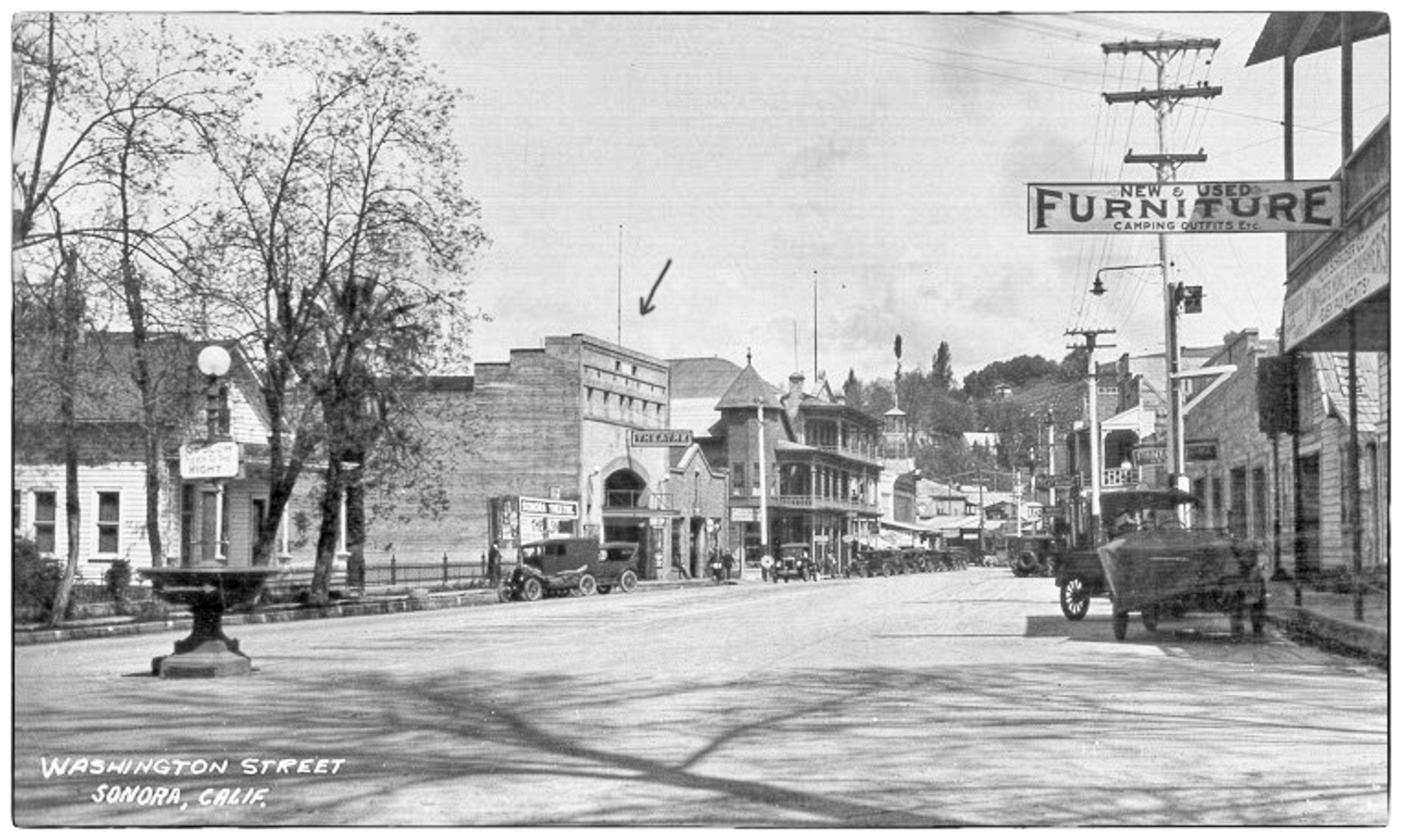
The ‘Downtown’ Theater was owned by Odillo Restano, a former mayor of Sonora. Restano was a dapper figure who, with his pencil-thin moustache, bore a striking resemblance to the actor Cesar Romero. The former mayor could occasionally be seen in the theater lobby, always impeccably dressed.
Two women, friends of my parents, worked at the Downtown theater. Doris Vars, widow of former Sheriff Don Vars, helmed the ticket booth, while Frances Ponce, a friend of my parents from their days living near Columbia, took the tickets from patrons and tore them in half as they entered the theater. The projectionist was Fred Dentone, a man who lived up the hill from us. I can still remember seeing Fred drive down the hill each evening on his way to work in his old 1953 blue Chevy.
Doris Vars was meticulous about her appearance. She had bleached blond hair she wore in a permanent and always applied enough makeup to insure she was doing her part to support the cosmetics industry. Doris drove around town in an old 50s era Cadillac. Shortly before her death, as if she’d sensed its approach, she drove her car to the funeral home and parked it in the parking lot while she sat and applied her makeup for the last time. Mortuary staff found her body later that day, make-up perfectly applied, ready to meet her maker in the style to which she had become accustomed.
Francis Ponce was married to Al Ponce, one of the operators of the fabled Stage Drivers Retreat saloon in Columbia. They had one son, Richard, who was my age. Richard was effeminate; to say he didn’t fit in very well with his peers was an understatement back in homophobic 1950s California. Richard and I used to play together in Columbia while my parents enjoyed a few beers now and then at the Stage Drivers Retreat. The lad was socially awkward and had a prickly personality, a combination of traits that impeded his attempts to build or maintain successful relationships.
It was Richard who broke the news to me in the fall of our freshman year in high school that one of our classmates had died of pneumonia brought on by a particularly virulent strain of influenza that struck the nation in the fall of 1957. Four years later, in our freshmen year in college, it was a different classmate, Jerry Moran, who informed me, that Richard had borrowed a pistol from his roommate and used it to take his life.
**
My recounting of the state of cinematic entertainment in Sonora in the 1950s is, as is readily apparent, not without the inevitable twists and turns that occur as one resurrected recollection slowly segues into the next. The tendency for thoughts to wander in this manner, like so many unattended sheep, calls for a refocused shepherding to restore the discourse to its original subject.
On the subject of movie-going in Sonora in the 50s, the admission price when I first started going to the movies by myself was 15 cents—a paltry sum by today’s standards.
Before long, the price had jumped to 35 cents, where it remained for a long time. Each theater only featured one screen. If multiplexes existed back then, I’d never heard of one. New movies would play each Wednesday and Sunday. Most of the time, they were double features—two movies for the price of one—and they always included a newsreel, a short feature film, and a cartoon or two.
The Uptown Theater was smaller, crowded into a narrow building, but it was deep and had more rows of seats than the Downtown. It also changed movies twice a week and often showed double features. The owner of that theater, Bob Patton, had some kind of special relationship with the folks at Disney because whenever a new Disney movie came out, he would show it before anyone else could. It was rumored that Patton had connections in Hollywood that enabled him, year after year, to screen High Noon—a famed Oscar-winning movie, from the year 1952, that was partly filmed in Tuolumne County.
Patton also hosted events in which a minor western movie star would headline along with a Saturday matinee. When I was quite young, I got to sit on Smiley Burnett’s lap at one such event at that theater. Years later, I attended another event there where a magician hypnotized the high school student body president and had him sing an Elvis Presley song while grinding his hips to the beat.
Years later, and long after Bob Patton’s time, the Uptown Theater was run by a fellow who turned down the thermostat in order to save money, creating conditions inside the theater that, as weather cooled, were better suited to preserving perishables than to maintaining a comfortable temperature for his patrons.
Once, while the theater was under the management of this individual, he advertised a special movie event for children that went horribly awry due to a film mix-up. Because of the prior publicity, the line of children awaiting admission to the event had extended down the sidewalk and up the side-street around the corner.
Instead of screening the film for kids that had been advertised, the projectionist ran a porno movie. As expected, there was considerable outcry over the mix-up. The local newspaper featured a big writeup about it and, not long afterward, the theater closed its doors for good.
In an early example of what can be lost when commercial interests succeed over quality-of-life concerns (a refrain heard all to often in Tuolumne County land-use decision-making), the Downtown Theater was eventually razed so the Bank of America could construct a new bank building at that location. The Uptown theater remained open longer and went through several owners before finally closing its doors, leaving the community without a movie house for the better part of the 70s. My first wife and I used to occasionally drive to Modesto during that period to go to a drive-in.
When I first moved to Petaluma in the late 1990s there was one theater multiplex in that town. In a stroke of irony, and as if history was repeating itself, the multiplex closed a couple of years after I arrived there, leaving no cinemas in town for a handful of years until a new one was developed downtown, thanks to the determination and perseverance of a group of high school girls whose refusal to accept defeat brought their dreams to fruition.
To be continued:
 sonora2sonoma
Leave a comment