A collection of short essays on my recollections of growing up in the Sierra foothills in the 1950s.
The onset of shorter days and cooler nights that is part and parcel of early November brings to mind the smell of burning leaves—an activity my father routinely performed that time of year back before air pollution caused the practice to be evaluated and subsequently prohibited. We had a number of large-leafed trees on our lot—mostly walnuts and sycamores—that each year produced huge volumes of leaves in need of disposal. Back then, city residents had the option to dump their piles of leaves and other yard debris on the side of the street, where city work crews would periodically come by and haul them off free of charge. As noted previously, it was a simpler time.
For reasons I never fully explored, my father sometimes chose to round up the expired vegetable matter and instead burn it in his burning barrel. The device consisted of a recycled 50-gallon stove oil drum with the top removed and a small vent hole piercing the side near the bottom to provide better air circulation and thereby, more efficient combustion. The top was covered by a suitably sized piece of heavy metal mesh screening, designed to prevent sparks from escaping.
Just as the startling displays of color provided each year by its fall foliage signaled the approach of winter, the smell of leaves burning in my dad’s burning barrel became forever associated in my mind with autumn’s glory.
When the memories of summer grew more distant and weather patterns favored rain, part of the annual ritual of the seasons dictated that exposed water pipes be inspected to make sure their newspaper wrappings were in good enough order to withstand the winter temperatures. Back in the 1950s, the weather was colder in Sonora and hard freezes were more the norm than the exception they are today. Snowfall was more frequent and significant then as well, and it was not uncommon for the careless or ill-prepared to wake up to discover their water pipes frozen or worse—burst open.
***
In December of 1955, it rained for two whole weeks without stopping. It rained so much it washed away the Highway 49 bridge spanning the Stanislaus River at Melones about a half-hour after my father drove across it. The storm also caused significant flooding around Sacramento. The Yolo Causeway was constructed after the deluge in response to this flood.
I still remember this event vividly because the dates of the rainstorm corresponded with the two-week school-break we kids got off for Christmas vacation. My mother would never let me play outside when it was storming. Since it rained the entirety of those two weeks, she kept me inside for the duration, insuring the school break would remain etched in my mind as a ponderously long, boring and frustrating way to celebrate a vacation. That series of storms famously became known, with more than a touch of irony (at least for me personally) as the “Christmas Floods.”
An additional local casualty of the flooding was the loss of an historic covered bridge that used to span the South Fork of the Stanislaus River at Pine Log Crossing, upriver from its confluence with the river’s main fork. The site was only accessible via a steep and strenuous hiking trail that descended the canyon from the lower end of Experimental Gulch Road, a couple miles northeast of Columbia. Narrower in width than covered bridges the likes of the one still standing at Knight’s Ferry, the bridge at Pine Log Crossing was designed to facilitate pre-20th Century foot and equestrian traffic only.
I crossed this bridge on a hike with my father in the summer of 1954, en route to a place called Crystal Cave, or Crystal Palace, a limestone cavern nestled in a gulch partway up the other side of the canyon. Not far from the bridge once sat a ramshackle cabin. My father told me the cabin was inhabited by an old hermit who avoided people when they came near.
I remember having seen someone dart off into the bushes when we’d gone by the place on our way to the cave. A year or two later I saw a news item in the local newspaper saying the remains of someone—likely the old hermit—had been discovered by some deer hunters, not far from the cabin.
The site of a thriving mining camp back during the Gold Rush, few people these days have likely ever even heard of Pine Log Crossing.
Crystal Cave was a limestone cavern with several levels that extended deep underground. The entrance to the cave was set into the side of a gully part way up the mountain crowned by the American Camp Fire Lookout tower.
A foundation outline was all that remained of what had once been a house situated in a pleasant meadow a couple hundred yards uphill from the cave’s entrance. Some years later, I had the opportunity to meet in Columbia with an old woman who had lived in that house as a young bride back in the 19th century. She told me her husband had discovered the cave while rabbit hunting, when he’d been led to its entrance by a rabbit he had shot and wounded.
The old woman also recounted how her husband would periodically make the long trek to Columbia for provisions, leaving her home by herself. On one such occasion, an Indian man appeared while she was tending her garden. Frightened, defenseless and unsure of the fellow’s intentions, the woman created the impression that her husband was off working nearby, to dissuade him, in her words, “from trying any funny business.”
+++
My love affair with the Stanislaus River began in my childhood when my parents brought me to Parrott’s Ferry on outings, dating as far back as I can remember.
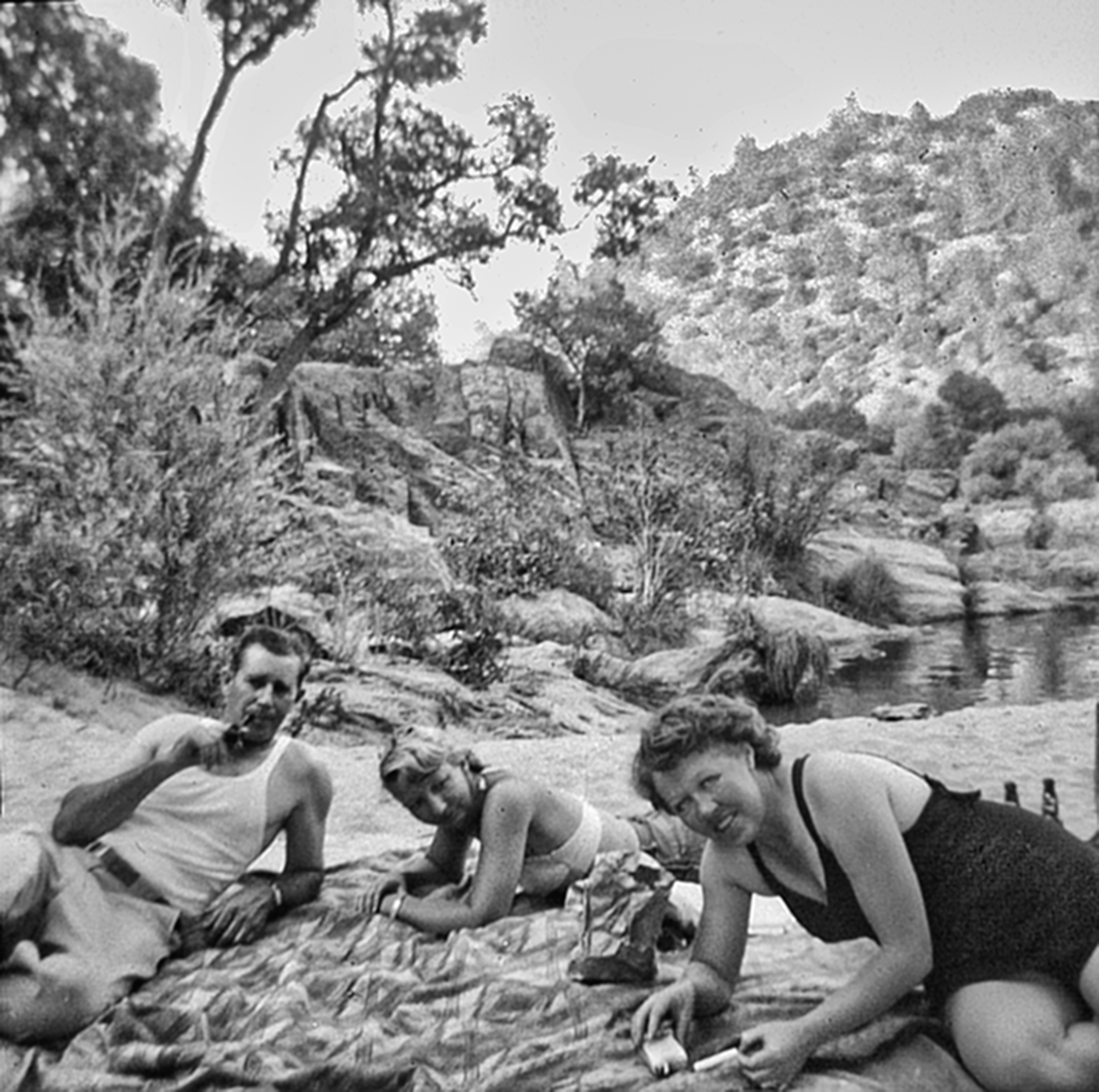
Parrott’s Ferry held special significance for my mother and father as they used to live, for several years during the Great Depression, on a mining claim just upstream of the Highway 49 crossing. Times were hard then, and fending off the land, aided by poaching the occasional deer, and “making do” with the barest of essentials became necessary adjuncts to survival.
I grew up hearing stories of how my dad and his friends would hike up the river to gather firewood that they would then fasten into rafts and float downstream where they could be used to keep the home fires burning.
Despite the hardships encountered, my parents’ stories of their time living on the river were always tinged with the kind of nostalgia that only accompanies the happiest of memories. They had the gift of youth, with all its attendant hopefulness, plus the great good fortune to be living beside a singularly beautiful river, in a simpler time, among friends and family all conjoined in common enterprise, unlike the soul stultifying preoccupation with self that characterizes the ways in which people relate, or don’t, to each other today.
Going swimming at the river was an activity I found myself engaged in at every opportunity once I grew old enough to drive myself to such places. With the inundation of the Tuolumne River that followed the raising of the New Don Pedro Dam in 1971, the Stanislaus River was the only remaining river locally that remained easily accessible. In the late 70s, in response to increasing demands for downstream irrigation needs, that river, too, became inundated “in the name of progress.”
Authorized in 1944 as a part of the Central Valley Project, Melones Dam was originally designed to provide irrigation water to farmers in the San Joaquin Valley. This dam was replaced by a higher dam, completed in 1978, creating California’s fourth-largest reservoir. In addition to expanding the river’s capacity to supply irrigation water, the new dam also allowed for hydropower generation and provided improved flood control and recreational benefits.
The expansion of the dam was controversial in its time and became the focus, during the 1970s and early 80s, of a prolonged environmental struggle, pitting those who wished to protect the scenic integrity of the (mostly, at that time) free-flowing Stanislaus River against the proponents of bigger and better dams. While the project’s proponents touted the dam’s perceived benefits, environmentalists, sportsmen, river rafters and others cited concerns ranging from loss of wildlife habitat to concerns about water quality.
Soon, lines were drawn and battle cries chosen, the river’s protectors hoisting banners proclaiming “Save the River,” while the other side produced bumper stickers exclaiming “Fill the Dam.” Inflamed by local politics, misinformation and rumor-mongering, passions ran high during that time, one stalwart river defender even going so far as to chain himself to a tree below the soon-to-be water line in an ultimately futile attempt to halt the reservoir’s filling. While the protestors who gathered in support of this failed venture were unsuccessful in turning back the clock on the new reservoir’s completion, they did succeed in bringing national attention to the larger battle of protecting the nation’s remaining free-flowing rivers, galvanizing California’s river conservation movement and influencing subsequent water policy changes on both the state and federal levels.
Living through that period in the county’s history and closely following developments as they unfolded provided me the opportunity to observe some of the more vexing aspects of human nature. The ideas beliefs and dreams of both sides of the conflict were on almost daily display in the local news, with both trying in their various ways to persuade others to support their respective positions.
Curiously, and tellingly, however, the two sides’ arguments were neither symmetrical nor equivalent. While the river’s defenders mostly relied on accurate and verifiable information in defense of their cause, the dam’s proponents operated free of such restraints, employing misinformation and hyperbole to spread fear, confusion and distrust among the people, much the same as present-day so-called Republicans employ similar tactics in the furtherance of their disingenuous, twisted and cynical agendas.
To be continued:
 sonora2sonoma
Leave a comment