Distraction, deception, diversion, talking points, one-liners, innuendo, baseless accusations, unblushing misrepresentations, barefaced outright lies, shameless and endless bluster; long on promises, short on accomplishments and equally so on substance; nothing in the way of planning, no information regarding implementation . . . To the president’s supporters and all the country’s other Kool-Aid drinkers, the recent final presidential debate amounted to a shining success; to the more discerning, to those in possession of their reasoning faculties—it was a megalomaniacal display of reality-turned-sideways blather, twaddle and jibber-jabber more properly suited to a psychiatric evaluation than a political debate.
The president’s throw-it-all-in-a-blender-and-see-what-comes-out debate performance was at once pitiable to behold and difficult to endure. His saddening and maddening attempts at transforming reality on a molecular level left particle physicists worldwide shaking their heads. Those hardy if self-punishing souls who forced themselves to endure the totality of the barrage were left feeling depleted, exhausted and faced with the dilemma of having to choose between taking a long shower, going to confession or becoming unrepentantly drunk.
As expected, Mr. Biden behaved like someone who actually cares about the welfare of those he seeks to serve, in contrast to the president, who seemed interested only in how he might use the office to continue the servicing of his personal interests. As Dana Milbank put it in the Washington Post, “Biden’s compassion accentuated trump’s soullessness. Biden’s common sense put trump’s fever dreams in sharp relief.”
So went the final debate between the two men who would have us choose which of them is to become the arbiter of our fates as we’re poised on the cusp of transformational change in a time of Covid, global warming and deep uncertainty, peering deeper into the first century of the third millennia while dancing the disturbing dance of destiny on the edge of Occam’s razor.
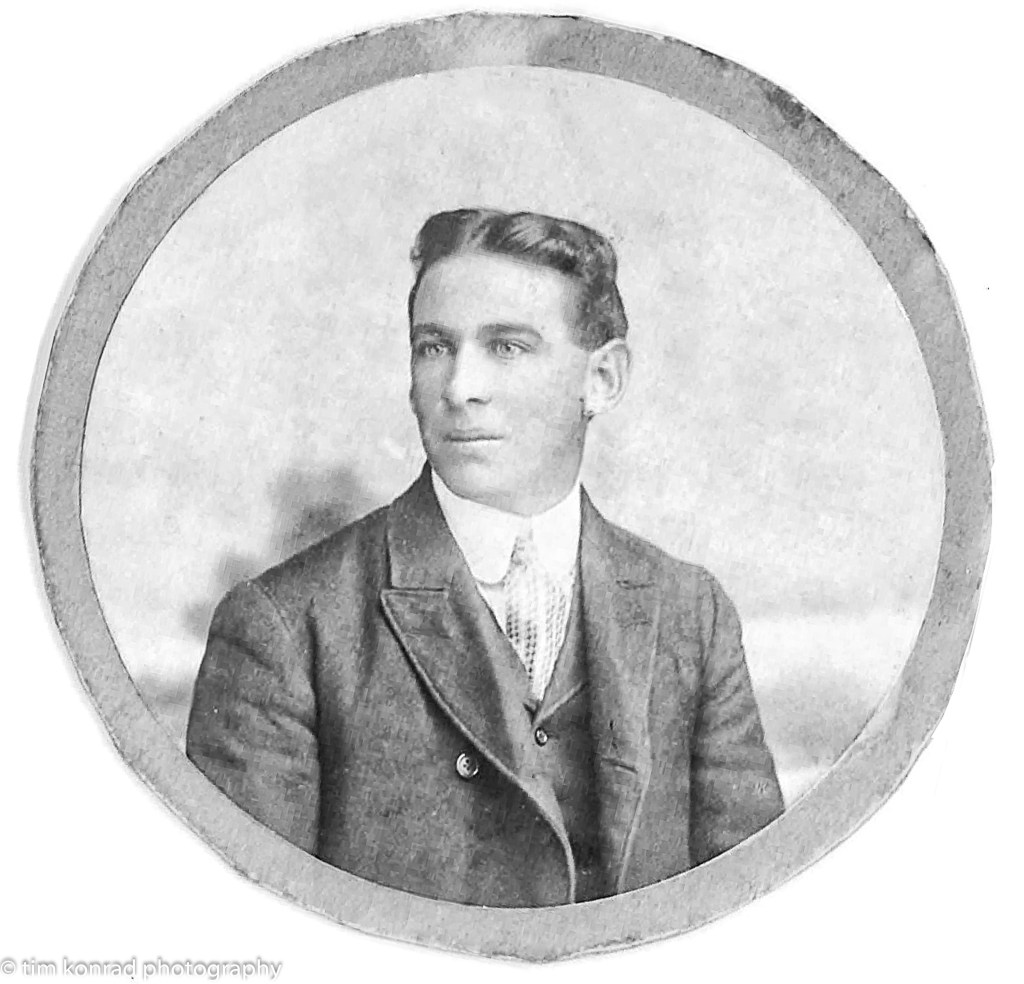
John Albert “Bert” Cartwright, my maternal grandfather
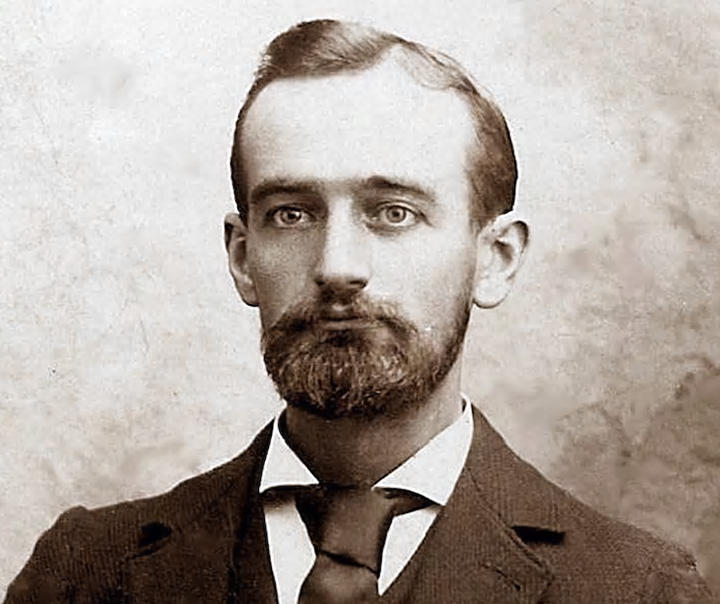
Friedrich Trump (maybe Drumpf)
Four days from now, October 25, will mark the 105th anniversary of the day my maternal grandfather, John Albert Cartwright, perished from the Spanish flu. I remember my grandmother telling me that one third of the population of the small town in Utah where they lived back then didn’t survive the pandemic surging across the nation at that time. His passing, like those of many others, had far reaching implications for his family that led my grandmother to eventually relocate to California, providing my mother the opportunity to meet a California boy who eventually became my father.
The story of my family’s experience with the Spanish flu, and my grandfather’s death as a result of it, left an indelible impression on me as a child and made me forever wary, in a deeply personal way, of the dangers of global pandemics.
Interestingly, the president, too, had a grandfather who didn’t survive that pandemic, passing on May 30, 1918 in the first wave of the pandemic. His grandfather, Friedrich Trump (possibly Drumpf), according to a March 7, 2020 Washington Post article, “came home from a stroll one day in May feeling sick (and) died almost immediately.” The president’s father, Fred, was only 12 when his father perished. It is inconceivable that the young donald didn’t possess some knowledge of what must have been a singularly significant event in his immediate family history.
Yet what the president made of that familial tie to the tragedy of losing a close family member to a virulent disease was, apparently, much different than that of other, more vigilant observers. The president was quoted in that same Washington Post edition of March 7, 2020 as having said “Does anybody die from the flu? I didn’t know people died from the flu.”
Is this man a bold-faced liar, or is he incredibly obtuse? More likely, he is both. In any event, it has become painfully obvious, to our peril, that he is incapable of learning from experience.
Ironically, Friedrich Trump came to the US from Germany at age 16 as an “unaccompanied alien child.” This didn’t, apparently, constitute sufficient cause for the president to reconsider his actions in his treatment of unaccompanied minors from Central America seeking to enter the country.
Also of interest, the trump patriarch was stripped of his Bavarian citizenship for not fulfilling the mandatory military service required of young men his age, thus setting the stage for a trump family tradition of dodging military service that has continued through mr trump and beyond, to his progeny.
This may go some way toward explaining the president’s disparagement of those who serve in the military, since he has had “no personal experience to learn from and appreciate military sacrifice.” http://www.nowaytrump.com/?p=427
But then, as noted above, he appears incapable of learning from experience anyway, so his lack of the personal experience from which he might have broadened his horizons is rendered moot.
As is any conjecture that a family history of loss due to the ravages of a pandemic constitutes reason to believe this man could develop a deeper understanding of and appreciation for the dangers of communicable diseases and the toll they take on their victims.
Not even a personal encounter with Covid itself, it seems, was capable of achieving that.
An utterly improper man, mr trump’s name should not be extended the dignity of according it the status of a proper noun.
In describing the man many would prefer to witness swap his orange head adornment for an orange jumpsuit, I have always refrained from following the convention of spelling his name with capital letters. Normally, peoples’ names are accorded the distinction conferred by granting them the status of proper nouns. However, while mr trump is inarguably a person, there is absolutely nothing about him one might consider proper.
For a man whose violation of not only norms but practically everything he touches appears routine, if not instinctual, the role of violator may well be his sole defining attribute; for such a person, a violation of the rules of grammar seems only fitting.
When first trump descended the golden stairway at trump tower, or climbed out from under a rock somewhere, either way appearing like some dismal and foreboding swamp creature, he appeared little more than a novelty, an unsavory caricature worthy of dismissal.
By the time his disruptive drivel had garnered enough attention that he began to attract followers, I had already grown to regard him with abject disdain. When he ‘won’ the presidency, if his ascension may be described as such, I resolved, more out of a sense of powerlessness than for any other reason, that the least I could do for the sake of my sanity was to deny him the deference accorded others, the dignity of a name’s capital spelling.
I long ago instructed my computer’s spell checker to regard his name, in lower case letters, as part of its saved vocabulary; it raised no objections and willingly complied.
mr trump has violated and continues to violate, both figuratively and literally, every norm, law, rule, regulation, statute, Supreme Court ruling, treaty, accord, agreement, tradition and custom that he has encountered. He has violated women; he has violated the trust of anyone willing to fall for his particular brand of bullshit—a subject of which he appears to be in possession of an inexhaustible supply.
Mr trump is himself nothing short of a living, breathing violation, the embodiment of broken faith, the agent of misplaced trust, bound by no allegiances, utterly lacking in compunction, without a shred of decency, oblivious to the astonishment his behavior elicits in others and totally lacking in concern for the consequences of his actions. Any concern he displays at all is only in evidence when he perceives something as having an adverse effect on him, personally, and then he becomes insufferable.
Some look into a mirror and see in their reflection what might otherwise elude their senses; when mr trump does so, he sees only projections—images produced by his vainglorious and mercurial imagination—a fantasy of delusions desperately denying reality at all costs. And everyone else, in one way or another, picks up the tab!
So, mr trump, screw you! The least I can do in return is to deny you the dignity you so desperately and pathetically crave.
Spent some time yesterday at the beach at low tide, poking around tidepools. While so engaged, I came upon a colony of mussels, clinging expectantly, bottom up, to the underside of an exposed ledge. I thought to myself, how dismal it must be to spend your entire life, nose downward (assuming mussels have noses), in the shadows, crammed shell to shell, alternately immersed in water, then left high, dry and parched, abandoned to a schedule that repeats mercilessly for the entirety of your existence—to live as a creature of the sea furloughed daily, without explanation, to an alien world, an inhospitable domain, with no assurance (presumably) you will ever see a return to normalcy. Imagine being forced to rely on this endless cycle for your very survival, for your daily sustenance, totally dependent on whatever washes your way borne on the confusion, detritus and foam of capricious circumstance.
While musing thus, the thought struck me how eerily similar, in a way, the life of these upended bivalves compares to our American experience under trump, with all its backwash, confusion, Covid claustrophobia and uncertainty!
Oh, how I long for the day when trump will be nothing more than a foul aftertaste that lingers in the mouth following an arduous and gaping tooth extraction, difficult to endure but with a certified end-date—a nightmarish memory receding in the fog of forgetfulness, the light of its darkness diminishing with each day’s sunrise until, finally, all that’s left is a faint recognition that there once was this awful person named trump who, like Hitler, made life a living hell for those forced to endure his malignant tenure.
But as much as I wish I could erase this man from not only my memory but the collective memory as well, no matter how sweetly the sound of the word ‘trumplessness’ rings to the ear, he must be remembered, like Hitler must be remembered, as a reminder, and an object lesson for future generations, of the fragility of democracy and of what can happen when the public drops its guard, becomes lazy, and fails to pay attention to the actions of its leaders. We must foster and preserve the recognition that the word ‘democracy’ should not be regarded as a noun only, but also as a verb, and not merely any verb, but an action verb, a power verb; a verb demanding participation in order for it to achieve its truest potential. For democracy to survive, flourish and endure into the future, it requires participation, it demands its due. Much as an insistent lover expects recognition and attention be repaid, so does democracy; it is a reciprocal relationship that only works if those involved sincerely invest themselves in the process.
By contrast, one theory of what brought about the fall of the Roman Empire lays its blame to apathy on the part of its citizens. It doesn’t take much reflection to recognize similar undercurrents in the swirling trends, the admixture of elements that created the conditions that made it possible for someone like trump to ascend to the presidency. If and when we are able to detach this barnacle of blasphemy from our ship of state, the toxic and corrosive elements—the mostly delusional ideas and beliefs that gained traction with his followers and empowered his hypnotic effect over them—will glaringly remain. Any attempts to restore reason to our politics will succeed only if they include those still under the spell of this self-serving charlatan: Such efforts must be truly democratic and they must address the concerns of everyone. Navigating these waters will be one of the most difficult challenges facing the country going forward.
As Elvis Costello optimistically declared, “there’s a wishful pencil mark in the diary of next year!” Hopefully, by then the spell cast by the twin curses of Covid and trumpism will be broken at last and the coming year will signal a return to sanity and the beginning of a much-needed house cleaning to rid the premises of the foul after-effects of our current devolution into misery and despair.
(For clarification, apologies are herewith offered for the insertion of the word ‘tadpoles,’ as well as the image of one, at the beginning of this article. Its inclusion served no other purpose than to embellish, via alliteration, the title of the piece. Forbearance is humbly solicited for any confusion that may have arisen as a result.)
Excerpted from ‘What About the Rest of the Constitution,’ written by Jamelle Bouie in today’s New York Times:
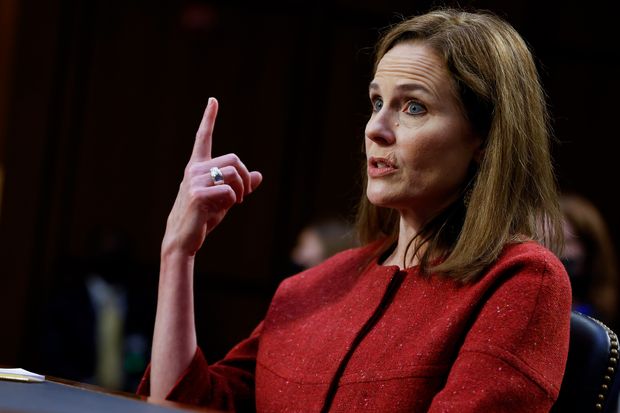
“On Tuesday, Judge Amy Coney Barrett took a few minutes during her confirmation hearing to discuss her judicial philosophy, best known as originalism. It means, she explained, ‘that I interpret the Constitution as a law, I understand it to have the meaning that it had at the time people ratified it. That meaning doesn’t change over time and it is not up to me to update it or infuse my policy views into it.’”
This statement, while implying an external locus of control on the part of Ms. Cony Barret, also suggests she interprets law in a way similar to that of fundamentalist Christians’ in their unquestioning interpretation of Biblical text.
I will examine the question of how locus of control affects decision-making on another day. Today I’m going to address semantics as they pertain to Ms. Cony Barrett’s explanation concerning how she approaches the interpretation of Constitutional law.
The importance of the precision in terminology addressed by semantics assumes added significance when it comes to parsing out shades of meaning such as those involved in the judicial interpretation of legal texts—an essential part of the job of all conscientious jurists.
Any endeavor to divine the original intent of the author of a particular document involves consideration of the following terms: interpret; construe; understand; believe. The meaning of these terms, respectively, according to the online version of Merriam-Webster, are:
“Interpret: to construe in the light of individual belief, judgment, or circumstance
Construe: to understand or explain the sense or intention of, usually in a particular way, or with respect to a given set of circumstances
Understand: to grasp the meaning of; to accept as a fact or truth; to believe or infer something to be the case
Believe: to consider to be true; to accept the word of; to hold as an opinion”
All of the above means of divining intent bear similarity in one important regard—they all are subjective in nature. Yet Ms. Cony Barrett appears to believe, if you take her at her word, that the originalist view of the Constitution is buttressed by and legitimized, with the imprimatur of objectivity.
The word ‘objective,’ as defined by Merriam-Webster, means “expressing or dealing with facts or conditions as perceived without distortion by personal feelings, prejudices, or interpretations.”
Merriam-Webster defines ‘perceive’ as: “to attain awareness or understanding of; to regard as being such”
But just how, exactly, does one “attain awareness” or ‘’understanding of,” by objective means, the intent of people long dead? What ‘facts’ exist capable of enlightening us on the original intent of the writers of the Constitution? What objective means are at our disposal to ascertain exactly what these people were thinking, what was going through their heads, when they crafted the document?
True, they left us much in the way of writings stating their thoughts about such matters, but the Founders thoughts themselves, like those of all people in all times, were imbued with the subjectivity in which all personal expressions are clad. And how, one might ask, is it possible to ponder any matter whatsoever with a mindset free of personal feelings, prejudices or interpretations? Our every thought is constantly informed by our experience, colored by our feelings, influenced by our prejudices and subject to our interpretations. Any attempt to convince ourselves otherwise is an attempt to assume divine stature, to imagine ourselves above the influence of such earthly matters, freed of our essentially human, and therefore fallible, natures. Such assumptions are utterly lacking in humility, stunning in their hubris, and, when they are undertaken by people in possession of the power to make decisions affecting the lives of others, they betray an alarming blindness in judgment. They amount to nothing more, in the end, than a pretense—a term defined by Merriam-Webster as “a claim made or implied, especially (italics theirs, not added) one not supported by fact.”
This quality of human nature, our ultimate liability to err, overlooked and ignored because of its inconvenient propensity to spoil the milk, is, to use an oft-employed analogy, the proverbial elephant in the room.
The folly in interpreting Biblical texts without question is easy to see. We all know, for example, that the world wasn’t created in 40 days and 40 nights, as “documented” in the Old Testament. The greater folly inherent in interpreting the Constitution in a similar, literal manner may be less visible, but exists nonetheless. Originalist thought overlooks the “facts on the ground”—the ever-changing needs of real people in real life situations— and by so doing renders it incapable of adequately addressing their needs.
By seeking to render ideological judgments that are abstract, sterile, and removed from reality, the Originalist approach to jurisprudence represents a real and present danger to democracy.
Last night we placed an order for groceries from Whole Foods using their Amazon website. The order included alcohol, which required that I meet the delivery person at the door when he arrived in order to show him my ID. When the young man came to the door with our order, he was not wearing a face covering. As I’m a member of a demographic deemed at high risk of infection from Covid, I was understandably concerned. I resolved to notify Whole Foods the following day so they could take steps to ensure this young man isn’t making deliveries to other people minus a face covering. Little did I know that doing so would prove as time-consuming and frustrating as it turned out to be.
The following day, before calling, I first scanned the Amazon Prime website from which I had placed my grocery order the night before, looking for a phone number to call to lodge my complaint. I knew from previously having tried to make a complaint online in regards to an earlier issue that there was no means of registering online feedback on that page beyond choosing one of two checkboxes— “satisfied” and “unsatisfied.”
After circling the website several times in search of a phone number and only ending up, each time, where I started from, I called the Petaluma Whole Foods store and was told they don’t do home delivery from the Petaluma store and my delivery likely came from either the Novato store or the one in Coddingtown. I was told I could find the right number to report my issue by looking on the Amazon website where I’d placed my order. This had proved futile when I’d tried it before, I told them, as it had only led me into a feedback loop.
Determined to persevere, I then dialed the number for the Coddingtown Whole Foods in Santa Rosa, explaining my complaint to the person who answered the call. That person told me their deliveries were managed by an independent contractor and provided me with a number for the contractor—888-280-4331.
I called that number, repeating my story, and was informed they, too, were unable to handle my complaint, and that I needed to call Whole Foods Customer Care at 844-936-8255. Interestingly, that person offered to provide me either a “replacement or refund” to compensate for my ‘inconvenience.’ When I asked him exactly what that would look like, he didn’t seem to grasp the true nature of my question, instead only repeating his offer. I pointed out that, while it was generous of him to make me such an offer, I failed to see how accepting his offer would lead to correcting the behavior of the lax delivery person in order to protect others going forward.
I thanked him for his time and then dialed the number he had given me to speak with Whole Foods Customer Care—844-936-8255, where I was connected to someone named ‘Michael.’ I explained my issue to Michael, who told me he was unable to help me and that I needed to take up my issue with Customer Service at Amazon Prime Now. I asked him for the phone number to reach them and he said he couldn’t give me a number for Amazon Prime Now, saying I could find it on the Amazon website. I told Michael I had tried repeatedly to find a phone number on the Amazon website without success. When he still refused to provide me a number to call, I asked to speak to his supervisor but he refused to do so, despite several attempts to get him to comply. As I hung up the phone, my thoughts were teeming with unflattering pejoratives I felt like aiming at Amazon’s corporate management, if only Amazon corporate management provided a number for the airing of such grievances.
It then occurred to me that I wasn’t certain the website I had placed my order from was the same website as Amazon Prime Now, so I navigated to it in hopes Michael was correct and I might finally find an opportunity to make my displeasure known to someone who could, hopefully, correct things such that the person who delivered my order would not needlessly place others at risk. Here’s how that went:
Primenow.amazon.com/storefront>Help>Contact Us>Call customer Service>Have Us Call You Right Now> (enter #) >Call Me Now
By following that thread, I received a phone call a short time later from a nice young woman named “Jenny,” who listened attentively to my account and offered assurances the matter would be forwarded to the proper channels so the delivery person would be told he needs to wear a mask and gloves in future. Jenny evinced an appropriate level of dismay upon hearing of the byzantine course of events I described in my crusade to report my concerns to an actual person. The empathetic manner in which she handled my grievance went considerable distance toward the redemption of my faith in the prospect of treading those waters in the future.
Interestingly, I learned from Jenny that the number I had dialed to reach the aforementioned ‘Michael’—the young man who had told me he could not help me but refused to provide me a number to call to reach the mysterious Whole Foods department of ‘Customer Care’—was the same number one would dial to reach her. Jenny, too, seemed to find that information interesting.
Jenny also confirmed that the Amazon Prime Now site is indeed not the same as the site from which I had placed my order but she explained that I could have reached her from there too by navigating to the “Whole Foods Market” logo, presented in green letters, at the top left of the home page, and accessing the drop-down menu beneath it. Had I done so, it would have revealed an option to click on ‘customer service,’ from which I could have either initiated a chat or selected the option of having them call me. Good information for the future!
For me, however, as I struggled in vain yesterday to find a way, any way, to reach a human being at Whole Foods, the obscurity in which the secret location of the link I sought was shrouded was strangely reminiscent of the location of an equally important piece of information sought by Arthur Dent in the ‘Hitchhiker’s Guide to the Galaxy,’ which he deftly described as “on display in the bottom of a locked filing cabinet stuck in a disused lavatory with a sign on the door saying ‘Beware of the Leopard’”—an apt analogy for “We Don’t Want You To Bother Us.”
But then, I guess if the business of dealing with Amazon’s customer complaints was made more user-friendly, Jeff Bezos’ wouldn’t be able to accrue his unconscionable wealth at such a breakneck speed. Poor fellow!
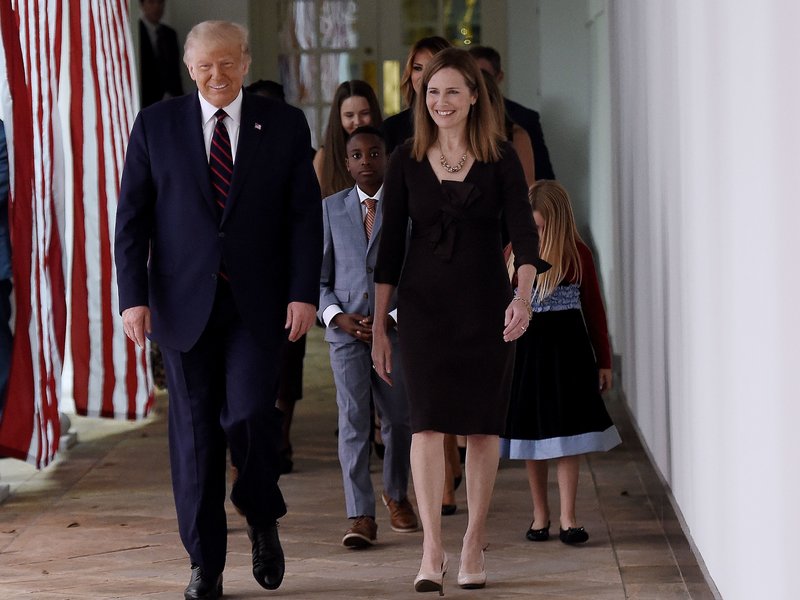
US President Donald Trump and Judge Amy Coney Barrett walk to the Rose Garden of the White House in Washington, DC, on September 26, 2020. – Trump nominated Barrett to the US Supreme Court. (Photo by Olivier DOULIERY / AFP) (Photo by OLIVIER DOULIERY/AFP via Getty Images)
Originalism, in the context of the interpretation of the Constitution, is the belief that the text of the Constitution should be given the original public meaning it had at the time of its writing. The immediate problem with such an approach is, because many of the issues that confront the world of the 21st century did not exist in the 19th century when the document was written, the originalist approach doesn’t reflect the current reality.
The ‘living constitutional theory,’ on the other hand, purports that “the legal content of constitutional doctrine does and should change in response to changing circumstances and values.” * This approach recognizes the dynamic, changing nature of a society as it evolves over time and was the approach taken by Ruth Bader Ginsburg in her tenure on the Supreme Court.
Those who, like the members of the Federalist Society—to which Amy Cony Barrett, the nominee proposed to fill the Supreme Court seat vacated by the death of Rut Bader Ginsburg, is closely affiliated—oppose the interpretation of the Constitution put forward by the advocates of the living constitutional theory, seek to label the latter as ‘judicial activists’ and characterize their efforts as attempts to ‘legislate from the bench.’
How can it be, since both approaches are essentially interpretations of what the authors of the Constitution intended when they crafted the document, that these so-called ‘judicial activists’ are ‘legislating from the bench’ while those of the originalist persuasion are not? Both approaches require the interpretation of the text of the Constitution, both require a parsing of the words contained therein. The only substantive difference between the two concerns the respective legal philosophies, the leanings, of those doing the interpreting—one side is conservative-leaning, veering into abstract legal distinctions that have been surgically removed from the real concerns of real people, while the other tends more toward moderate-liberalism, informed more by humanistic concerns than by sterile legal jargon.
Additionally, the very notion that originalists possess some exclusive “window” into the minds of the crafters of the Constitution implies a lack of self-awareness on the part of those holding that view, as well as a hubris of immense proportions.
The authors of the Constitution were people of an 18th century mindset, possessed of an understanding and worldview commensurate with their times. Many of the currents running through the social discourse of the 21st century—birth control and equal rights, to just name two—were absent from the dialogue of that time, while others—matters such as gay rights, transgender/gender neutral concerns and fetal tissue research—would have fallen so completely outside the purview of an 18th century person as to have exceeded their ability to comprehend them at all, much less enable them to foresee the need to devise the Constitutional framework necessary for the judicial rendering of such questions.
How, then, can originalist-minded justices be expected to render wise decisions that adequately and fairly address 21st century issues while stuck in an 18th century mindset? They cannot! The only way the Constitution can remain relevant to the times in which we live, as well as persist so into the future, is by viewing it as a dynamic document capable of reinterpretations befitting the times in which the decisions are rendered.
Such is how the Constitution was conceived and such is how it was intended by its framers, who devised a document pertinent to their times and designed to address the particular issues and needs relevant to their times. It was never intended to be enshrined like a holy object, considered inviolate and rendered incapable thereby of maintaining relevance in order to accommodate the vagaries of time and changing circumstance.
To resort to a foolish analogy to illustrate the foolishness inherent in such myopic thinking, if the medical profession was guided by originalist thinking, none of the advances in medicine that have occurred since the republic’s founding would be deemed acceptable for inclusion in today’s treatment regimens.
Such efforts to turn back the clock have and will always be similarly myopic. As Henry Ford once so inelegantly observed, “those who attempt to sit on the lid of progress will eventually be blown off.”
In the long run, history will prove, one way or another, the price paid for such extreme and self-defeating attempts to maintain control over the course of events as those put forth by the originalists and others of like persuasion.
For the Supreme Court to retain relevance, it must be capable of rising above the seductive allure of politics, and also resist deference to religious influence, the former, in particular, being something those who profess to believe in originalism, to their peril, have yet to grasp. And, because not enough of us members of the electorate have been paying adequate attention in our electoral choices for far too many election cycles at this point, to our peril too.
Douglas Adams was prescient when, in his splendid opus, ‘The Hitchhiker’s Guide to the Galaxy,’ he described how the Golgafrinchans rid their planet of its hairdressers and telephone sanitizers, sorts they regarded as dead weight, by duping them into believing their home world was in imminent danger of being devoured by a great mutant star goat and then shipping them off, having been misled into believing the others would follow, on an intergalactic ark in search of a new home in the stars.
That these folks eventually landed on a primordial earth and set about a chain of unfortunate events that, eons later, resulted in its being peopled with their kind today (yes, humans) goes a long way toward explaining how we are currently beset with a such sizeable number of folks who, despite all odds, still consider trump the best thing that’s come along since chocolate.
But I digress. The real message here is, if sanity prevails in the upcoming election and trump and his sycophants are defeated, these hopeful developments alone will not be sufficient to end our long national nightmare. We will still be left with those who will cling like barnacles to the perverse notion that their ‘war president’ received a raw deal. It is not likely that these people, of much greater concern to society than hairdressers and telephone sanitizers, will submit meekly to their unrealistic hopes and dreams having been dashed on the rocks of reality.
And it is those hopes and dreams, or more accurately, the injection of such irrational nonsense into the national discourse, and, most worrisome, its normalization, that will be the most difficult phenomena to counter in any efforts to steer the ship of state into calmer waters.
If only the technology existed to enable us to build such an ark as Adams envisioned, it should not prove all that difficult, given the tendency of trump’s followers and sympathizers to blindly accept the preposterous, to convince them of earth’s impending doom by some equally outlandish means. Then it would just be a matter of presenting a ride on a spaceship within their reach and selling it as not only their sole means of salvation but also as a special opportunity for each of them, personally, to be among the first participants in the Great trump Diaspora—a chance to forge ahead to create a great ‘trumpian utopia’ beyond the stars.
I had been struggling to coordinate a follow-up meeting between a handful of people who had participated in a large backyard event involving musicians, attendees and various supporting staff. This proposed follow-up gathering was the wish of the woman hosting the event. She was disappointed with the photos I had taken for her that day, and hoped to re-group everyone a week later for the purpose of staging a short follow-up photo shoot designed specifically to produce the images she had hoped to find among the photographs I had taken earlier that day. The job of making this all happen—getting everyone back together, which for some would entail more than an hours’ travel—she assigned to me.
Hampered by the fact she had given me no clear indication of what imagery, exactly, she had been looking for, and without any pronouncement from her at the party following the original event empowering me to act on her behalf in seeking to enlist the support of the mostly creative types on her list of requested participants, I found myself, during the party, running from person to person trying to pin down commitments. This proved exceedingly difficult since she had given no indication of a willingness to provide compensation for those she sought to enlist in her project.
During the party, I learned from the husband of the woman hosting the event, quite by accident, what had disappointment her and what it was she had wished to have seen in my photos. She had envisioned, he explained, seeing a series of action shots of people riding dirt-bikes frozen mid-way in flight while exercising straight-at-the-camera maneuvers, making jumps just a mere dizzying few feet away. No matter that the party had been conceived as a backyard concert—a musical event. No matter that there were absolutely no dirt-bikes, nor riders at the event nor had there been any arrangements made for staging such a stunt had any been present. And, of course, the photographer, yours truly, had not heard a word going in concerning the hostess’s expectations.
But such is the nature of dreams, with their mix-master ability to comingle disparate elements into a byzantine potpourri patchwork, with often preposterous associations, whose combined product can be at times gobsmackingly vaster than the sum of their parts. This dream even had echoes of a Robert Altman film, starring not only Joe Craven (who actually had a role to play, and a key one at that), but also featured a cameo with Laurie Lewis (who appeared more as a prop than an actual participant). My father, who moved on to broader horizons thirty years ago, was also involved, although his exact role was unclear to me, other than that he proved to be one of those whose refusal to be pinned down, like many others at the party, was reminiscent of the futility of attempting to herd cats.
My frustrations multiplied as I tried and failed and tried again to capture the attention of a succession of prospective participants, most of whom seemed preoccupied with more important matters like perusing the temptations laid out on the dessert table, being otherwise engaged, or wishing they could be, in conversation with other partygoers, or simply preferring not to be bothered.
I finally succeeded in gaining Joe Craven’s attention and I made my pitch to him. “Are you available next Saturday,” I asked. His answer, “that depends on whose interests are being served,” was, for me, revelatory.
Boundaries! A topic of considerable familiarity to me owing to my background in psychology. I had thought my boundaries were pretty well-ordered up until that moment, but, then, it’s always easier to see the folly in the behavior of others than it is to view with similar clarity one’s own foibles.
In an instant, Joe’s response made me realize that my dream-dwelling hostess’s wish for a photo shoot do-over was not my problem to solve. If she desired it so much, the legwork necessary to make it happen was hers to do, not mine, and also, she should be prepared when she does so to offer remuneration to the participants for their time too, just as she should in our daytime reality!
*****
This dream, and the seemingly countless others I’ve been having since trump’s behavior has grown increasingly sideways, all share one common theme—in each one, there exists some seemingly insurmountable problem that I have been assigned the impossible task of resolving. In each one, I try and try to succeed. In each one, the resolution escapes me. In each one, there is this inescapable sense of the overwhelmingness of the task, of the sheer futility of trying to rise to the occasion. In each one, I push on anyway, unfailingly, often to the point of exhaustion.
Michelle has been telling me, when she shares with me some difficulty she is experiencing, I respond too often by offering her advice. She doesn’t want advice, she tells me; she just wants to be heard.
But it’s almost second-nature for me to attempt to fix things. I do so without even knowing I’m doing it. Almost by default. Maybe it’s a guy thing, I don’t know.
What I do know is this: When that sense of being the eternal “fixer” is writ large, like it has been in my nightly dreams of late, it’s time to make some changes to my approach!
In my campaign to “fix” things, I now realize what is most in need of fixing is my need to fix things. Toward that end, Joe has unknowingly given me the tool that’s been missing in my toolbox—a means of assessing more accurately what’s mine to fix and what isn’t—an applied and personalized version of the Serenity Prayer straight out of my subconscious in the guise of a person I admire and respect. I can go for that!
My hat’s off to you, Joe! Enduring thanks, blessings and good wishes!





 sonora2sonoma