sonora2sonoma

  • (*Give Me Four More Years)

    On the radio this morning was a local story about how small businesses are struggling to remain solvent in the midst of the economic turndown resulting from the coronavirus epidemic. On any given day now, news of this sort fills the airways and, every time I hear it, my mind almost immediately turns to the president and the role his mishandling of the coronavirus crisis is playing in bringing ruin to the lives of so many Americans.  

    By almost any metric, it’s become apparent that trump is a failure, yet his supporters, turning reality on its side, view his performance as evidence of his superb leadership, some even going so far as to call him the greatest president in the history of the republic. How on earth can his followers, many of them otherwise sane-seeming, intelligent people, cling to him with almost religion-like devotion?  

     Some describe the hold the president has over his followers as cult-like. A quick perusal of “cult-like” in online dictionaries offers “some pastors have a cult-like control over their church members,” and “former members of congregations point to the cult-like power of many independent fundamental Baptist churches and the constant pressure to never question pastors or leave the church.”

    Merriam-Webster defines ‘cult’ as “great devotion to a person (or) idea,” adding that the word evolved from the Latin cultus, whose original meanings were, variously, “cultivation, training or education,” and “adoration.” By the 17th century, according to Merriam-Webster, the word had evolved to mean “worship;“ by the 18th, “non-religious admiration or devotion, such as to a person, idea or fad;” and by the 19th century, to “a religion regarded as unorthodox or spurious.”

    Merriam-Webster defines “devotion” as “the state of being ardently dedicated and loyal.”

    Adoration, dedication and especially, devotion— all adjectives aptly describing traits commonly shared by ardent trump supporters—dovetail nicely with the commitment to unquestioned loyalty exhibited by his more enthusiastic followers.

    People sometimes make comparisons between trump and Hitler. While some people viewed Hitler, like many now see trump, as the “devil incarnate,” Rense.com, a source dedicated to the propagation of conspiracy theory-related materials, describes Hitler as a “savior of man standing up against the enslavers of the world,” a view only the most ardent of trump’s supporters might share.

    But, while Hitler, at least initially, brought prosperity and a return of national pride to the people of Germany following the degradations suffered after Germany’s defeat in the first World War, trump has benefitted more from the policies of his predecessors for the thriving economy he inherited than by any actions of his doing. Under his leadership, these economic gains were mostly furthered by an onerous tax restructuring that favored the few at the expense of the many; the gains achieved thereby have been largely undone at this point through his amateurish mishandling of the coronavirus epidemic.

    A report on the psychology of Adolf Hitler, prepared by the Office of Strategic Services in the midst of WWII, predicted that, as the war turned against him, Hitler’s emotions would intensify, manifesting in more frequent outbursts, not unlike the increasingly erratic behaviors trump has been exhibiting in his appearances and public pronouncements.

    Comparisons can be made between the propaganda employed by Hitler and his associates and the propaganda-like pronouncements of the president and his administration and, at this point, the Republican party itself. According to Wikipedia, Hitler’s use of propaganda was “a crucial instrument for acquiring and maintaining power.” Without propaganda, according to the New York Times, (2019.10.16, How Hitler Pioneered ‘Fake News’) Hitler “never could have become a public figure, let alone risen to power.”

    Trained by the Army as a propagandist, Hitler was assigned in 1919 to infiltrate the German Workers Party, a right-wing group. He soon gained notice, per Wikipedia, for his “oratorical flourishes” and began “using a mirror to perfect his expressions and gestures,” transforming himself into “a performer, an artist.” He later wrote in Mein Kampf that “the correct use of propaganda is a true art.”

    “The key to understanding why so many Germans supported” Hitler, writes Benjamin Carter Hett, “lies in the Nazi’s rejection of a rational, factual world.” The style of propaganda employed by Hitler, as described by the philosopher Jason Stanley, “begins with a total persuasive technique, passes through the creation of a pure myth, and ends with the speaker leading his country on a chase for fake phantoms.”

    Hitler wrote in Mein Kampf that propaganda “must confine itself to a few points and repeat them over and over.”

    Based upon multiple reports that trump doesn’t read, it is unlikely he ever studied Mein Kampf, but, based on his mastery of the art of propaganda, one might reasonably conclude he didn’t need to.

    During the Great Depression, Hitler and the Nazis hastened the collapse of independent newspapers in Germany with the slogan, “Lügenpresse,” which translates into English as “fake news.”

    Coincidences?

    Given, then, the dysphoric state envisioned by white disenfranchised voters in this country and what they perceive as inaction on the part of government to meaningfully address their issues, is it any wonder they worship so zealously at the altar of the Orange One?

    Tim Konrad

    2020.09.02
  • As Heather Cox Richardson has noted in yesterday’s edition of her excellent blog, “We have lost almost 185,000 people to Covid-19. That number is a 9-11 attack every day for two months. It is flying a full 737 airplane into a mountain every single day for more than two years. I cannot fathom why combatting this disease is not an all-hands-on-deck national emergency.”

    Why, indeed!

    And, more to the point, how can anyone find this acceptable???

    Look at the furor that resulted from the 911 attack! The wars, the unravelling of the tenuous balance that once kept the middle east from bursting wide open at its seams, the enormous toll in human suffering that continues to this day!

    And yet, this administration glosses over the facts or, more accurately, attempts to hide them from the American public, in a cruel attempt to pin a happy face on a human tragedy of enormous proportions. And for what?  So a pitiably empty shell of a man can retain control of a governmental apparatus he openly despises yet cannot even begin to comprehend!

    How can this be okay?

    The coronavirus may not be trump’s fault, nor is it China’s, but what is clear and beyond dispute is the responsibility he bears for the fact that the epidemic continues to remain unchecked on his watch.

    And yet this president—the same person who, prior to becoming president, tweeted, on November 8, 2013, “Leadership: Whatever happens, you’re responsible. If it doesn’t happen, you’re responsible,”—said this past March, when asked about the lack of Covid-19 testing in the United States, said “I don’t take responsibility at all.”

    And now, as evidenced by the mind-numbing messaging of the RNC’s recent convention, we are to believe the pandemic has passed, that the president’s admirable leadership has all but vanquished the plague from our shores, and that, soon, the economy will be surging back like runoff from snowmelt following a heavier-than-usual winter’s snowfall.

    And the vice-president, a much-publicized deeply religious man, belies his true intentions by repeating the indecencies of the president—a man to whom religious piety is as foreign as a bacterium is to the immune system.

    And their supporters, loyal followers all, believers who persist in their beliefs without question, consume, like good soldiers, their daily doses of soma—the drug given people in Aldous Huxley’s prescient novel ‘Brave New World’ to create an “impenetrable wall between the actual universe and their minds,” to “make people avoid reality.” And, all the while, more and more families grieve the loss of loved ones whose funerals, thanks to Covid, they’re barred from attending.

    One thing is clear: As long as the president denies any responsibility whatsoever for the epidemic ravaging the country on his watch, his hopes for the return of a vibrant economy will remain just that—hopes.

    Or, as David Byron writes in Rolling Stone, “there’s no way to overcome the virus with a country at war with itself.”   

    Tim Konrad

    2020.09.02

  • The upcoming election, in the end, won’t be decided by the Democrats or the Republicans—it will be decided by Perception, for it is not facts or opinions that guide peoples’ decisions, not beliefs even, but the perceptions that underly and support those beliefs and opinions. And, to our great consternation, neither wisdom nor even the ability to accurately assess the virtues of a particular proposition are of much help in this endeavor compared to predisposition, temperament and timing. Call it kismet, chance, fate or God throwing the dice . . . even indigestion may be the equal of the wisest counsel available to those charged with the awesome and solemn responsibility of collectively determining our nation’s destiny! Successful navigation of this malign marathon requires, above all, a healthy and abiding sense of humor.

    Tim Konrad

    2020.08.25

  • I’m a bit confused! News broke yesterday that the director of national intelligence (DNI) announced he intends to eliminate in-person election security briefings to Congress. Today’s New York Times notes such a move “could leave the public with a diminished understanding of the threats facing the election as it enters a critical phase.” The reason, says the director of national intelligence, John Ratcliffe, is to “stop a pandemic of information being leaked out of the intelligence community.”

    How can such a move best serve the country’s interests?

    Beyond the  obvious questions of who leaked what to whom and why we don’t know about it, this raises questions with profound implications for election security, one of which is how will our election be made more secure by limiting the ability of congress to perform it’s constitutionally-mandated function of overseeing the government’s performance in protecting our elections from foreign interference?

    “Who needs to know this information,” ask David E. Sanger and Julian E. Barnes, the reporters who wrote the above-referenced Times article, “just the president, or the voters whose election infrastructure, and minds, are the target of the hacking.”

    The DNI’s new directive will deny Congress the ability to ask questions about the information offered them. And it will add to the clouds of doubt swirling about concerning whom to believe and which candidate is the wiser choice to lead the country out of the deplorable state in which our country and we, it’s citizens currently find ourselves.   

    So, again, I must ask, how does the withholding of information from the public about foreign election interference serve the country’s best interest? Unanswered questions are the devil’s playground; the imagination fills in the gaps. For instance, could it be, as many suspect, that the interference in the upcoming election thus far reported is primarily Russian, and could it be that their focus this time or not limited to misinformation and cyber mischief but rather has branched out into somehow enabling the mysterious “anarchists” who those allied with trump keep citing in their fearmongering about violence in primarily Democratic-run cities?  

    A little bit of sunshine to dispel the shadows in the mind created by the overzealous classifying of information, a bit of transparency, would go a long way toward clearing up such matters while also alerting the public to be wary of Russian trolling of their social media.

    The president, referring to his mythical notion that mail-in ballots will lead to fraud, an allegation lacking evidence to support it, said a month ago the election will be “the most rigged election in history.” On that point, he may be right, but not for the reasons he intended.

    Tim Konrad

    2020.08.31

  • Suddenly, poisonously unhinged rhetoric began issuing forth from my television set

    And I realized it had been co-opted by

    Gasp!!!

    Republicans!!

    So, I did what any sane person would do

    In my circumstances . . .

    I quickly established a perimeter

    Around my tv set

    And I sprayed the entire area

    Including the tv

    with Lysol

    Ortho

    Oh, NO

    And anything else I could think of to make it

    Not grow

    After which I smudged the entire surroundings

    And prayed to all that is holy, sane and normal

    Yes, I even called upon normal

    (trying times call for exceptional acts)

    That the devil seed–

    Sinister and festering faux-orange sperm of Beelzebub–

    Had been vanquished

    Extinguished

    Terminated

    Liquidated

    Eliminated, eradicated, obliterated

    And annihilated

    Before it was able to inveigle its grubby little finger-like roots

    Into my sensibilities and my world.

    Tim Konrad

    2020.08.27

  • The Rotten N’ Corrupt (RNC)s’ televised assault to Make America Grate, culminated last night with a wincing thud: The cognitive dissonance was deafening. The affair, in the eyes of its unmasked participants, amounted to no less than a glorious success, while constituting, to those for whom the term ‘alternative facts’ rings as false as a lead bell, a fetid and malodorous one and an offense to the sensibilities unequalled in living memory.

    The entire affair brought to hitherto unparalleled heights the notion of ‘preaching to the choir,’ while aptly illustrating the administration’s penchant for conducting and encouraging super-spreader events to demonstrate the efficacy of ignoring scientific advice concerning the Coronavirus.

    The irony was gripping: the horrible state of affairs each speaker guaranteed would result with a Democratic electoral victory in November was a description of conditions as they stand today under their fearless leader’s watch. One shudders to think how they would acquit themselves given four more years to further carry out their erasure of everything they despise.

    How will those who remain true to this monstrous lie of a president account for what will surely follow if his forces hold sway come November? Most likely, they won’t even notice . . . until his depredations affect them personally.

    This is the state of affairs in which we currently find ourselves—living in a land where sense of community and notions of social responsibility have been subordinated for far too long by purely personal interests. This is most noticeably demonstrated in our time by the actions of the current president and his administration, where it’s clear to see. What’s less obvious, but equally injurious, is the little acts of impunity many of us commit in our daily lives, ranging from—back when dining out was popular—short-tipping, to the avoidance of paying taxes whenever possible.  When we act with impunity, the kind of injurious leadership offered by the current administration is a natural consequence.

    And, when that happens, we have no one but ourselves to blame.

    We in America need much, much more than a change of leadership—we need a fundamental re-set of what it means to be a citizen, a neighbor, a friend and a fellow traveler on the road we collectively traverse. On this road, the idea that we travel alone is a false notion borne of a false narrative into which we have been culturally indoctrinated.

    We need to become aware that our every action has effects, collectively, on the lives of everyone else. No one travels this road alone; we are all of a piece with our fellow travelers, participants whose collective efforts combine to affect, in ways seen and unseen, the courses of our lives and the events that shape them. Ultimately, our individual choices join together to craft not only our personal stories but the stories of everyone and, thereby, our history as a people.

    We need to cultivate this awareness of our connectedness and incorporate it into our daily decision-making. Only then will we become worthy of government that values people over money, compassion over indifference, equality over discrimination, inclusion over exclusion and care for the environment over wanton exploitation.  

    The choice, as they say, is ours. But that choice doesn’t end on November third. Rather, it’s a choice we must continually and consciously make with our every act.

    Tim Konrad

    2020.08.28

  • One of my online acquaintances recently posted a message announcing her intention to vote Republican all down the ticket this fall. Although I don’t know this person well, I have come to respect her for her kindness and reasonableness in her online behavior.

    After my initial shock and disbelief that someone of her perceived sensibilities would—no, could—harbor such views, I began internal deliberations over whether or not I should respond. As this person has an active presence on FB, a number of other people shortly chimed in with a variety of responses ranging from incredulity to disbelief. Some of the retorts were condescending in nature; to these she responded with calm and wisely-worded defenses that spoke to the importance of treating others with respect while calmly defending her right to voice her beliefs. She responded similarly to the baiting taunts and derisive comments that came her way: Her responses were all in character with the person I have come to respect and admire for the good judgment she has always exhibited.

    And yet, here she was, voicing support for a man whose reelection will spell doom for the social safety net ushered in following the Great Depression to provide financial security for seniors, the ill and disabled; doom to the system of checks and balances that has enabled our democracy to flourish since its founding; doom to any hopes of reversing the effects of climate change while we still have a chance to make a difference—in short, doom to life as we know it.

    Just yesterday, it was announced that, if trump is reelected, he plans to eliminate permanently the payroll tax. Doing so, according to the Chief Actuary for Social Security, Stephen C. Goss, would end disability insurance by mid-2021 and end Social Security by mid- 2023.*  How could the president make good on his promise to restore the economy when faced with the unimaginable financial disruption that would result from the discontinuation of Social Security? Speaking in purely economic terms, this defies logic.

    In fact, most of what mr trump promises defies logic.

    But, based on the resoluteness of my online acquaintance, I doubt these concerns will sway her vote.

    What is one to do when good people with good hearts make such bad decisions? Yes, she is entitled to her opinions, and to her ability to express them in any way she chooses. And yet, by choosing to reelect trump, she is making a decision that will have profound effects on my life, and those of countless other retired and disabled people across the nation.

    For the life of me I cannot understand how anyone who either depends on Social Security or expects to do so when they retire, as I suspect my online acquaintance does, could elect a president who seeks to end this program permanently.

    All justifications aside, bad decisions made in good faith, by good people, are nonetheless bad decisions.

    I don’t pretend to know the answer to this question, but some quotes from an article that appeared in the August 6, 2020 edition of Rolling Stone may be instructive in this regard. Written by anthropologist Wade Davis and titled ‘The Unraveling of America,’ the author offers the following:

    Having “nothing to do with political ideology,” the “measure of wealth in a civilized nation is . . the strength and resonance of social relations and the bonds of reciprocity that connect all people in common purpose.”

    Davis observes that, due to the elevation of the needs of the individual over those of the community, we, as a nation, have lost our common purpose. The current politicization of mask-wearing and its resultant furor is a prime example of this state of affairs, or, as Davis puts it, “evidence of such terminal decadence is the choice that so many Americans made in 2016 to prioritize their personal indignations, placing their own resentments above any concerns for the fate of the country and the world, as they rushed to elect a man whose only credential for the job was his willingness to give voice to their hatreds, validate their anger, and target their enemies, real or imagined. One shudders to think of what it will mean to the world if Americans in November, knowing all that they do, elect to keep such a man in political power.” 

    Tim Konrad

    2020.08.26

    * Source: https://www.ssa.gov/oact/solvency/VanHollenSandersWydenSchumer_20200824.pdf?fbclid=IwAR1jOVZ7Dh_ra7YBbj6bnflCBZ_6tj55nuFVAcnh-_NNob943wo-oUoNDB4

    Quoted from source:

    “If this hypothetical legislation were enacted, with no alternative source of revenue to replace the elimination of payroll taxes on earned income paid on January 1, 2021 and thereafter, we estimate that DI Trust Fund asset reserves would become permanently depleted in about the middle of calendar year 2021, with no ability to pay DI benefits thereafter. We estimate that OASI Trust Fund reserves would become permanently depleted by the middle of calendar year 2023, with no ability to pay OASI benefits thereafter.”

    (OASI)– Social Security’s Old Age and Survivors Insurance (commonly called ‘Social Security’)

    (DI)– Trust Fund and Disability Insurance

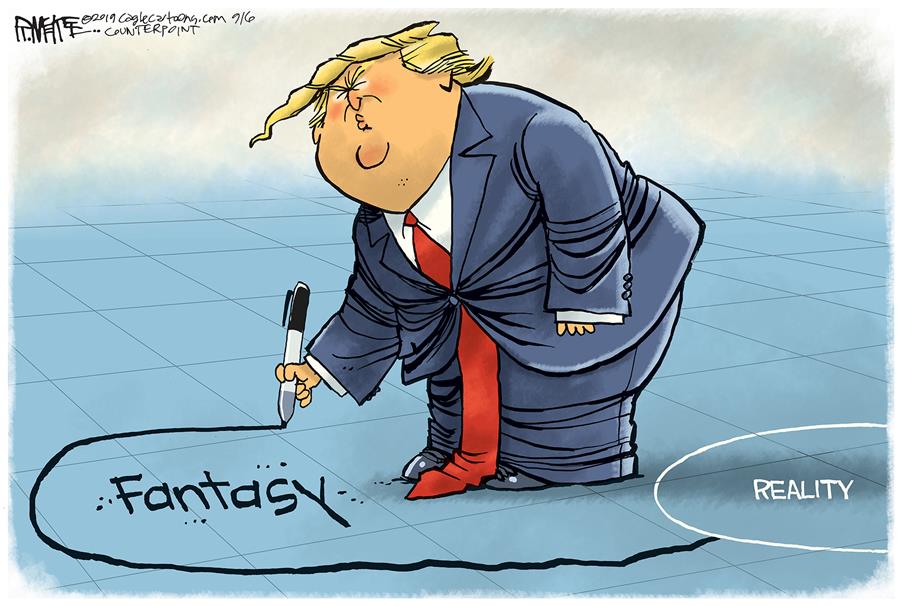
  • The president alleges without evidence that there will be voter fraud with mail-in ballots in the upcoming election, yet he continues to maintain there was no Russian interference in our last election despite ample evidence of its occurrence. But this is not surprising coming from a man for whom reality is viewed as an obstacle to be overcome rather than a condition in need of accommodation.

    The president’s anchorage in a mythical reality is an incredible phenomenon to witness that is only eclipsed by the willingness of his followers to eagerly play along, so far as it suits their needs, which up to now has been most of the time. Some, although little, solace may be found in an observation by the British comedian John Cleese, who said, “When I was young, I thought the world was basically sane with little patches of insanity lying here and there; now I know it’s the opposite—the world is mad, with areas of reasonable intelligence scattered about.”

    So, it seems we’re all living in an insane asylum whose only walls are the ones the reasonably intelligent among us erect to protect ourselves from the asylum’s inmates. Who the inmates are and who they aren’t is largely a matter of perspective but boils down generally to which reality they are grounded in—the one people used to traditionally agree was the only one, from which all deviations were thought to be the realm of mania, and the one Kellyanne Conway famously termed “alternative facts.” For the reasonably intelligent, no passport exists to allow them entry into the latter, save the complete abandonment of the senses.

    That very condition—the complete abandonment of the senses—helps to explain why certain Republican congressional leaders continue to support this president. What else could explain their behavior? For these men and women, hewing to the party line these days requires a willful refusal to acknowledge the facts surrounding the issues, as well as an utter disregard for the consequences of their words and acts. Do these actions describe the behavior of reasonable, much less intelligent people?

    The only recourse for the reasonably intelligent in the face of such societal mania is to speak out in objection, and to do so loudly and clearly, to add our voices to the growing chorus of those who refuse to submit themselves to the writhing tentacles of pathology seeking to invade our minds and overcome our spirits.

    And the ultimate act of defiance available to us is to vote, and to do so carefully, not just in whose names we mark on our ballots, but also in the manner in which we do so. Become aware of the pitfalls the asylum’s inmates exploit to invalidate ballots. If you haven’t already done so, make sure to register before the deadline, take care you sign your ballots legibly (your signature will be checked to see that it matches the one on file) and, if you vote by mail or via absentee ballot (the same thing) send your ballot back extra early to ensure it gets there in time to be counted. And don’t procrastinate; the asylum’s inmates are hoping you will. Disappoint them. Vote this time like your life depends on it, because it just might.

    To say that this November’s election will be the most consequential election in decades is a tremendous understatement. The very survival of our democracy may well be at stake!  In order to save it, everyone’s voice needs to be heard this November. and your vote is the means to make sure the message comes through clearly and unambiguously. A resounding defeat for the party currently in power will be a clear mandate for change trump and his acolytes will be unable to ignore. It is the only reasonably intelligent path toward truly making America Great Again.

    Tim Konrad

    July 31, 2020

  • When CNN’s Jake Tapper noted to White House chief of staff Mark Meadows, as quoted in today’s Washington Post, “that there’s no evidence of widespread voter fraud,’ Meadows could respond only, “There’s no evidence that there’s not either. That’s the definition of fraud, Jake.”

    What on earth, I wondered, was this man talking about?

    Meadow’s definition of fraud left me scratching my head. The definition of fraud, he seemed to be saying, was, while there’s no proof of widespread voter fraud, there’s no proof there isn’t either. Do I have that right? And just how, please explain, does that constitute fraud?

    In fact, how is that really saying anything, I pondered? And, if it does contain a coherent meaning, I wish someone would show me the key to unlocking it!

    Lacking the means to decipher the opaqueness of Meadow’s assertion, I turned to my usual online dictionary resources to determine if I could shine more light on this puzzling conundrum.

    Fraud, according to Microsoft’s obscured dictionary resource, is defined as 1) “a wrongful or criminal deception intended to result in financial or personal gain,” or 2) “a person or thing intended to deceive others typically by unjustifiably claiming or being credited with accomplishments or qualities.”

    Not wanting to rely solely on anything Microsoft has its wandering fingers in, I broadened my search to include other sources.

    Merriam-Webster said of fraud, “deceit, trickery: intentional perversion of truth in order to induce another to part with something of value or to surrender a legal right,” and “an act of deceiving or misrepresenting.”

    At that point in my investigation, the words “deceit” and “deception” appeared to be deeply involved in this mess, as did the idea of creating a false narrative for the purpose of “deceiving” people toward a given end.

    But, I thought, just to make sure I was on to something, I should delve a little further.

    Cambridge, it turns out, painted a similar picture: Here, fraud was described as “something that is not what it appears to be and is deliberately used to deceive people.”

    The word “deceive, which is the active form of the word “deception,” lined up nicely with the theme expressed in the other definitions of fraud described above. Additionally, the word “deliberately” also had an air about it that seemed to fit uncannily with Meadow’s assertion.

    It appears that Meadows’ would have us believe that either proof of something, or its absence, is sufficient “evidence” to conclude something is fraudulent: Could it be, ironically, that his artless dodging of Tapper’s question in itself constitutes a fraudulent claim?  

    Overlooking for a moment the deceit inherent in Meadow’s word-mangling postulation, if one were to accept his circular reasoning as valid, cases could also be made for the existence of the abominable snowman, alien mind-control and overwhelming public support for the president’s coronavirus response.

    I had originally intended to end this piece by saying “It’s all just so confusing!”

    Actually, it’s all become quite clear!

    Tim Konrad

    2020.08.17

  • Of all the advances of modern science, from the development of germ theory to the recent Space X landing and recovery, the one area in which little progress has ever been made concerns a property whose effect on our lives is beyond dispute. Time.

    Try as they may,  people have been attempting to modify or overcome the toll time takes on our bodies since at least the time of the Pharaohs, and likely far earlier. Supremely democratic, time ignores distinctions like class, race or status with the same disinterest as does the coronavirus, and neither science nor the deepest sorcery has so far found a way to master it.  

    Anyone over 50 can probably relate, at least to some extent, to the various aches and pains that, unfortunately, announce their presence more pointedly with each subsequent year. The gradual nature of those changes makes it easy to dismiss their import unless some chronic illness interrupts the process. The sudden appearance of an object from one’s past, however, has the power to bring the effects of the passage of time into sharp focus.

    An old tin box, into which I placed some important papers 50 odd years ago, tells the story of time in a way mere words alone cannot. Once bright and shiny, it now sits covered with so much corrosion that, when I came across it in a corner of an old cabinet this afternoon, I at first though it a relic of a bygone time. The papers inside, now browned and brittle with age, were still readable, reporting what I spent having a Volkswagen engine repaired that broke down in New Mexico just a couple of days before Neil Armstrong walked on the Moon. The corrosion, worse on the inside, imparted a coarse and dirty feel to the box’s contents from the dust resulting from it’s slow surrender to the ravages of time.

    Reflecting on my discovery, and my initial thoughts about the box’s provenance, it dawned on me that it is, indeed, a relic of a bygone time. After that realization, it took little time at all to realize that I, too, am in large measure a relic of a bygone time. Or might be, depending on the way I choose to process that information.

    A glimmer of hope appeared as I realized my seniority status, increasing daily,  in no way means I’m becoming irrelevant. After all, Joe Biden is not much older than I am, and look how he’s chosen to spend his time! Only those who buy into the notion of “over the hill” find themselves traversing the slopes that lie beyond. I’m not yet ready for that journey. For me, the summit lies ever ahead.  I’ve still got more to do, more to be.

    My only problem is finding the time to do it!

    Tim Konrad

    2020.08.14