A collection of short essays on my recollections of growing up in the Sierra foothills in the 1950s.
The year was 1913. My paternal grandfather, Timothy “Pop” Konrad, was living in San Mateo, California, married, with a wife and three children to support. The growing popularity of automobiles had led him to expand his blacksmithing business to include the care and maintenance of these vehicles. In addition, he had only recently obtained patents for an airplane he had invented in his blacksmithing shop.
Things appeared to be going well when, without warning, my grandmother, Pearl, fell ill. She lay in hospital for a week without a diagnosis, her condition worsening each day until, finally, she succumbed. It was later determined she had died of a ruptured appendix. The hospital’s malfeasance was the primary reason my father held a dim view of doctors until his dying day.
After Pearl’s passing, my grandfather took in a roommate—my mother’s aunt Veda—to help out with the children. My aunt Dorothy was nine at the time, my dad was seven and my uncle Jack was three.
***
In 1917 the country and the world were ravaged by the Spanish Flu pandemic. Among its many casualties was my maternal grandfather, Bert Cartwright. My mother was seven when her father died; both she and her brother, Jack, also contracted the illness but survived.
My grandmother, Lowney, newly widowed, sent my mother and uncle to live with her sister Veda in California and my extended birth family was born.
***
My grandfather and Veda remained roommates, minus a few interruptions, until Veda’s death, around 1951, despite her cycling through several husbands along the way. One of those husbands was Charlie Silva. I knew Charlie and his wife Marie when I was a small child. They used to live out in Shaw’s Flat in a pleasant little house with a huge weeping willow tree in its front yard. Before my time, Charlie had been married to Veda, but their friendship had endured and they’d all remained friends, my grandpa and Marie included, until the end of their lives. I remember Charlie as a kind and gentle soul with a most arresting smile. Witnessing their camaraderie as a child served as a proof, although I wouldn’t realize it until much later, that it was possible to maintain friendships beyond marriage.
My father, on the other hand, never warmed to Veda; he viewed her as a user, someone who would always put her needs first, regardless of the circumstances.
***
My grandfather’s mother died in childbirth. His father subsequently succumbed to a brain aneurysm, at age 29, while smoking a cigar. Orphaned at three months, young Tim was raised by family friends in Covington, Kentucky.
In his youth, Tim longed to be a railroad engineer, but he suffered from a partial hearing loss that placed that dream beyond his reach. He became a machinist instead, but, feeling unfulfilled, and yearning for more, he took to adventuring in Mexico, where he searched for buried Spanish gold in the state of Colima on Mexico’s Pacific coast.
Discovering what he believed to be a large cache of treasure concealed in a cavern perched perilously in a seaside cliff, Tim miscalculated the amount of explosive needed to widen its opening for further exploration. The resulting explosion blasted the grotto, as well as whatever contents may have existed, into the ocean below.
This was during the period when Pancho Villa was stirring up trouble in the region. Tim’s return to the States was hastened upon learning he was being sought by people aggrieved over a matter concerning the honor of a certain Mexican senorita.
Eventually landing in San Mateo, Pop became by turns a blacksmith, an auto mechanic and an inventor.
Possessed of a restless spirit, Tim briefly considered an overseas job when the Russian government announced a drive to recruit machinists to help expand their railway system. Fortunately, he chose to forgo the opportunity, a decision that proved to be prescient when many of those who responded were later killed in the Bolshevik Revolution of 1917.
***
Although the dust had settled from the bustle of the Gold Rush decades earlier, it was the promise of gold that brought my grandfather to the hills outside of Columbia a few years later, where he and a small group of investors had purchased a working gold mine on the banks of the south side of the subsequently submerged Stanislaus River not far upstream from Parrott’s Ferry.

Known as the Republic Mine, the venture never turned out to be the source of riches my grandpa had hoped for but did manage to provide a stable enough base for him and his family to successfully navigate the depths of the Great Depression.
The mine turned out to be unprofitable for the stock-holders; what earnings it produced were consumed meeting the expenses necessary for maintenance and upkeep. The occasional poached deer kept food on the table.
My father told stories about how he and his friends used to hike upstream to gather firewood, where they would fashion rafts out of driftwood to transport the wood, and themselves, downriver to where their cabin was located. Those days were happy ones, as evidenced by the wide smile my father would always display when recounting his adventures.
My grandmother, Lowney, eventually followed her children to California. At some point, she met and married her second husband, Ernest Wolfe, with whom she bore her third child, who became my Uncle Bob. By then, my mother was a teenager, and she and Ernest didn’t mix well. After an incident in which Ernest physically abused her, my grandmother shipped my mother off to Tuolumne County to live at the mine with Veda and my father’s family.
On account of these unusual and tragic developments, my mother and father essentially grew up together, largely in the same household. The early mining venture at the Republic Mine was abandoned in favor of another opportunity and the family moved upstream to take over the operation of the Von Tromp Mine. The Von Tromp was located on the south side of the river canyon not far from the larger Experimental Mine. That mine was located, a few miles past Columbia at the end of Experimental Mine Road, off of Italian Bar Road. My father and his brother, also named Jack, worked this mine with my grandfather and assorted others, among whom was Lyle Schoettgen, who in later years became Columbia’s justice court judge.
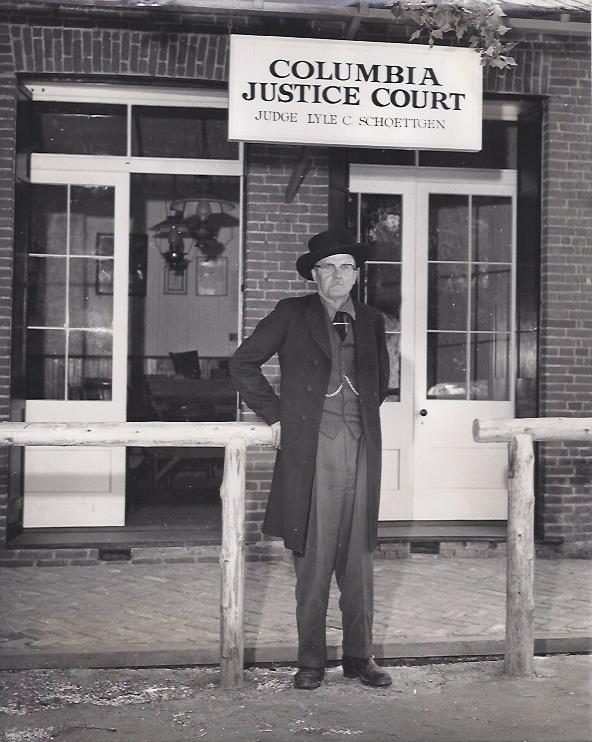
My father and Lyle shared a cabin together back when they were drilling and blasting their way into the mountainside following gold-bearing quartz veins, minus the use of air filtration devices, as was the custom in those days. Consequently, both men exhibited signs of respiratory distress in later life, accompanied by a frightening-sounding cough. While my father’s cough was distressing-sounding, Lyle’s cough sounded tubercular. My father once told me that Lyle suffered from silicosis, which may well have contributed to his eventual demise.
It was during this time that my family became acquainted with the Ponce family, descendants of Chilean miners who came to Tuolumne County during the Gold Rush The Ponces lived at a ranch just up the road from the Von Tromp Mine. One of Lee Ponce’s brothers was killed while working at the Von Tromp mine. He’d been investigating a fuse that had failed to fire when it had gone off unexpectedly, blowing him up in the process. Such accidents were not uncommon back then, as there was no way to determine why a charge had failed to ignite except through visual inspection.
My family’s friendship with the Ponce family endured into the 1950s and beyond when Lee and Al Ponce and their wives Pearl and Francis operated the Stage Drivers’ Retreat—the saloon in Columbia currently known as the Jack Douglass. My parents used to frequent the Stage Drivers’ Retreat for beers on Sunday afternoons, where they would catch up on the latest Columbia news.
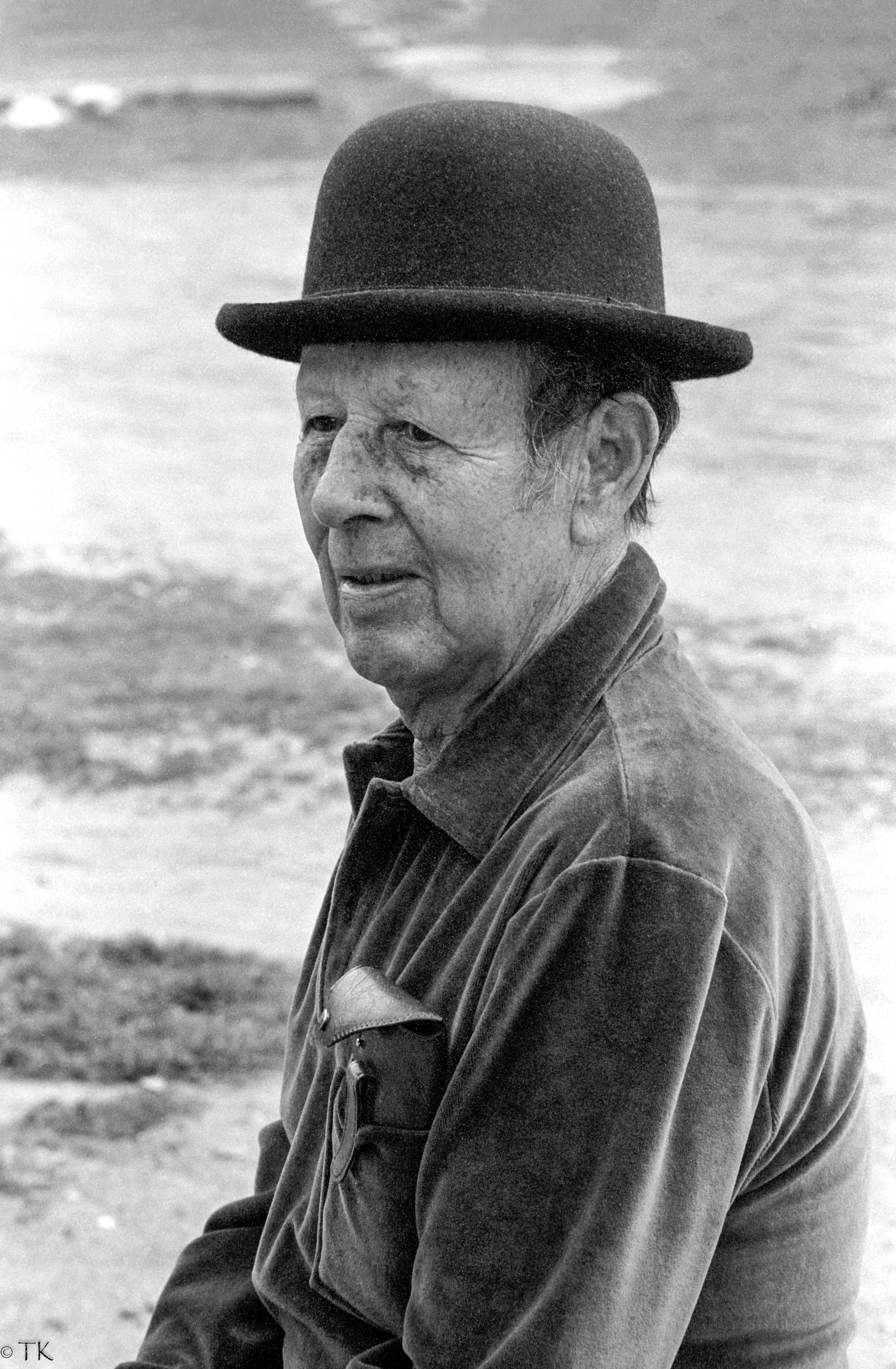
My dad had long been skeptical of the profitability of gold mining when, sometime in the latter part of the 1920s, he became totally disillusioned with it and got a job working as a house painter in Sonora. He had apprenticed in his teen years under a Hungarian house painter in San Mateo, where he’d learned everything from how to make paint out of lead paste and linseed oil to applying antique finishes and hanging exotic wallpapers.
The new job in Sonora afforded my dad the opportunity to put his painting skills to use. While he was living at the mine, my father had been giving his earnings to Veda, who handled the money for the family. He resented how she would, in his mind, “spend all the money on chocolates” instead of using it for things he considered more essential. When, after he’d been on the job for a few months, he’d gotten a raise, he hadn’t shared the news at home, instead saving the extra funds until he’d accumulated enough money to elope with my mother and establish a residence in Sonora.
To be continued:


Leave a Reply