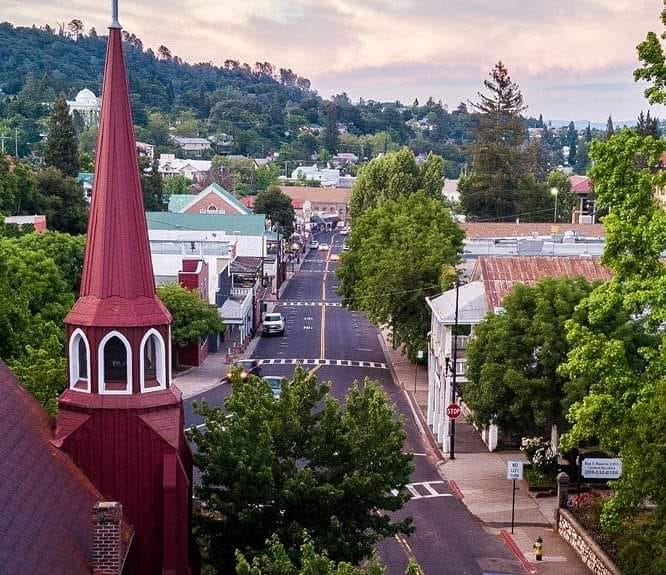
Sonora’s Main Street, Washington Street, followed the course of an old Indian trail as it descended into the little valley that had been transformed by 1850 into a booming mining town by the influx of gold-seekers hoping to strike it rich in the Gold Rush. The street names in downtown Sonora were first noted back in 1850, when they appeared on a map by Cooper & Gulledge.
Our little block of South Shepherd Street was bordered by Barretta Street to the east, Lytton Street to the south and Livingston St to the north. According to an article, “Sonora’s Early Streets,” in the Tuolumne County Historical Society quarterly, “Chispa,” Vol. II, No. 4, April-June, 1972, Barretta Street was named after Jacinto Barretta, one of South Washington Street’s pioneer merchants. Lytton Street got its name from a member of the town’s first informal city council, John B. Litton. Shepherd Street was named in recognition of Dr. William M. Shepherd, “one of Sonora’s most colorful and turbulent pioneers.” A physician and heavy drinker, Dr. Shepherd was known for “being as proficient with a Bowie knife as he was with a scalpel.”
Near the bottom of the hill overlooked by my house, the ground rose up again sharply just beyond what was once my boyhood friend Mike’s house, the bottom-most of the small string of houses that lined our block. Once the grass turned yellow and dried up in the small triangle bordered by Livingston, Shepherd and Barretta streets, this grass-slicked 45-degree slope made for the perfect surface for us kids to slide down while riding on pieces of cardboard.
Occasionally, someone would get ahold of a large box, such as a refrigerator carton. After knocking out the end flaps, several of us would climb inside and tumble down the hill, head over heels, sometimes spilling out the sides, laughing, while the carton continued its downward course, with the abandon only children can muster.
On one occasion, my joy was short-lived; while sliding down the hill, the cardboard under my knees met abruptly with an ill- tempered rock that penetrated the cardboard, and my knee, occasioning a trip to the doctor that involved needles and stitches to repair. Another incident brought my celebratory mood to a screaming halt, literally, when a foxtail sticker became lodged in one of my eyes.
Springtime, when the grass was still green and the soil still soft from the spring rains, created the perfect conditions for pulling compact, throwing-sized clods of dirt and grass from the ground. We neighborhood kids would take full advantage of this phenomenon as we gathered in opposing groups to play war games, lobbing dirt clods at each other while ducking down to avoid becoming struck by incoming missiles. By gripping the grass close down to the base and throwing over-hand, as in hardball, some of us could hurl a dirt clod with respectable accuracy. This was an accomplishment worthy of celebration, but only when we were on the offensive side.
After the memories start flowing, however, there’s no choosing which ones attain prominence: once that spark is lit, they all tumble out of a piece, good and bad alike, associations cascading one after another until the fount of inspiration dwindles to a trickle.
On the whole, my memories of the joy I experienced sliding down that hill, or even ducking to avoid being struck by incoming dirt clods, eclipse any residue left from the cuts and bruises I experienced in the doing of it.
Sonora was, to my young eyes, a simpler place. A place of safety, of security, where kids could play outside at night, walk downtown to the movies by themselves, and never have to worry about any of the kinds of things children fall prey to in this day and age. The same was true of the schools, although the threat of bullying by older and bigger kids was ever present, much as it appears to be today. The best time of year to my young way of thinking, however, was summer, because it always meant warm weather, swimming, and best of all, no school.
Tuolumne County in the 1950s offered many opportunities to swim in rivers. The stretches of the Stanislaus and Tuolumne Rivers that are now inundated by reservoirs were then running mostly free and were easily accessible.
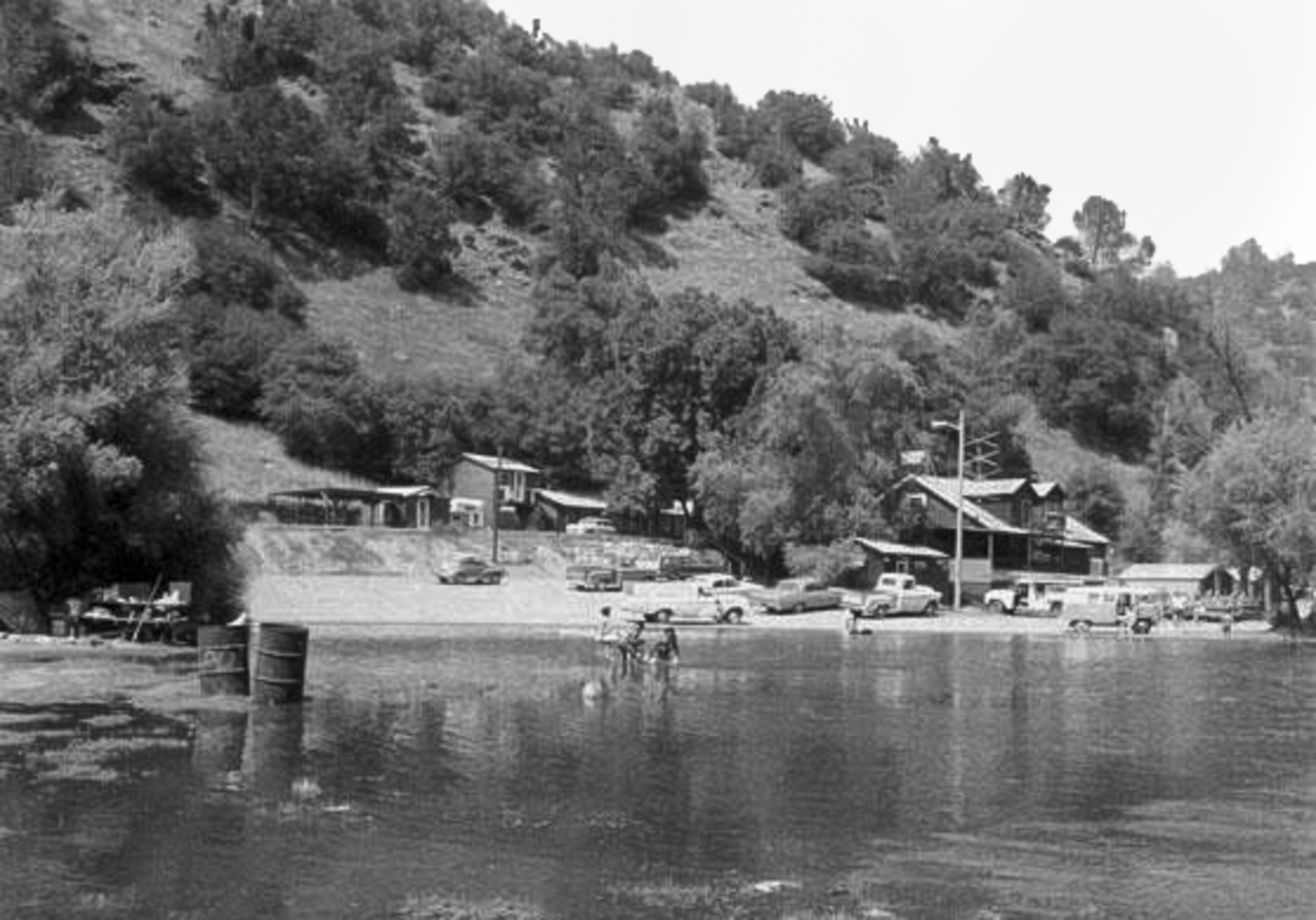
One of my favorite pastimes on a lazy summer afternoon was to go swimming at Mountain River Lodge on the Tuolumne River.
Mountain River Lodge
Long since inundated by the higher waters of New Don Pedro reservoir, Mountain River Lodge once sat along a calm and deep stretch of the Tuolumne River, just downstream from the Stevens Bar Bridge where State Highway 120 crossed the river on its way toward Moccasin, Groveland and Yosemite.
Giant cottonwood trees lined the river’s sandy banks, shading the beaches from the blazing summer sun. The “cotton” from the trees covered the ground and, whipped about at the whim of the winds, would pile up against the tree trunks and other vertical objects.
As kids, we would swing far out into the river, dangling off ropes hung from the trees’ branches. Boys being boys, the activity often became a game, the object of which was to see who could swing out the farthest before dropping into the cold water below. Try as I did, it was always someone else who would win that coveted acknowledgment.
One summer, a half-dozen or so very large inflatable pontoon-type flotation devices, shaped like giant black-colored hot dogs—likely old military surplus—were moored under the trees by the riverbank beneath where the rope swing dangled from the branches high above. It was possible, by angling just so, to swing out and craft a landing onto one of those floats.
After taking several turns successfully doing just that, my next attempt went awry. Releasing my grip on the rope at what I believed was the correct moment, I was caught off-guard when, instead of plopping down on the pontoon’s rubbery surface, I slipped unexpectedly between two pontoons. I hadn’t taken in a gulp of air beforehand, not expecting to suddenly find myself under water, needing to breathe . . and SOON! I kept trying to swim out from beneath the massive buoys, but all I could see above me was the black bottoms of the pontoons.
Running out of air, I began to panic. The thought struck me that I would never see my parents again. I didn’t want them to have to suffer over me. I felt both sad for them and gripped with terror, all in less than an instant. I realized that soon, I would no longer be able to hold my breath and would have to gasp for air, even though I also knew that doing so would fill my lungs with water and I would drown.
When you need to breathe, I discovered, you need to breathe, come what may! In such moments, there are no other choices available. Regardless of the consequences, that moment had arrived! Devoid of hope, I started to gasp . . . just as sunlight appeared and I broke through to the surface, and air, precious air!
****
In addition to the beach, there was also a camping area up by the road, away from the river. A couple of gas pumps stood beside the highway in front of the lodge, with a phone booth set off to one side.
The lodge featured a large barroom, an equally spacious dining room, and a wide deck that extended out from the back of the building, facing toward the river. Speakers were mounted on the deck to conduct whatever tunes were playing on the bar’s jukebox and broadcast them out to the campgrounds, the beach and the river beyond.
I can still recall, almost as if it were yesterday, hearing the strains of Hank Williams “Jambalaya” drift across the river on one summer’s languid afternoons as I floated lazily on an inflated inner tube. Another summer the prevalent song was “A White Sports Coat” by Marty Robbins. The earliest tune I recall hearing broadcast across the water was Patsy Cline’s “I Fall To Pieces.”
There is no better way, excluding olfactory means, to recall such moments than when one’s recollections include the taste and feel of a place in conjunction with the tune that accompanied the memory! It’s like having a memory with a theme song appended to it. The multiple modalities of such recollections strengthen, reinforce and enrich them in ways unachievable through one modality alone.
As noted above, my parents would take me swimming at the Tuolumne River on hot Sunday summer afternoons. My dad’s Oldsmobile didn’t have air conditioning. Accordingly, when the weather was warm, we would ride with the windows open. As August inched toward September, the pungent smell of tarweed filled the car as we drove past the fields surrounding Chinese Camp on our way to the river. The odor of tarweed has always been, to me, ‘complicated,’ Slightly noxious yet strangely enjoyable, it mirrored my inner turmoil over witnessing summer’s slow surrender to autumn, with its cooler temperatures, and the inevitable return to school, regimentation and responsibility.
A couple of the men who worked for my dad and his partner lived in nearby Jacksonville and spent their leisure time at either Mountain River Lodge or at the bar Fred Klein operated at his place down-river in Jacksonville. My dad and mom would join them and their wives for drinks at the Lodge bar while I went swimming in the river. This became something I would look forward to each summer and then savor the memory afterward during the long, cold winter months that would follow.
Louie Libor and Ernie St Clair, the two men in my father’s employ who lived in Jacksonville, had been friends in the navy during WWII. They’d both met and married Hawaiian women while stationed in Honolulu and, while Louie had since divorced and remarried, Ernie was still with his war bride, a pleasant and engaging middle-aged woman named Rose.
Once, during a trip to the Lodge, I found myself hanging out in the bar with my parents and their friends. Prior to 1957, minors were allowed in bars in California. Rose put a nickel in the jukebox and chose a Hawaiian song to play. She began to dance the hula to the music and invited me to join her. I resisted, feeling self-conscious and fearful of embarrassment, but she persisted and soon my resolve was worn down.
My first real attempt at learning how to dance became a template for future failed experiments in dancing, each of which would ultimately stiffen my conviction that I was born with two left feet. The unfortunate result of this history is that my wife Michelle, a woman for whom dancing is as fulfilling as I find taking photographs, is left without a dance partner. In order to fulfill her needs, she is forced to seek out others who share her passion for dance, as I have concluded that, for the sake of everyone involved, the dance floor is a better place without me on it.
Due to the influence of Rose and other Hawaiian transplants who resided in the area at that time, the lodge would host occasional luaus where a pig would be lowered into a hole dug in the beach that had first been prepared with burning coals, then covered up with sand, where the pig would be roasted in the manner in which it had been done in the “Islands” for as long as anyone could remember. The pig, once cooked, would be served up with vegetables and a side consisting of a starchy substance called poi that was made from ground up taro root. To my child’s sensibilities, poi didn’t sound particularly attractive, but I resonated with the idea of slow-cooked pork.
It mattered not, however since these affairs were for adults only. I was left with only my imagination, and the descriptions provided by my parents after the fact, to fill in the details of what I might have experienced had I been invited to participate.
No more than a thousand feet upstream from the lodge, the Stevens Bar Bridge spanned the river. Built of steel in the 1930’s, the bridge looked like it had been constructed out of pieces from a giant erector set. Peering down from it, the water was clear enough to see the ridges of upturned slate that jutted out from the sandy bottom.
Everyone knew how Slim Edwards had dived off the bridge and broken his neck a few years earlier. At about 33 feet from the roadbed to the water, it was possible, as I discovered twice, to jump off the bridge and escape injury. One needed only to take care not to land where the rocks were upthrust. Having a few beers under one’s belt helped build the required courage. Dropping 33 feet allowed time to think on the way down, but not enough time to draw any firm conclusions, except that a), while plunging downward, it seemed like a helluva’ long ways to the water, and b), it hurt if you didn’t land just right.
Whether I was jumping into it, floating on it or just swimming and having fun, I always felt good when I was near that river!
One afternoon, as I was hanging out on the beach, I heard a commotion. Turning around to see the cause of all the fuss, I spied a car racing across the beach toward the riverbank. To the distress of the onlookers, the driver made no attempt to slow down. It quickly became apparent that he was going to plunge his car into the river.
But when he reached the water, instead of sinking, the car remained upright and kept going, floating on the surface as it continued its course into deeper water. It was then that I noticed a shiny spinning propeller protruding from the back of the vehicle.
Its speed slowed due to the resistance of the water, the amphibious car, a small and crudely constructed contraption, putted across the river without incident. I resolved immediately that I wanted one, but my father, just as he had when, at age 5, I had spotted a baby alligator at an outdoor bazaar in Ciudad Juarez and pleaded for him to buy it for me, promptly dashed my hopes. I could always count on my father to inject a dose of reality to counter my more fanciful impulses.
Life itself, it turned out, was equally adept at injecting reality when judgment flagged. The owners of Mountain River Lodge, like the residents of Jacksonville, were compensated for the loss of their property when the area was cleared prior to the inundation of the river canyon by the rising waters of the then-completed dam. The lodge’s owners, apparently reluctant to abandon their franchise in its entirety, erected a new structure just off the County road that led to Jamestown via Stent. The new structure, consisting of a row of individual units resembling a motel, was located a mile of two from the river in a clearing surrounded by scrub oaks and buck brush, where it soon sat silent, forlorn and abandoned. Whatever the owners had hoped to achieve with their new venture, it lacked the lovely river setting that had given the original Lodge its charm and it never succeeded in attracting the followers that had enabled the river location to succeed.
The rivers’ swimming holes are no longer accessible, thanks to people whose priorities ranked agribusiness over preservation, a tilting of nature that will be corrected in the fullness of time. But not, sadly, in our time.
While I remain grateful that I was afforded the opportunity to experience these wonderful places that are no more, I lament that the youth of today have no chance to experience them as I did.
***
On the victory of agribusiness over conservation, a common theme some describe as ‘progress,’ a few words are in order concerning what the American manifestation of that concept has come to mean for our lives. In spite of what global consumerism has done and continues to do to our planet, I am not unmindful of the sense of wonder I feel when I reflect on the fact that we live in an age in which we have the ability to climb inside a car and drive pretty much anywhere we choose, crossing territorial divides with little cognizance of the fact that, in other times, such activities, if even possible, would have been fraught with peril.
We are able to traverse great distances, mostly without restrictions, and can do so at speeds that our ancestors would have found impossible to comprehend. And we do so as if it were our birthright, which of course it is not. And by so doing, we are passing responsibility for our actions on to our descendants in the forms of depleted finite resources and carbon pollution, fouled air and polluted groundwater.
My ‘sense of wonder,’ therefore, is shrouded in guilt and regret: guilt over deriving enjoyment from an activity that mortgages our children’s future; and regret that our human frailties predispose us to submit to temptations that a dispassionate observer might view as counterproductive, if not ultimately suicidal.
We find ourselves part of a body politic in which we are at once participants and spectators, joined in something larger than ourselves that embraces self-defeating principals as a survival mechanism. How, as thinking, rational beings, are we supposed to respond to such absurdity?
I don’t pretend to know the answer to that question, but there’s one thing I’m crystal clear about: If the choice is between a river and a reservoir, there is no choice!
This morning greeted me with a quote of Jack Kornfeld’s, “Many people have their first spiritual experience in childhood, that of an innate and natural connection with what is sacred and holy.”
After reading it, my thoughts took me back to a time, early in my childhood, that I haven’t visited in years, and reminded me of what it felt like when my life was infused with that magical quality one experiences before the weight of the world takes hold and drowns it out.
When I was new to this world, my consciousness was infused with a sense of purity and wholesomeness that enabled a connection with my “child within.” To merely say “enabled,” however, fails to fully describe what that was like. A more accurate description would be to say my inner child embodied me so completely there was no room for anything else to enter and spoil its serenity.
I’ve always been in touch with my conscience; its guidance has ever proven true and especially so when telling me things I didn’t want to hear at that particular moment. In my childhood, my conscience was unblemished, and accordingly, my perspective was unblemished too. My thoughts as a child were free of any of the associated sorrows that accompany regrets, the stains that color one’s awareness after having failed to live up to one’s guiding principles. There were no dark clouds hovering overhead threatening to overwhelm should one stray too far from the path. In that regard, I was, unknowingly, free of both the past and the future and totally immersed in the present.
It was in that state and from that point of reference that I would view the behavior of the adults in my world, often with bemusement, but always with the sure understanding that they were clearly incapable of understanding the world I and my childhood friends inhabited. The behavior of the grownups always displayed a quality that indicated they just didn’t get it! When it came to understanding that which was crystal clear to my friends and me about what was important and what was not, it was clear that what we found funny, interesting, worthwhile, or, conversely, what to us seemed tedious, vexing or oppressive about any given situation was vastly different from how the grownups viewed things.
The other kids in my circle all innately understood the parameters of the world we shared with each other and the sensibilities associated with it. From that perspective, the adult world seemed at times foolish, undoubtedly alien and certainly not a place we had any interest in inhabiting at the cost of losing touch with our child-natures.
I would puzzle over witnessing the adults, time after time, failing to grasp the significance of a given encounter or being able to see it through my eyes. Each succeeding encounter would reaffirm my conviction that my parents and their friends had somehow lost touch with the common understanding my friends and I shared about what it felt like to be a child.
On more than one occasion, I remember swearing never to allow myself to drift so far from my childhood understanding as to cost me that sense of wonder my parents had lost touch with; it seemed so fundamental to my notions at the time that losing that connection seemed inconceivable.
And then, one day, I realized that connection had become broken.
I hadn’t seen it coming. I hadn’t been aware a change had been taking place at the time and I don’t know when it occurred; I only realized after the fact that the part of me I swore I’d never lose touch with had somehow given me the slip when I wasn’t watching. I had now, in the parlance of childhood, become an “adult.”
***
In looking back, one particular event stands out as relevant to my attempt to tease apart the threads that might explain how it came to pass that I lost that understanding that had formerly bridged the gap between the two different worlds inhabited by grownups and children.
In the times in which I grew into my teenage years, two things appeared in my still-forming mind as essential to understanding what constituted being an “adult”—cigarettes and alcohol. Such notions as responsibility were mostly foreign to me back then. At the time, it seemed everyone smoked tobacco in some form or another, even the president, and alcohol was ubiquitous. My mother smoked cigarettes, my father smoked a pipe and an occasional cigar, and the town we lived in had more taverns than churches. Since my parents were fond of popping into a bar for a few drinks on a Saturday night, and bringing me along with them, I knew most of the bartenders and innkeepers by their first names.
As a result, I started smoking cigarettes when I was 16 and continued until I turned 29, and the lure of alcohol began attracting me about the same time. In addition to concealing my newfound “vices” from my parents, I also had to devise means of circumventing the laws prohibiting minors from partaking of such things, both of which required a certain level of dishonesty on my part.
I now view these little deceits as incremental steps in the gradual erosion of the clear conscience that I had enjoyed in my early years.
But one seminal moment stands out in my long, slow descent into the corruption of spirit that helped facilitate my fall from grace.
The liquor laws made it difficult for teens such as me and my friend to obtain alcohol and often required devious means of coming by it. One such means was thievery. I had been raised never to steal for any reason, the lesson being deeply embedded in my psyche; yet necessity, as they say, is the mother of invention. Desperate measures lead to fertile ground for justifications to pop up like seedlings on warm spring afternoons—justifications designed to ameliorate whatever misgivings one might have about violating taboos.
Once that was settled, a plan took form:
The idea was to “procure” a quart of scotch whiskey from a particular downtown drugstore. Unfortunately, the scheme was missing one important element—I had the poor judgment but lacked the courage and desperation necessary to pull off a successful shoplifting adventure.
To overcome this complication, I persuaded a boy one year my junior to pull off the heist in my stead. Why I chose scotch instead of a more approachable spirit is an enduring mystery! The taste of it sickens me to this day. Maybe the attractive shape of the bottle is what lured me, but such was the plan, and my accomplice pulled it off without a hitch.
The success of our venture was, for me, short lived, as it was accompanied by a heavy inner sense of darkness, of gloom that unrelentingly permeated my thoughts. Up until that moment, my connection with my child nature had remained secure and clear as it had always been. I remember being aware just following the caper that something about that connection felt different. My conscience was no longer clear, and the threads that had connected my child-mind to my evolving adult awareness had been severed. Try as I might to trace the threads so I could re-establish that connection, I was no longer able to do so. I fell into depression, I felt unclean, unworthy. I began leading a secret life in which I was one step removed from full participation in my surroundings. If people only knew what a bad person I was, I secretly thought, they would no longer want to associate with me. I felt ashamed of what I’d done and fearful that my parents might find out and be disappointed in me, which actually happened because of what followed, but that is a story for another day.
The upshot of all this is that I continued to be plagued by thoughts of unworthiness for decades afterward. And my connection with my child-mind has never been re-established, except on occasion under certain circumstances, and then only for periods of short duration.
A lot of things have transpired since that time, both in my inner world and in the world at large: Neither bears much resemblance to the state of things extant when I was a child. A quote from a Grateful Dead tune sums it up succinctly “What a long, strange trip it’s been!”
As I said, it’s been years since I’ve visited these recollections of a mind-space that once seemed so essential to my very existence.
The rest of Kornfeld’s quote goes, “The playfulness, joy and curiosity of our childhood can become a foundation for the delighted rediscovery of this spirit in our practice.” That might just be the key to re-establishing that connection.
As Paramahansa Yogananda once said, “Everything the Lord has created is to try us, to bring out the buried soul immortality within us. That is the adventure . . the one true purpose of life. And everyone’s adventure is different, unique.”
Different, yet I suspect in other ways universal, common and shared by all: Only the details differ.
Sonora was a quieter place back then–nothing like the bustle and fuss of the traffic generated today by being the regional hub of commerce for a three-county area. Where once the loudest sounds to be heard were the noon blast of the fire alarm at city hall or the Jacob’s brakes of logging trucks slowing down on Washington Street as they entered town from the mountains, now there’s the much-too frequent intrusion of sirens—police and fire—as respondents’ race to administer their services to those in need. In reflecting on these ‘Sireneers,’ as I’ve come to call them, I’m made mindful of the time as a small child when I saw the Sons of the Pioneers (I love wordplay) appear in a Roundup Parade on Washington Street. As I said, memories lie in wait in profusion in such places.
The Sonora of my youth was a town of 2500 souls, many of them second and third generation Italians whose progenitors emigrated there during the latter half of the Nineteenth Century lured by the prospect of opportunities denied them for whatever reason in the “Old Country.”
It was not uncommon in those early days, when accompanying my mother on shopping excursions, to recognize practically everyone one encountered. My father was, like his father before him, affiliated with several of the fraternal organizations that formed the backbone of social life in rural America at the time. My parents shared bonds with their friends that went back decades; the resulting connections ran deep.
I would hear stories as I grew older about how the local Elks Club used to host an annual fund-raising event, called “49er Night,” where members would retrieve old slot machines and roulette tables from storage (all of which was illegal since gambling was outlawed in the state) and set up, for one night only, a casino at the local fairgrounds. An extremely popular event, this went on for years until, one year, when Edmund G. “Pat” Brown (Jerry’s father, later to become governor of California) visited Tuolumne County during his tenure as state attorney general. The local folks wined and dined him and told him about their event, after which, when Brown returned to Sacramento, he took steps to shut down the enterprise. My father, not a vindictive man, felt a sense of betrayal at Brown’s actions and never forgave him for it.
I also heard tales as a child about how Sonora used to be more “wide open.” From illegal distilleries during prohibition to prostitution, the place sounded like it used to be much more lawless and unencumbered than it was in the Sonora of my memory. My father told tales of how, during Prohibition, he and his friends used to go to outdoor dances in Columbia on Saturday nights. The dance floor was behind the Fallon Theater parking lot where the effects of earlier hydraulic mining had created a natural amphitheater, still visible today. They would park their Model T cars in the fashion of modern tailgate parties and serve up moonshine whiskey to the revelers.
My dad’s former business partner, Ralph Denton, a man who described himself as possessed of “the gift of gab,” used to tell a story about “Old Man Nicolini,” (father of the County Recorder at the time) from Chinese Camp, who was a distiller of bootleg whiskey during Prohibition. The local constable, as the story goes, was an amiable person who, if he knew you, would extend you the courtesy of alerting you when the Federal authorities planned to conduct raids on the local distilleries, in exchange, of course, for some “product.” Prior to the onset of one such raid, the constable warned Mr. Nicolini to conceal his operation, which, for reasons never made clear, but probably involving pride or stupidity, he neglected to do. As a result, he was caught, cited and subsequently made to appear in Court. When he had his day in Court, the judge told Mr. Nicolini his fine would be $20, to which the man replied “That’s nothin’! I’ve got that in my ass pocket.” The judge continued, “and a week in jail. Do you have that in your ass pocket too?”
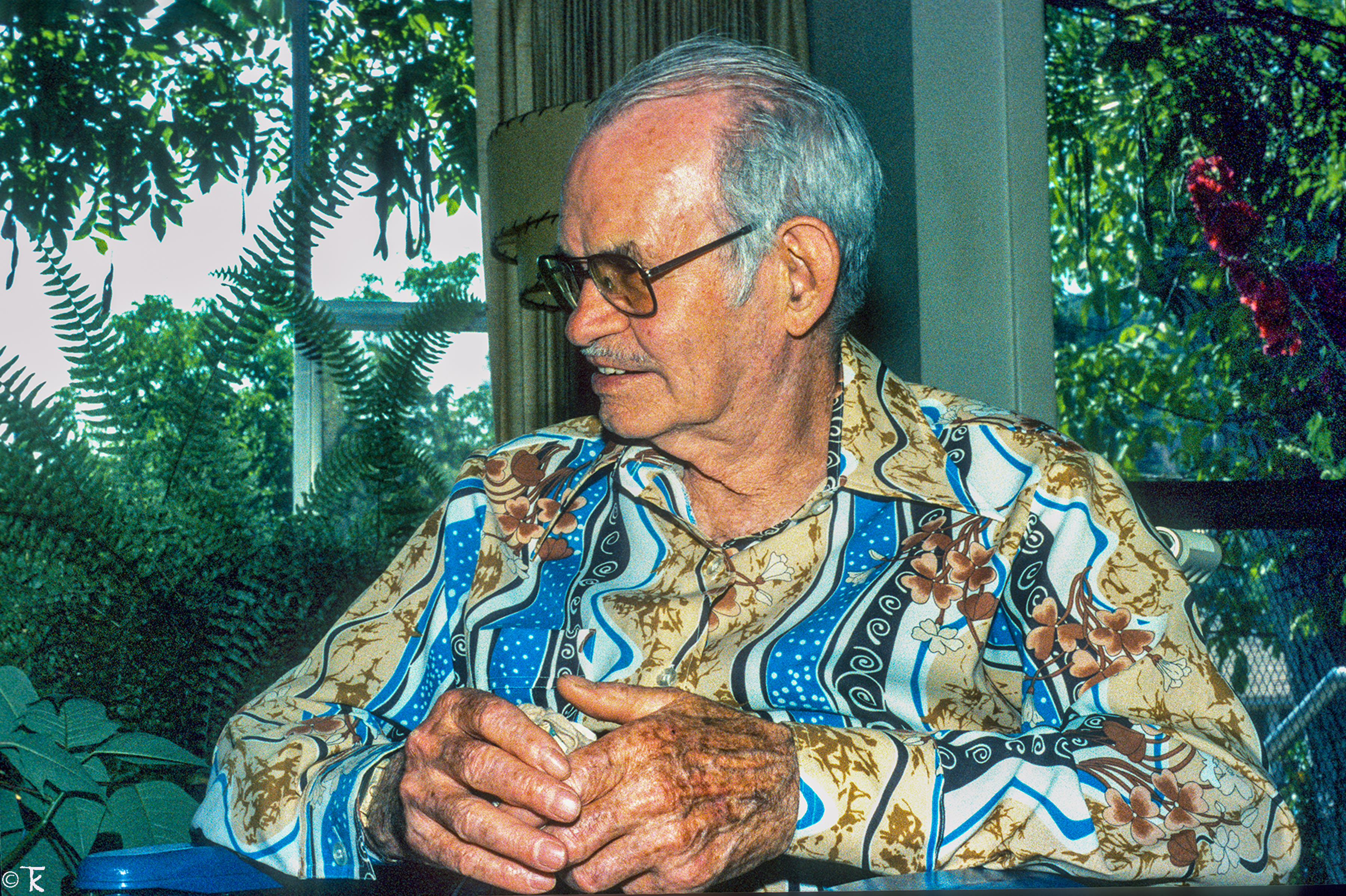
Ralph Denton
Regarding prostitution, one notorious “house of ill repute” was located at Yosemite Junction, below Jamestown, where Highway 120 veers south from Highway 108 toward Groveland. It was managed by a fellow named Dave Bonavia, a man well known for his involvement in such enterprises in the Mother Lode of that time. Bonavia was implicated in a couple of scandals that came to public light while I was living in Sonora. One involved gambling and was the downfall of a business collaboration between Bonavia and a fellow named Russ Rolfe, who at the time owned the Sullivan’s Creek Restaurant east of Sonora at the site of what is now the Peppery Gar & Brill. At issue was a smaller building uphill and behind the dining establishment that was attached to the restaurant by a covered walkway. This building housed a gambling enterprise, run by Bonavia, and, by virtue of it’s being physically attached to the restaurant building by the covered walkway, it led to the shuttering of the entire operation once it came to the attention of state authorities.
The other bit of scandal involved Bonavia and the sheriff at the time, a former Highway Patrolman named Mervin Mullins. Mullins, back in his state trooper days, was said by some to have been fond of forgiving truckers’ citations in exchange for a bit of cargo—say, a case of whiskey, etc. Later, after he’d become sheriff, Mullins was secretly tape-recorded having a clandestine meeting with Dave Bonavia on top of Myers Hill. While I can’t recall the subject of the conversation, its revelation caused a controversy that ultimately proved damaging to the sheriff and led to the end of his career in law enforcement.
It all seems so far away as I sit drinking a beer on this unseasonably warm November afternoon one hundred thirty-eight miles and a lifetime away in the spoiled and crowded wilds of Sonoma County. Twenty plus years living here haven’t touched the deep sense of familiarity I still feel toward the place where I spent my formative years. Some of the issues remain the same wherever one lives—traffic density, the disappearance of open spaces, over commercialization and the myriad problems resulting from the overemphasis on money that characterizes our culture.
I suppose every generation has felt some of the same things about the ways in which “progress” diminishes and cheapens our experiences by influencing the manner in which we interact with and relate to our surroundings. Every innovation seems to have its drawbacks and for every gain, something is lost. In the exchange, it’s usually the issues pertaining to quality of life that are the ones that suffer the most.
Yet, it’s in our nature as a species to want to reinvent the wheel, it seems, and each generation has its own take on how to go about it. The Roman historian Tacitus, in fact, lamented this process when he wrote his treatise, Germania, in 93 A.D.. The only constants, he noted, are that change will occur and money will be involved. Precedent is eyed with suspicion in this enterprise, and history is almost universally ignored or disregarded, followed eventually by the usual (but certainly not in all cases) homage to the wisdom of hindsight.
In the Sonora of my youth, for example, one needed only pick up the telephone and dial “O” to get another human being on the phone. These days, not only experience and patience are required before one can reach an actual person, but also luck, and oftentimes, even specific knowledge of phone extensions.
The fruits of this so called “progress” are both large and small and can be seen in a variety of places. There was a time, for instance, when the shopping carts in the supermarkets were gathered inside the stores where they were more conveniently accessible to shoppers. I remember this being the case at my local Save Mart in Sonora where I used to shop. One day, presumably after the folks at the corporate office realized they could make more room for product by moving the carts outside, the shopping carts were relocated outside the building with the explanation that the move was made “for your convenience.”
A much larger, and more egregious bit of commercial propaganda was pulled off successfully by the oil and gas industry during the so-called gas shortages of the 1970s. Before the first gas shortage, people were accustomed to getting their tanks filled with no appreciable wait time at the pumps. It was literally taken for granted that all one needed do was drive up to the pumps to get their tank filled. Then, OPEC held us hostage (or, at least, that’s what we were told) and the next thing we knew, people were waiting in long lines for their turn at the gas pumps and, rather than feeling resentful at the inconvenience, they were actually grateful they were able to get gas at all. And at an inflated price to boot! A fancy bit of social engineering, and one that didn’t escape the notice of people eager to capitalize on the “herd instinct” aspects of human nature.
Not one to miss a beat, Madison Avenue was watching, and gaining deeper insight into the power achievable through the regulation of supply. Coupled with the advantages to be exploited by preying on the naïveté of the young, and taking into account the diminishing supply, thanks to attrition, of older folks who knew better, it wasn’t long before it became almost impossible to reach an actual person on a corporate phone call. What had once been taken for granted had now become outside of common experience and, hence, mostly a thing of the past. And for whose convenience???
There were two movie theaters in Sonora when I was growing up. Both of them were within walking distance, each being less than 6 blocks from my house. Every few days, my parents would send me off with a couple of dollars in my pocket to go buy dinner at my favorite eatery, The Europa, followed by a trip to the movies.
The roast beef was great at the Europa, but my absolute favorite meal consisted of a hamburger and French fries, with a chocolate milkshake added from the Greyhound Bus depot next door. The milkshakes were made by Mrs. Ball, the old woman who ran the bus depot. Mrs. Ball made milkshakes the old-fashioned way, with real ice cream in an old-fashioned mixer that made more milkshake than the glass it came in could hold.
Mrs. Ball would deliver the milkshakes to the restaurant via a doorway joining the restaurant to the bus depot. To my delight, she always left what remained in the metal mixing cannister for me to finish. It was that little bit extra that made the meal all the more memorable.
I was sitting in that cafe drinking coffee one morning, years later in November of 1963, when Mrs. Ball walked through that adjoining doorway, ashen-faced and shaken, to announce, “they just shot Kennedy!”
***
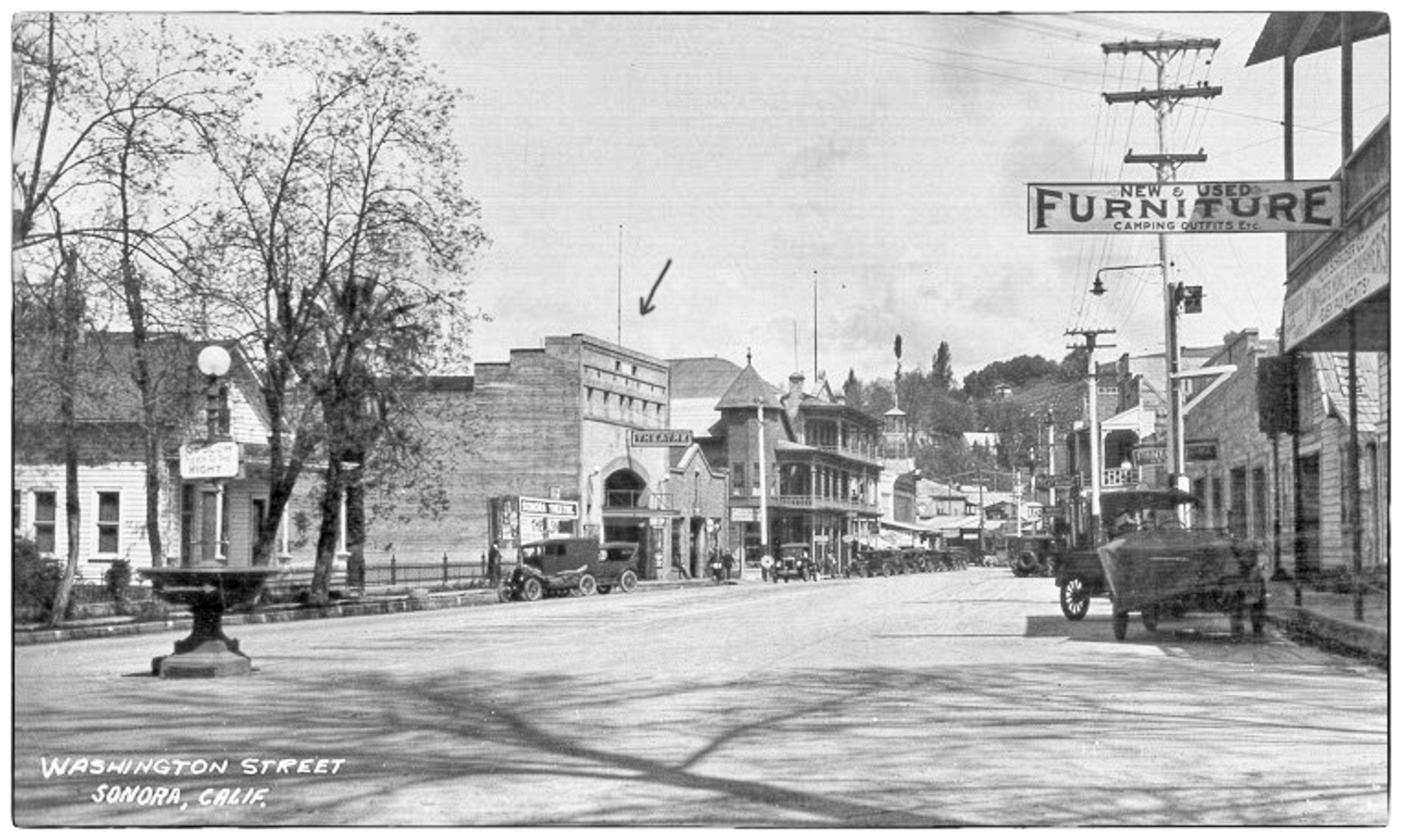
The movie theater nearest my house was by far the grander of the two. Named the Sonora Theater but popularly called the ‘Downtown’ Theater, it was situated where the Bank of America now stands. Much larger than the other cinema, it had an actual stage with curtains and even featured a band pit. There was an upstairs balcony and a loge section on the lower floor that was reserved for smoking. Wallpaper depicting Art Deco styled dancing figures was visible high on the walls lining each side of the auditorium—wallpaper my father had installed.
Sonora (Downtown) Theater (indicated by arrow). Date unknown
The ‘Downtown’ Theater was owned by Odillo Restano, a former mayor of Sonora. Restano was a dapper figure who, with his pencil-thin moustache, bore a striking resemblance to the actor Cesar Romero. The former mayor could occasionally be seen in the theater lobby, always impeccably dressed.
Two women, friends of my parents, worked at the Downtown theater. Doris Vars, widow of former Sheriff Don Vars, helmed the ticket booth, while Frances Ponce, a friend of my parents from their days living near Columbia, took the tickets from patrons and tore them in half as they entered the theater. The projectionist was Fred Dentone, a man who lived up the hill from us. I can still remember seeing Fred drive down the hill each evening on his way to work in his old 1953 blue Chevy.
Doris Vars was meticulous about her appearance. She had bleached blond hair she wore in a permanent and always applied enough makeup to insure she was doing her part to support the cosmetics industry. Doris drove around town in an old 50s era Cadillac. Shortly before her death, as if she’d sensed its approach, she drove her car to the funeral home and parked it in the parking lot while she sat and applied her makeup for the last time. Mortuary staff found her body later that day, make-up perfectly applied, ready to meet her maker in the style to which she had become accustomed.
Francis Ponce was married to Al Ponce, one of the operators of the fabled Stage Drivers Retreat saloon in Columbia. They had one son, Richard, who was my age. Richard was effeminate; to say he didn’t fit in very well with his peers was an understatement back in homophobic 1950s California. Richard and I used to play together in Columbia while my parents enjoyed a few beers now and then at the Stage Drivers Retreat. The lad was socially awkward and had a prickly personality, a combination of traits that impeded his attempts to build or maintain successful relationships.
It was Richard who broke the news to me in the fall of our freshman year in high school that one of our classmates had died of pneumonia brought on by a particularly virulent strain of influenza that struck the nation in the fall of 1957. Four years later, in our freshmen year in college, it was a different classmate, Jerry Moran, who informed me, that Richard had borrowed a pistol from his roommate and used it to take his life.
**
My recounting of the state of cinematic entertainment in Sonora in the 1950s is, as is readily apparent, not without the inevitable twists and turns that occur as one resurrected recollection slowly segues into the next. The tendency for thoughts to wander in this manner, like so many unattended sheep, calls for a refocused shepherding to restore the discourse to its original subject.
On the subject of movie-going in Sonora in the 50s, the admission price when I first started going to the movies by myself was 15 cents—a paltry sum by today’s standards.
Before long, the price had jumped to 35 cents, where it remained for a long time. Each theater only featured one screen. If multiplexes existed back then, I’d never heard of one. New movies would play each Wednesday and Sunday. Most of the time, they were double features—two movies for the price of one—and they always included a newsreel, a short feature film, and a cartoon or two.
The Uptown Theater was smaller, crowded into a narrow building, but it was deep and had more rows of seats than the Downtown. It also changed movies twice a week and often showed double features. The owner of that theater, Bob Patton, had some kind of special relationship with the folks at Disney because whenever a new Disney movie came out, he would show it before anyone else could. It was rumored that Patton had connections in Hollywood that enabled him, year after year, to screen High Noon—a famed Oscar-winning movie, from the year 1952, that was partly filmed in Tuolumne County.
Patton also hosted events in which a minor western movie star would headline along with a Saturday matinee. When I was quite young, I got to sit on Smiley Burnett’s lap at one such event at that theater. Years later, I attended another event there where a magician hypnotized the high school student body president and had him sing an Elvis Presley song while grinding his hips to the beat.
Years later, and long after Bob Patton’s time, the Uptown Theater was run by a fellow who turned down the thermostat in order to save money, creating conditions inside the theater that, as weather cooled, were better suited to preserving perishables than to maintaining a comfortable temperature for his patrons.
Once, while the theater was under the management of this individual, he advertised a special movie event for children that went horribly awry due to a film mix-up. Because of the prior publicity, the line of children awaiting admission to the event had extended down the sidewalk and up the side-street around the corner.
Instead of screening the film for kids that had been advertised, the projectionist ran a porno movie. As expected, there was considerable outcry over the mix-up. The local newspaper featured a big writeup about it and, not long afterward, the theater closed its doors for good.
In an early example of what can be lost when commercial interests succeed over quality-of-life concerns (a refrain heard all to often in Tuolumne County land-use decision-making), the Downtown Theater was eventually razed so the Bank of America could construct a new bank building at that location. The Uptown theater remained open longer and went through several owners before finally closing its doors, leaving the community without a movie house for the better part of the 70s. My first wife and I used to occasionally drive to Modesto during that period to go to a drive-in.
When I first moved to Petaluma in the late 1990s there was one theater multiplex in that town. In a stroke of irony, and as if history was repeating itself, the multiplex closed a couple of years after I arrived there, leaving no cinemas in town for a handful of years until a new one was developed downtown, thanks to the determination and perseverance of a group of high school girls whose refusal to accept defeat brought their dreams to fruition.
Before 1957, when a change in California law made it so that minors could no longer enter bars that didn’t serve food unless accompanied by an adult, I had begun to offer shoe-shining services to local bar patrons for the modest price of twenty-five cents a pair. I was thirteen years-old at the time and the idea of having a few coins to clink around in my pocket had begun to have a certain appeal to me. The inspiration for my undertaking had come from noticing how successful an enterprising school-friend had become at earning money shining shoes. He had graciously agreed to share with me the secrets of how he’d started his venture.
In the 1950s, the nation’s attitude toward alcohol consumption, like that surrounding smoking, was one of acceptance. Everyone, it seemed, either drank alcohol or smoked cigarettes or did both—in the movies and in everyday life, inside auditoriums, in restaurants, on airplanes, in homes, in hospitals. Even the president smoked!
Beer commercials and cigarette advertisements were displayed on billboards, in magazines and newspapers as well as broadcast over the airwaves. The use of these substances was equated with “living fully,” as if their use magically conferred upon the user a sense of well-being unattainable through ordinary means, an approach seen in beer commercials even today! The public discourse of the time did not include any appreciation for the health concerns inherent in alcohol abuse or cigarette smoking. What little concern was voiced about the health risks of those substances was actively suppressed or quickly discredited.
In the Sonora of that time, the number of taverns and bars lining Washington Street exceeded the number of churches serving the community’s faithful. This meant opportunity abounded for enterprising young people willing to do their part to combat shoe-neglect among the alcohol-aficionados lining the town’s barstools. Upon discovering that bar patrons, some likely out of bemusement, seemed okay with the idea of helping a kid make a little change, I found enough takers to maintain my interest in sticking with the enterprise.
One fellow, an obvious trickster, threw me a curve one afternoon when, after agreeing to a shine, he revealed the shoes he was wearing were white tennis shoes. While the joke was on me, I quickly located a source for a type of shoe treatment designed to spruce up white tennis shoes and added a can of the stuff my shoe-shine kit so I would be prepared the next time someone tried to pull that trick on me.
Just when I thought things were going somewhere, however, the law was changed and I was no longer allowed to enter those establishments, effectively cutting me off from access to my former customer base.
At that time, I already knew more about the bar culture in Sonora in the 1950s than a child my age should have known. My parents, frequent patrons of the local watering holes, would often bring me along when they went out drinking, buying me grenadine-laced soft drinks to solicit my cooperation and maintain my interest. It was thus that I learned, early on, that a Roy Rogers without ice (balls) was a Shirley Temple and a Shirley Temple with cherries was a virgin version of that well-known concoction. Of the half-dozen or so drinking establishments lining Sonora’s main street in the 50s, I knew the bartenders by name in all but one of them.
The one exception to this routine was the sole saloon my parents never visited, at least when I was with them. Called, ironically, The Louvre—ironic since the folks who patronized the place bore little resemblance to art aficionados—the decorative motif of its interior might best have been described as Slaughterhouse Chic, as I’d discovered when, after my 21st birthday, I’d visited the place to satiate my curiosity.
On display spread across the dimly lit wall behind the Louvre’s long bar were a series of sprawling age-yellowed photographs portraying large, open pits into which had been thrown dozens of dead livestock, animals that had been shot to combat an outbreak of hoof and mouth disease that had ravaged the county in the 1920s. The images depicted were raw, brutally honest and difficult to observe without becoming overcome by their sobering bluntness and sad sense of loss.
The general vibe of starkness, shadow and simplicity inside the Louvre was complimented by the total absence of the sort of adornments commonly employed in such places to make people feel welcome. Upon reflection, I wondered if the depressing décor of the place, and especially its “artworks,” played a role in why my parents never took me there. I couldn’t imagine my mother would have felt any more comfortable than I did sitting at that bar beneath the stultifying spectacle of those soul-deadening photographs staring down from the dingy, cobweb-laden shadows looming high above.
Where the Louvre was concerned, the irony didn’t end with its naming!
Having grown accustomed to the company of my parents and their friends and drinking acquaintances, I found myself more at ease with adults growing up than I was with my peers. My mother was 33 and my father was 37 when I was born, which was a fair bit older than the parents of most of my classmates.
While my peers’ fathers engaged in various activities with their kids, taking them skiing, coaching sports, etc., my dad did few such things with me. He took me fishing sometimes, but I wasn’t very good at it. He took me hunting a few times, but most of his hunting days had taken place when he was in his 20s. He took me on a couple of memorable hikes, but their principal distinguishing feature was their rarity. And so it went. As a provider, my father was peerless; as an engaged father, he was busy working more than I would have liked. I found myself envious of classmates’ fathers who would spend more time doing things with them.
In addition, although I was the third child in the birth order, I grew up in effect an only child. My older brother was still-born and my sister only lived 18 hours. My closest cousin, emotionally speaking, lived 3 hours away and we only got to see each other every 6 weeks at best. With no siblings with whom to bond, and no kids in the neighborhood my own age, I had much more exposure to adults growing up than I did other children.
The opportunity to observe my parents interacting with their friends and acquaintances in the local taverns broadened my sense of their world, insofar as such exposure can inform a mind still in process of development. The downside of accompanying my parents on their drinking and socializing outings was the unintended effect the normalization of that behavior had on my young and impressionable mind.
For years afterward, I believed it was my “duty” somehow to carry on the “family tradition” of holding up bar stools in dimly-lit dives spending too much money consuming substances that never really agreed with my physiology in the first place. Whether this twisted logic was borne of a naive misunderstanding of what being authentic looked like or was merely a means of justifying self-destructive behaviors, it took me years to tease apart and disarm the maladaptive thoughts and feelings that sustained it.
At some point, though, in the manner of wisdom teeth, some bull’s horns eventually grow out, while others never do. I’m thankful that, whatever the reason, I belong to the former group.
Our neighborhood was a mostly friendly place for a child to grow up. We knew most of our neighbors, many of whom remained in the neighborhood for years.
The neighbors uphill from us, Josie and John, were like family. John was enjoying his retirement after laboring for many years doing railway maintenance for the West Side Logging Railroad out of Tuolumne.
John was born in Edinburgh, Scotland, and said he’d come to America because there’d been no opportunities in Scotland for a young man to get ahead. His fair complexion had not fared well against the relentless California sunshine whose effects necessitated repeated trips to the doctor for the surgical removal of skin lesions that are routinely frozen off by dermatologists these days.
Josie had emigrated from Italy, or what she called “the old country,” when she was a young woman. A pious person with a lifelong devotion to helping others, Josie seldom ever spoke ill of anyone.
Once, while telling me how her eldest son had died fighting in the Second World War, Josie had shocked me when she’d sworn in my presence, referring to Benito Mussolini, Italy’s then head of state, as a “son of a bitch.” She’d been showing me an old newspaper clipping at the time that pictured Mussolini and his “prostitute” girlfriend, as Josie called her, hanging upside down, their remains on public display following their murder at the hands of an angry mob while trying to escape the advancing Allied Forces during Italy’s defeat.
Swearing was very out of character for someone like Josie, but it seemed entirely appropriate given what the war had cost her.
For many years, my parents would get together with Josie and John on Christmas mornings to share shots of whiskey.
Bertha and Carlton, the neighbors across the street from us, were also friendly people who contributed to the overall harmony of the neighborhood. Both Bertha and Josie exchanged greeting cards with our family on special occasions.
My mother didn’t socialize much with Pat, the neighbor downhill from us. Her husband, “Tar,” was a warm and friendly man who grew an impressive vegetable garden in his backyard every year, but he left it to his wife to arrange their social calendar.
Pat had never forgiven me for having kicked her in the shin with my cowboy boot when I was around four years old. Even though I have no recollection of the act, that didn’t stop Pat from reminding me of it periodically for decades afterward. Every time she did so, her reminders always bore the sting of indictment.
Following that event, battle lines were drawn, at least as far as Pat was concerned, that would remain in place for the duration of our acquaintance. The atmosphere during that time along the area bordering our yards was best characterized as tentative, semi-frigid and unwelcoming.
Pat was one of those people who despised clutter, a proclivity that manifested in her yard as well as her house. Tar had planted two fruit trees in their front yard to shade their house from the afternoon sun. Just about the time the trees had grown tall enough to begin providing shade, Tar died suddenly of a heart attack while fishing in the mountains with his brother-in-law.
Tar was only in his fifties, and Pat was angry at her husband for having died and left her alone—something she never forgave him for. One of her first acts after his passing was to have the two trees he’d planted cut down to prevent having to deal with the inevitable leaf-litter she knew would descend on her domain and disturb her sense of order.
What Pat couldn’t do, however, was control the course of the leaves that, floating on the breezes like fractal confetti, insinuated their way from our yard, or from the walnut tree that then grew beside Bertha’s house across the street, to hers.
While some may find the feuille morte of autumn leaves comforting, nostalgic even, Pat was not one of those persons. This uninvited vegetable matter was a source of annoyance for Pat and became the target of her rapid-response-team approach to leaf eradication, prompting my father to share the mental picture he had conjured of her, rake in hand, standing at the ready lest some errant and offending leaf should dare to transgress her sovereign territory.
For years after my father’s passing, Pat periodically grumbled at me over the leaves from the trees in our yard that would, in spite of her best efforts, succeed in obeying the laws of gravity, bedeviling her efforts to control her environment as they deepened the frown lines in her face.
But sympathy failed to bridge the chasm of miscommunication that existed between us, and Pat’s solution to the leaf business—removing the offending trees—was, for this tree-loving person, too drastic a move to contemplate, much less employ.
The experience of growing up in Sonora, a charmingly small town in the Sierra foothills of northern California, contributes significantly to the “constant nostalgia” that spins around in my head.
To quote from Orhan Pamuk, in his tribute article in the November 1, 2018 edition of the New York Times, honoring the late Turkish photographer, Ara Guler, “For those who, like me, have spent (a long time) in the same city, the landscapes of the city eventually turn into a kind of index for our emotional life. A street might remind us of the sting of getting fired from a job . . A city square might recall the bliss of a love affair . . An old coffeehouse might evoke the memory of our friends long since gone.”
Such is my experience when I return to Sonora—a place now much different than it was in my formative years, but loaded nonetheless with memories waiting to be resurrected at the slightest provocation.
A walk down most any street in Sonora will elicit, for me, an outpouring of memories whose mental imprints often span decades. The chronicle of experiences thus recalled serves as a veritable history of personal development and transformation, anecdotally defined by the events, large and small, that influenced and helped to guide my becoming.
Histories of places usually focus on descriptions of locations, events and timelines. They seldom pay much notice to the internal dialogues of the places’ inhabitants, those aspects of the story being considered capricious, or unreliable, shaded as they are by emotions, making them unverifiable and therefore not worthy of inclusion.
But this is not a history of place so much as it is a history of personal experience of place, a chronicle of becoming, a tale of metamorphosis, a transformation from youthful naivete to, if sophistication is too generous a descriptor, a more seasoned understanding of what the business of living is all about.
Therefore, the act of strolling by a house is apt to stir memories not only of the people who once lived there but also of different interactions I had with them over the years, including the flavor and tenor of those interactions and the impact they had, for better or worse, on my developing psyche.
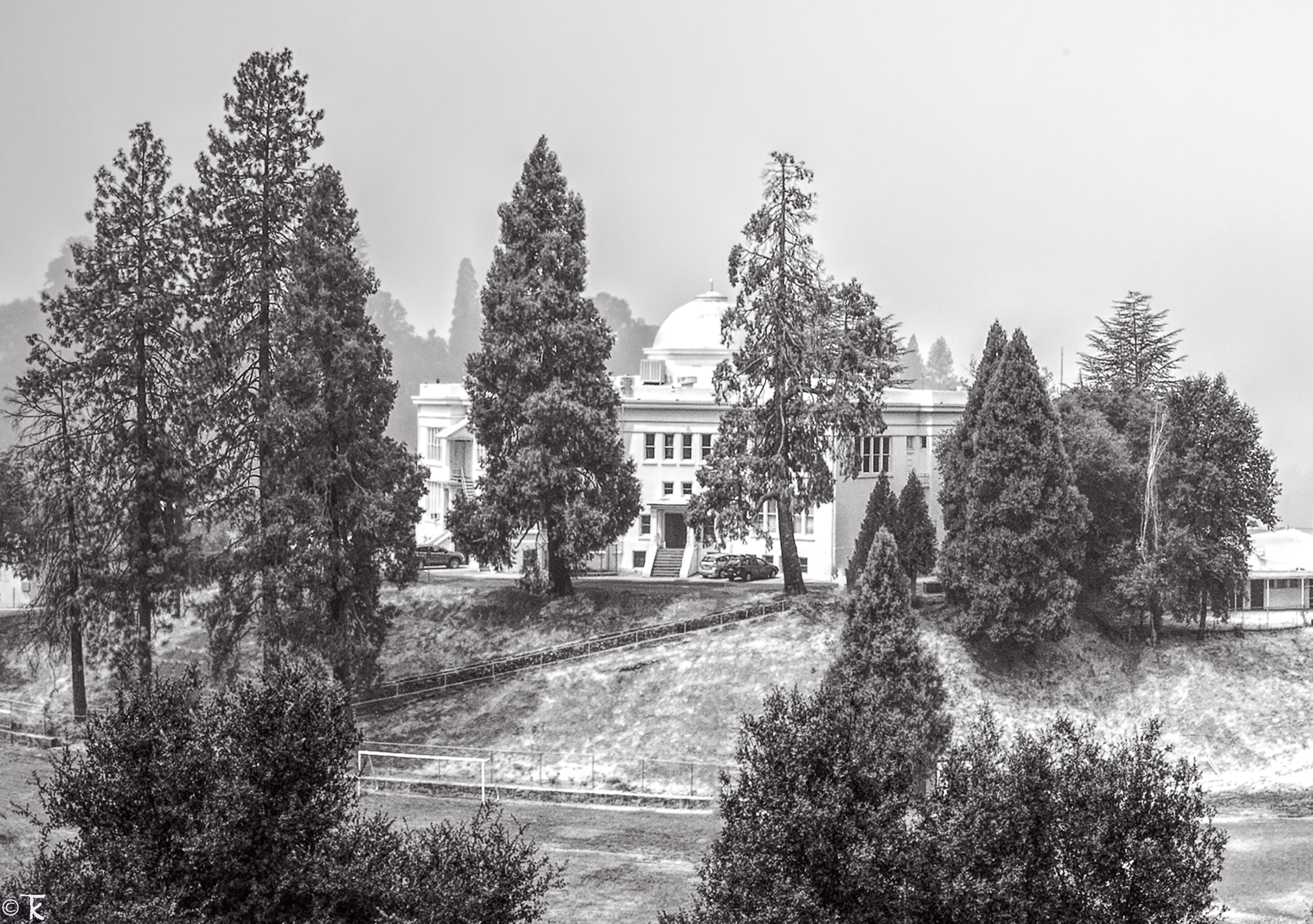
The “Dome” as seen from the east on a smoky day
A walk to the old “Dome” where I attended grammar school might elicit a flood of memories spanning the nine years I spent there between kindergarten and eighth grade—memories such as being kept after school over mischief by my 4th grade teacher, more often than I’d like to remember, when it was time to go to cub scouts, or fonder recollections of going fishing on Saturdays with my sixth-grade teacher, or having an eighth-grade teacher who moonlighted as a disk jockey at the local radio station and would let us submit requests to dedicate songs we wanted to hear on his show.
And then there are the not-so-happy memories from grammar school, like not raising my hand to avoid appearing stupid when I didn’t understand certain of the more arcane nuances of long division. Or being struck across the face with a whistle-strap by Mrs. McCormick, a teacher some thought was the devil’s spawn, while I sat on public display on “the bench”—a mid-50s variation of the pillory used during the middle ages to utilize public embarrassment as a disciplinary response to, in my case, some long-forgotten infraction.
Another recollection reminds me of the seminal decision I made in 5th grade, after being repeatedly befuddled by the hellishly difficult exercises unnecessarily inflicted upon us in the quest to teach us the ponderous science of sentence diagramming. It occurred to me that I could simultaneously end the torture and put that time to better use by tuning out the teacher and gazing out the second-story window, imagining I was soaring above the landscape on a flying carpet.
Choosing to follow my own course in this particular matter, while it allowed the finer points of sentence diagramming to forever languish in obscurity—arguably not a bad thing—did not appear to hamper my ability to construct complex sentences, and the lesson I gleaned from that experience concerning my power to choose where to focus my energies, and where not to, has been of far greater benefit to me over the years than any amount of sentence-diagramming expertise could ever have.
I employed that same strategy when burdened in high school several years later with the task of learning income tax preparation. To this day, the mere mention of W-2 forms makes my eyes glaze over and my brain go tilt like a pinball machine in an earthquake. After all, there are knowledgeable and qualified people available who are perfectly happy to act as surrogates when it comes to such mundane matters! Some of them, I am told, even enjoy doing so! And, while I can’t imagine how anyone could find pleasure in such mind-numbing pursuits, I say, let them do it!
It’s not as if I’m against learning. Far from it! It’s just that, pragmatically speaking, there is far, far more knowledge in the world than any one individual could ever absorb in a single, or even a handful of lifetimes. Knowing where to place one’s energies to greatest effect, therefore, seemed only prudent to my young sensibilities, as it still does today.
A walk down the hill from the “dome” might take me by the home once occupied by the town’s official librarian, Miss Mae Kelly. Now a bed and breakfast, I did some painting work on Miss Kelly’s house back in the 70s. A spinster and a prim and proper person accustomed to the formalities common in her youth, she’d insisted, when it came time to pay me, that I join her in her kitchen for a shot or two of whiskey, straight from a shot-glass.
In a similar manner, Carlo Sardella, uncle to famed local sheriff Miller Sardella, insisted I join him and his wife for drinks upon completion of a paint job I did for them, also in the 70s. Carlo and his wife lived over behind the old county hospital in the section of town formerly called “Little Italy.” Carlo’s drink of choice was red wine that he made personally in his basement from grapes grown in his front yard. The area around Carlo’s basement was teeming with fruit flies drawn by the pervasive background aroma of fermenting grapes. The wine he produced, which was served in old, recycled Welch’s jelly jars, made up in potency for what it lacked in flavor; two glasses of the stuff made you unsafe, not to mention illegal to drive.
And then there was the abandoned store front, between the red church and the high school, where I and some other students witnessed, on our way to school one morning, an oversexed monkey liberally spraying the large window separating us with his seed, embarrassing the Methodist minister’s daughter as she passed by pretending not to notice.
Walking about town, memories such as these present themselves, revealing, like exposed strata, layer upon layer of recollections from various points in my life, all clambering for attention in a cacophonous concerto of nostalgia-empowered and nuance-infused memorabilia and noteworthiness.
Our power went out last night. Not sure why. A Nixle Alert told us there was a downed power pole somewhere across the freeway. The power company estimated a 9:00 pm restore time that turned out to be overly optimistic. When that didn’t pan out, we turned in early, hoping the morrow would bring a fresh supply of electrons to power our peripherals.
It struck me as odd to realize the similarities between the power outage and being without power in our Airstream during our recent trip up north, and yet it felt quite different, qualitatively. During our travels, we were unable to connect with outside power because of an undiagnosed electrical problem. We still had lights, thanks to our solar array, but we had no heat, no tv, none of the other conveniences we were accustomed to back home.
Yet we were happy nonetheless, swept up in the unconventionality of being in new and unfamiliar places and the novelty of our first big-miles adventure in our cylindrical silver road-ship. Being a little inconvenienced was just part of the package—something we willingly and cheerfully accepted.
But being home, where such comforts are routinely taken for granted, was a different story. The furnace wouldn’t work without electricity to power the pilot thermocouple and the temperatures had dropped over twenty degrees from the previous day‘s high. The cold seemed somehow colder than it had on our trip. Ironically, we were reluctant to open the refrigerator because we didn’t want to squander what frigidity remained inside, not knowing how long the power would be off.
And the tv . . .Television is a thing we’ve never associated with camping. The fact the RV camp neighbors we camped beside on our trip were almost universally plugged in elicited only faint traces of envy when we spotted a screen sporting slivers of light and movement. Yet at home, where the television, for good or ill, has become an object of daily dependence, I found myself at a loss. Reading by candlelight lacked the appeal it once had, and I’d left the lantern in the Airstream after our trip.
What, I wondered, was the missing ingredient that turned one situation into an adventure while transforming another into an ordeal? Granted, the two situations weren’t exactly analogous to each other, but they weren’t that dissimilar either, especially when comparing their respective pluses and minuses.
The thing that made the difference, that magic something that made mud into mud-pies, must have been the make-do attitude we’d adopted on the trip—the willingness to make the most of whatever came along, come what may. It was that little shift in perspective that made the inconveniences we experienced on our trip not so inconvenient, the cold less frigid-seeming, the rain a blessing and not a curse and the sunshine all the more glorious.
Easy to do when the view outside your window changes each morning. Maybe less so when it’s the same, day after day. But, as they say, it’s not about what happens to you, but how you deal with it that counts.