sonora2sonoma

  • A public display of a different sort was the Sign House. This was a house on a different back street that was liberally adorned with signage sourced from roadsides, residences, businesses, and the like.
    Literally anything interesting, attractive or different was considered fair game.

    The fact of the mere existence of the Sign House attested to the unique nature of the Alaskan mind-set, where eccentricity was not only accepted but celebrated. This spirit was portrayed authentically in the early 90s in the tv series ‘Northern Exposure.’ The residents of the Sign House were hailed in some circles for the boldness they evidenced in how they made their acquisitions and for their shamelessness in the manner in which they displayed the fruits of their re-appropriations.

    It was almost expected of the residents of the Sign House that newly erected signs about town would sooner than later (often sooner) turn up as the latest addition to adorn the house’s exterior. A recently-erected dentist’s office sign, cleverly centered around the cheery image of a floating bicuspid, had just made its way to the Sign House a few weeks before my arrival where it sat, proudly displayed amongst the myriad other signs, for all the world to see.

    ***

    The absence of zoning meant it was common, as in Mexico, to see newer and more affluent homes sitting adjacent to older, more humble dwellings. The people, similarly, seemed to have no airs about them of the sort commonly found within communities “outside,” which was another term used by the locals to denote the contiguous United States. The homogenous character of Nome society I found to be refreshingly hopeful, for it attested to what people could accomplish when they pulled their heads out of their derrieres and treated each other with the respect and kindness due them.  

    That sensibility seemed ingrained in the character of the people who lived there. The police, regarded with wariness in certain circles back home, answered to a different sense of purpose in Nome, one characterized more by a focus on helping people than arresting them.

    Survival in a hostile environment called for a greater degree of cooperation from all involved parties than might be necessary in forgiving climes. The police were valued more as a helpful resource than a display of force. Patrols responded to calls for help as often as they did to reports of criminal activity. Such reports as were received frequently involved violations of fish and game regulations.

    By way of illustration, I witnessed an incident one night at the town’s premiere watering hole, the infamous Board of Trade Saloon, owned by Nome’s equally infamous Jim West, who owned many of the town’s rentals. A group comprising members of the town police force, state troopers and fish and game officials had been assembled for  a dinner party celebrating the birthday of one of those present.

    An inebriated middle-aged woman with fake blonde hair was sitting at the bar, twenty or so feet away from the table where the officers were gathered. Beside her sat an obviously inebriated Inupiaq man of similar age. They were said to be a couple by another bar patron who claimed knowledge of them.

    Before long, an argument broke out between the two as the man, obviously incensed, began shouting epithets at his partner. His shouting soon grew loud enough to draw the attention of the officers seated nearby.  

    Seeming initially reluctant to become involved, one of the officers, a town policeman, walked over to the couple and attempted to calm the fellow down. This gambit succeeded for a short time only, as the man soon resumed his tirade. As the man’s voice increased in both pitch and volume, the officer returned to where the couple was sitting and again attempted to abate the situation, this time taking the man aside and delivering him a warning to calm down.  

    For a brief period, it seemed, the officer’s intervention was successful. The respite was short-lived, however, as the man soon began pursuing his grievance against the woman with increased intensity. This time the officer took more forceful action, ordering the man, having been forewarned, to leave the premises immediately.

    A minute or two later, the man, re-entered the saloon, walked up to the woman, and struck her on the side of her head. Having clearly crossed a line this time, the man’s action occasioned an immediate response from not only the original respondent but several other of the officers as well, all of whom who sprung from their chairs and surrounded the man, escorting him, squirming and protesting, off the premises and, presumably, to somewhere where he could do no further damage.

    While reluctance to disturb the dinner party may have been a motivating factor for the initially forgiving approach the officers took to the couples’ quarrel, it also spoke to the general tendency of the authorities in Nome to refrain from immediately resorting to arrest and incarceration as the solution to all matters in need of police involvement.

    Tim Konrad

    (To be continued . . )
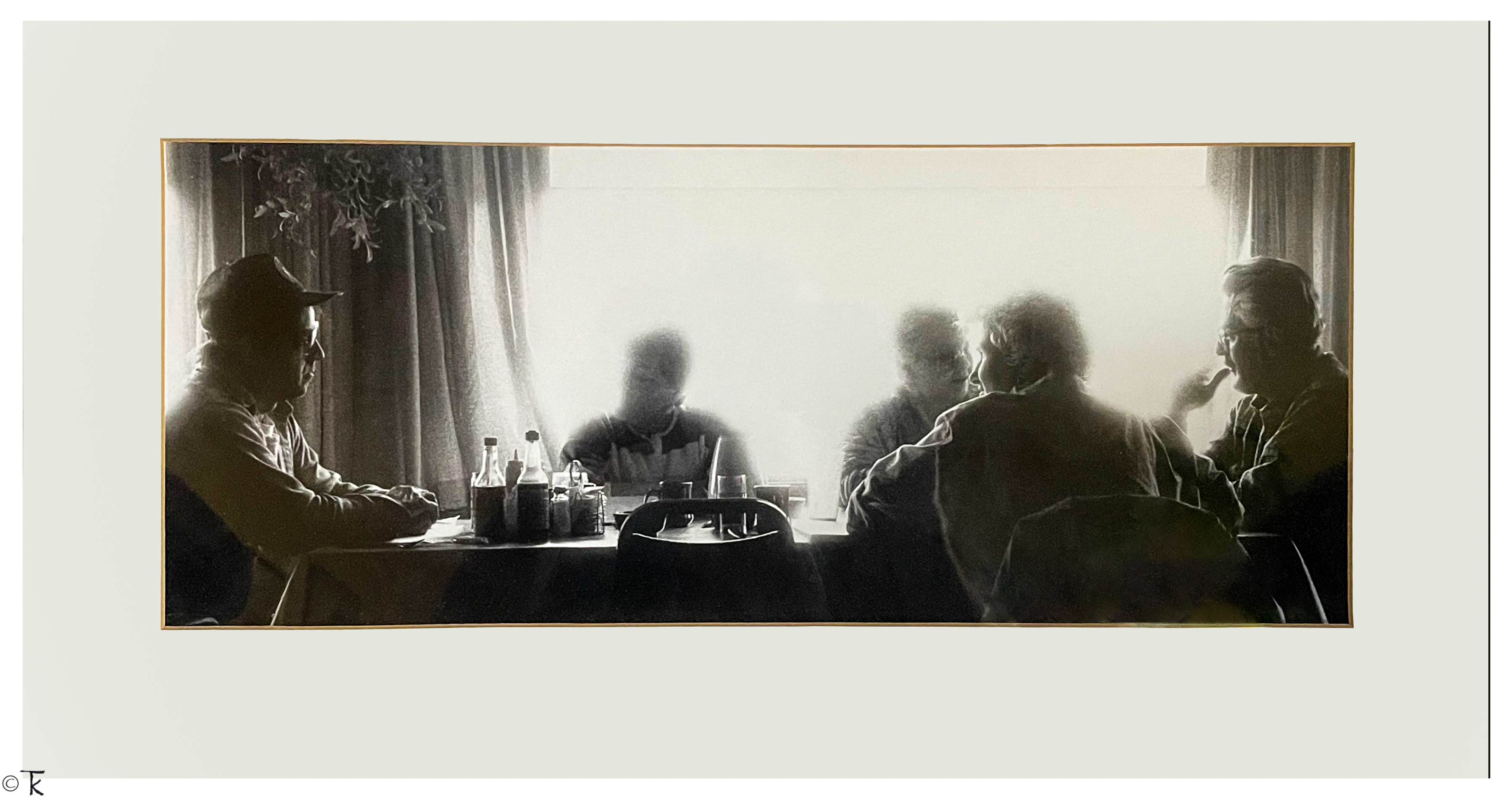
  • From Part Nine, the photo of the dredge that became a different image entirely:

    Brunch at Fat Freddie’s ©1981-Tim Konrad Photo

    It was common among the men I encountered in Nome for them to sport beards whose mustaches were adorned with icicles hanging, drape-like, beneath them when they were outdoors. The frigid temperatures caused noses to run while simultaneously freezing the resulting runoff. It wasn’t an alluring sight!

    I approached the matter with much more understanding, however, the first time I caught a glimpse of myself in a mirror after having been outside. To my dismay, my mustache, too, was glistening with crystallized rivulets cascading beneath it.

    Proof of gravity, I mused, taking comfort in having just learned that our commonality of affliction meant my initial shock at the realization I was now “in the club,” so to speak, rendered the whole matter moot.

    It’s difficult to be embarrassed over how you look when everyone else looks the same way.

    ***

    Not only does the sea freeze in Nome, and mustaches begin to resemble stalactites, the town sits north of the tree line. Before going there, it never occurred to me to wonder about such things, but it turns out species’ habitable zones are defined not only by altitude, like they are in the Sierras, but also by latitude. As far north as Nome sat, the permafrost proved too dense for the roots of deeper-rooted species to penetrate.

    Owing to the permafrost, the tree line in that region of the Seward Peninsula ended a short distance north of White Mountain, about 50 miles south of Nome. Beyond there, the permafrost had an out-sized role to play in determining which plants could survive the harsh climate.

    As my visit lengthened and Christmas drew nearer, I was surprised to see Christmas trees being imported for sale. It struck me as ironic, given the millions of evergreens in the state, until I remembered the reason. Thanks to climactic conditions, purchasing a  tree just as one might do in Albuquerque or Atlanta was the only means by which a person could come by one.

    It struck me as typically American, in a sad sort of way, that the people of Nome had to obtain their Christmas Trees via commerce much as people in big cities acquired theirs.

    ***

    One day, as I was driving around the back streets of Nome, I turned a corner and, without warning, spied, scrawled across the side of a shipping container in huge, crudely crafted, bright yellow letters, an announcement that read “I f***ed Jane Doe.” I can no longer recall the poor girl’s actual name, but wouldn’t use it here if I could. Suffice to say the indelicacy of the update was compounded by the shock value engendered by the ambitious manner in which it was displayed.  

    More a thing one is likely to find inscribed on a bathroom wall in a sleazy bar than on a shipping container in a residential neighborhood, I wondered how it must have felt for the poor girl’s parents when they first laid eyes on it, for they almost certainly did, since the Nome of 1981 still had, in many ways, a small-town feel about it.

    Whether unimpressively boastful, grossly insensitive, childishly stupid, or all three, such adolescent displays are not, it seems, limited to modern times. Whatever yearnings these messages seek to fulfill, that urge existed long before our time. Among the ancient artifacts unearthed by archaeologists probing the ruins of Pompeii was a bit of graffiti scrawled on a wall that read, “I screwed the barmaid.”

    Tim Konrad

    (To be continued . . )

  • Recalling details of places been and things seen near 40 years ago presents its own set of challenges, not the least of which is accuracy of reporting. While my goal here is to represent my recollections as accurately as memory will allow, that accuracy has definitely been impacted by the burden placed on it by the growing number of years my long-term memory has been expected to account for.  

    Memory is a double-edged sword: the price we pay for the luxury of forgetting the sting of painful episodes is the annoyance and frustration of learning to cope with undesired lapses of memory. If anyone with knowledge of the topics detailed in my account should find erroneous details sprinkled about, please know they are not the result of poetic license so much as faulty memory.

    ***

    Terry and I were enjoying a long lunch together on a typically gray afternoon at one of her and Dave’s favorite eateries, a place called “Fat Freddies.” The diner featured large picture-windows aimed seaward from which could be seen the re-purposed tin dredge that sat at anchor a couple of miles offshore. The talk of the town when it had made its debut, the contraption rose several stories in to the sky, making it visible from afar.

    In fact, the dredge was the first thing that had come into view when Dave and I had flown in from Anchorage and Dave had proclaimed, “We’re almost there.” From 30 or so miles away, the outline of the crane’s derrick could be seen rising from the greyed-out horizon long before the town’s buildings had come into view.

    The dredge was a hub of activity. Helicopters could be seen twice daily ferrying workers to and from the site at 12-hour intervals. There was no absence of applicants for positions, the  good pay luring workers despite the long shifts. With commitment and perseverance, a man so inclined could earn enough money to accumulate considerable savings over time.

    The dredge had been towed across the Pacific all the way from Singapore, where it had originally been utilized in a tin-mining operation. The sight of the device, looming large in the distance, had been the  source of much speculation and rumor since its arrival.

    Being situated offshore meant this dredge was working gravels that hadn’t been accessible to the earlier miners. The gold yielded, therefore, was more plentiful than that recovered by the land-based operations.

    The table at which Terry and I were seated during our lunch was set back 15 to 20 feet from the picture window. Another table, at which a handful of people were enjoying a meal, sat beside the window, directly between us and the view outside.

    I’d struck on the idea of composing a photograph showing the dredge framed by the window in order to create the feel of peering outside through a portal. For my idea to work, however, it required there be no people in the foreground. Not wanting to bother them, I decided, with Terry’s generous acquiescence, to see if we could wait them out, hoping they would soon be finished and on their way.

    The diners had other thoughts, apparently. As their gathering drew on past the two-hour mark with no  signs of wrapping up, I began setting up my camera on a tripod where I could operate it while remaining seated at our table in order to not appear too obvious. When, after a while, the diners remained engrossed in conversation, I began taking some preliminary shots to obtain the correct exposure and desired composition.

    I had decided to use black and white infra-red film for the project, wishing to create an artful, dreamy look.  

    In 1981, it must be noted, digital cameras, like cell phones,  were still a thing of the future; the instant gratification afforded by them was, though longed for, something still in the realm of dreams, or science-fiction. The best one could hope for was, by skill and planning, a correct exposure could be obtained. The uncertainties were compounded when using B&W infra-red film, since achieving the correct focus while working with the longer wave-lengths of light associated with that medium was more a matter of art than science.

    With the window-diners firmly ensconced in their positions, and not wanting to inconvenience Terry any further by remaining still longer, I decided to aim my camera at them instead, hoping that the stopped-down aperture would allow enough light to record the  presence of the dredge rising beyond them in the distance.

    When all was said and done, the dredge did not appear in the resulting images, but the best shot achieved my goal of capturing a photograph with the dream-like look I had envisioned.

    Tim Konrad

    (To be continued)

  • Dave had kindly arranged for and accompanied me on a tour of the larger of the land-bound dredging operation a couple of miles west of town.

    Being a life-long “left-coaster,” my sense  of direction was continually challenged by the geography of Nome. The Seward Peninsula juts so far westward from the rest of Alaska that, at it’s extreme, at Point Barrow, a mere 35 miles of water separate it from Siberia. Nome is situated on a coastline that is predominantly south-facing—a difficult thing to reconcile for a person accustomed to seeing the sun set in the west.

    Getting a tour of the dredge was a fascinating experience. I’d heard of dredges when, as a youth, my father had told me about them and how they were responsible for the rows of neatly piled rocks still visible in certain places along the Tuolumne River and elsewhere in the Mother Lode region where I grew up.  By the time I’d come along, the dredges were long gone, having been dismantled and hauled off as scrap metal during the Second World War. But I’d never actually seen a dredge before.  

    Dredging is, unlike traditional hard-rock mining, a placer operation similar to gold-panning; both seek to retrieve gold that was separated from its native rock by natural forces in prior geological epochs. Gold-mining as employed by dredges such as those in Nome amounted to gold-panning on an industrial scale.

    The dredge we toured retrieved gold from the ground by means of a huge conveyor-belt apparatus supported on a derrick and equipped with large bucket-like scoops that were inserted to depths ranging from 50 to 65 feet into the earth to in order to gather up material and bring it to the surface, where it was then sorted with pressurized water in large sluices to separate the gold from the surrounding muck. After the area immediately adjacent to the dredge was worked out, the entire apparatus was moved to a new location where the process began anew.

    The dredges were working the same plain the early miners worked in the Gold Rush of 1898, only in those days the gold was reached by tunneling down to the ore-bearing strata hidden some 50-plus feet below. The dredges at times encountered some of these early tunnels, snagging in their buckets bits of track, ore cart and other paraphernalia left behind.

    Before a dredge could penetrate the permafrost, it first had to be thawed out. To do this, tracts of land designated for subsequent mining were equipped months beforehand with a matrix of pipes inserted deep in the earth and lined with perforations to allow steam to be pumped into them to soften the surrounding material.

    When it came time to move, the entire apparatus was winched along on skids to its new location. The areas the dredge had worked previously were identifiable by rows of neatly piled rocks similar to  those I’d seen along the rivers back home—the detritus of industrial-scale mining operations.

    Permafrost isn’t something people in California would have occasion to experience. Encountered chiefly in polar regions, permafrost is a thick sub-surface of soil that essentially never completely thaws out. The implications of this can be profound, affecting the surrounding vegetation in dramatic ways. The  frozen   ground limits the coexistence of trees except in places where hot springs have softened the soil.  

    Permafrost also affects the placement of buildings: As the spring thaw softens the soil’s upper layers, undulations result that wreak havoc on their foundations. To counter this, the older houses in Nome were set to rest on large beams supported by piers set atop the ground. This allowed the houses to be adjusted back to level in the springtime through the use of hydraulic jacks.

    By way of illustrating the folly of ignoring the physics of fluid dynamics, one overly-optimistic individual had erected a structure with a cement foundation on the east side of town a few years before my visit. Jutting perilously aslant and unusable, it stood as a silent yet graphic commentary on the do’s and don’ts of tundra settlement.  

    Tim Konrad

    (To be continued . . )  

  • Ship of Fools

    It’s at once tragic and perplexing to witness the same cycles playing out over and over again in our politics and in our economic policies here in the United States. We currently appear poised on the precipice of the relaxation of the latest round of restrictions imposed for the containment of the coronavirus, an act that, from experience, has come by now to reliably presage the spike in cases that inevitably follows close on its heels.

    Bizarrely, a similar cycle also plays out repeatedly in the politics of our economics. Not meaning to point fingers or anything, but notice how, in recent years, incoming Republican administrations have inherited strong economies and budget surpluses from the previous Democrat administrations, which they’ve then turned around and squandered during their terms in office, bequeathing massive budget deficits and a tattered economy to the succeeding Democrat administration, which has then returned the economy to firmer footing and decreased the national debt, only for the following Republican administration to repeat the same behaviors they did the last time, laying waste once again to everything within reach.

    Yet nobody seems to take notice!

    It would appear that those of us who oppose MAGA cult beliefs and the like are all unwilling passengers aboard a ship of fools on which the navigation ceased proper functioning once ‘alternative facts’ entered the lexicon. And no one seems to know how to fix it.

    How many of these cycles of national Bi-Polar Disorder must we collectively endure, or more properly CAN we endure, before the resulting injuries compound to a point where something in the social order breaks down, leading to massive societal change?

    Viewed from afar, even events the scope of sea change are but a normal part of a bigger cycle repeating itself down through the generations. Trouble is, our mortal natures deny us the luxury of the long view.

    Tim Konrad

    March 1, 2021

  • After I’d been in Nome for several weeks, the sun was setting noticeably earlier than it had been when I’d arrived. I was really struck by how much the days had grown shorter when, just before Halloween, I watched the moon rise over town in the dark of night at 3:30 in the afternoon.

    These things—the Northern Lights, the freezing sea, the shortened days, all conspired in convincing me of the exotic nature of the place I’d come to visit and helped me to realize that I’d embarked on an adventure like none other I’d been on before.

    Although far from the oil fields of the North Slope, the energy accompanying the prosperity commensurate with job creation of the scale on display on the North Slope created a sort of background hum that seemed to permeate the environs, producing in me an almost palpable sensation. This only served to augment the frontier feel of Nome, which I found exhilarating, for it truly was a frontier—one of the last remaining outposts in the westward expansion of a people always on the lookout for the next big strike, an over-the-rainbow bonanza-fantasy belief structure more akin to a dream whose success stories have always been dwarfed by its numbers of shattered illusions.

    With an urgency not unlike that of Spring’s fitful blossoming, the perennial call of gold has turned out, for most of those who’ve answered it, to be an itch no amount of scratching could ever relieve.  

    Still, that has never dissuaded the hordes of hopefuls who immodestly answered its call from throwing in their lots, for better or worse. Not even Wyatt Earp, history tells us, was immune to the lure of “riches for the taking.”

    Without the Gold Rush of 1898, in fact, the settlement of Nome would likely never have occurred.  The town isn’t situated in a sensible location, lacking as it does a port or any physical features that might provide shelter from the harsh winds constantly blowing in off the Bering Sea. The wind is so disagreeable even the mosquitos avoid it, providing humans respite from the constant onslaught of the blood-seeking creatures ubiquitous a few miles inland.

    The Eskimos had the good sense to locate their villages where the topography provided relief from the merciless weather, or afforded access to waterways or good hunting grounds.  There was nothing of the sort in Nome.  

    The town sat right at the water’s edge on a coastal plain that extended several miles inland before the elevation rose up to a series of low-lying hills. Consequently, there was little protection from the elements until a massive sea wall was constructed to keep the sea from further ravaging the town like it had in the 50s when a particularly large storm surge resulted in the relocation of some of its buildings.

    As the diggings played out and the miners moved on, many communities withered and died like Autumn leaves. One could still see, when I was there, remnants scattered about the outlying tundra—sections of water pipe, stays made of redwood, left over from the earlier mining operations. Owing to the extreme dryness of the region, desert-like in its ability to preserve, these relics exhibited little signs of aging save redwood’s customary greyish patina.

    Communities like Nome survived the miners’ exodus because they had other resources available to sustain them. Their ability to adapt to changing circumstances allowed them to remain not only viable, but also prosperous, even after the initial attraction dimmed.

    But in Nome’s case, even decades after the gold rush, the gold hadn’t run out.

    There were still individual prospectors eking out a living, however meager, operating sluices on the flat plain extending several miles inland from the coast. The truly profitable diggings, however, were reachable only by the big operations being run by corporations, notably a couple of large dredging operation on the coastal plain as well as another floating dredge anchored a couple of miles offshore.

    Tim Konrad

    (To be continued . . )

  • One morning the first week of my visit, October 6, 1981, to be exact, I was awakened to the sound of Dave’s voice proclaiming excitedly “They just shot Sadat!” He had come to my room to share this dreadful news he’d just heard on the radio—one more bit of hope dashed on the rocks of ignorance and fear!

    No matter how inured we become to the actions of those who view violence as a legitimate means to redress grievance, events like this never seem to lose their shock value.

    They also provide markers capable, like certain smells, of directing our attention in an instant to a former time in a different world. How many people remember, for instance, where they were and what they were doing when JFK was assassinated? Or Martin Luther King Jr.? Or when the planes took out the twin towers? Sadat’s killing was, for me, such an instant, a cause for reflection then, and even now these many years later. Will it ever end? Not likely, I fear, at least in a time any of us will live to see.

    How different our world might be if people but realized the absolute truth embedded in the words of Anne Frank, penned faithfully and trustingly, despite the unspeakable horror lurking just beyond her walls,

    “How lovely to think that no one need wait a moment. We can start now, start slowly, changing the world. How lovely that everyone, great and small, can make a contribution toward introducing justice straightaway. And you can always, always give something, even if it is only kindness!”

    Though what Anne gave did not ultimately benefit her personally, beyond the moment, the gift of her writing continues to provide inspiration and hope to oppressed peoples everywhere.

    And perhaps that’s the point!

    Somewhere in my maze of misplaced memorabilia I still have the Newsweek issue commemorating Sadat’s assassination. It saddens me every time I come across it.

    ***

    I made the acquaintance of a young Eskimo woman while in Nome. I can still recall how she pronounced her name in Inupiaq but cannot come close to spelling it out properly. Suffice to say her name translated to “Shooting Star.” I met her in a bar and she came home  with me. The next morning, she was already gone when I awoke and so was the small mini-cd/tape recorder I’d brought with me from California. I never saw either of them again.

    The night before, Shooting Star had told me about her grandfather and how he’d been a shaman who’d possessed the ability to view “Eskimo Television.” The idea behind it was to fill the bottom of a bucket with water and then peer into the bucket, where a person possessing the ability to do so could view events from the past or see things that hadn’t happened yet.

    Naturally, the early Christian missionaries took a dim view of such practices and sought to eliminate them from the native culture by whatever means necessary. In Shooting Star’s grandfather’s case, that meant he was forced to undergo a ritual “killing” of his old self in order that his new, “Christian” self could arise to replace it.

    After her grandfather had undergone his new “transformation,” his immortal soul would be able to be “saved” when judgment day arrived. The poor man also, in the process, lost his ability to see Eskimo Television.

    I’ve always found it curious how Christian Missionaries venturing into the world’s wild places for the purpose of inculcating in them the notion of “original sin” do so in order that they can then turn around, once done, and offer these poor people, after they’ve sufficiently taxed their spiritual beliefs, a remedy for what then ails them.

    My own grandfather, on my mother’s side, did a stint as a Mormon missionary in New Guinea in his youth, as was expected of men of his cohort in the Mormon religion.  Somewhere I have, courtesy of my cousin, Linda, a copy of his diary describing his time there. Unfortunately, it’s more a succession of notes detailing when he did his laundry, how far he walked on such and such a day, and other such mundane bits rather than a dive into his feelings about his mission, what it meant and if he’d had any doubts about its efficacy.


    Disappointingly, I never got to meet the man as he was among those who perished, at 27 years of age, in the deadly second wave of the Spanish Flu pandemic of 1918.

    Tim Konrad

    (To be continued . . )

  • To say the only means of reaching Nome were by air or sea ignores the means of transportation by which the place became legendary. In Winter-time, when the rivers and creeks, and even the ocean, are hard frozen, travel by boat is impossible: Prior to the invention of the snowmobile, the dogsled provided an ingenuous work-around.

    Gold-seekers travelling the historic Iditarod Trail by dog team made their way to the gold fields of White Mountain and Nome in the early 1920s. Trappers likely used the trail before them and the indigenous peoples long before the trappers.

    The inspiration for the famed Iditarod dogsled race was the use of the trail in 1925 to mount an emergency effort to deliver medicine to Nome in the midst of a diphtheria outbreak.

    Fast-forward four decades to 1967 and the first organized race along a portion of the Iditarod Trail took place, organized by Tribal groups to celebrate Alaska’s Centennial Year. A similar race was held in 1969, leading to the official beginning of the Iditarod Trail Sled Dog Race in 1973. The race’s length grew over the years and now runs the entire 1,610 km from Anchorage to Nome.

    The race was a source of pride to the residents of Nome and many of those who completed it were held in high regard by the locals. My host, Dave, took pride in his involvement working check points along the race’s course over the years.

    ***

    Much has been made of the idea of a Bering land bridge—the theory purported by thinkers and theorists for the past 400 years that a strip of land existed during the last ice age that connected Siberia with the extreme western tip of Alaska. This bridge, it is believed, provided people of that time the means to cross between continents and populate the Americas.

    As I mentioned earlier, I watched the ocean freeze over during my stay in Nome in the fall of 1981. Usually, while the ocean is freezing up, my hosts informed me, the freezing takes place in the midst of stormy periods that upset the ice and render it a jumbled mess as it re-forms and thickens. A few years after my first visit to Nome, a former San Francisco supervisor’s son actually walked to Russia over the ice one winter, sparking an international diplomatic incident.

    I heard stories, however, of one year back in the 1920s, when no storms disturbed the ice and it froze over smooth, allowing a person driving a Model T to motor across to the Russian side.

    Prior to the Russian revolution, Yupik families with kin on the Siberian side of the straight, and vice-versa, would cross by boat in the Summertime to visit each other. This practice was virtually halted during the Soviet era.

    So, while the land-bridge theory appears to hold water (no pun intended), based on data from multiple disciplines, and may well have been the impetus for the succeeding waves of immigrants now believed to have made the crossing, it is possible others could have continued to do so by venturing over the ice once the seas swallowed the land as the climate warmed.

    ***

    Dave and his wife Terry bent over backwards to show me a good time while I was in their world. On the second or third night I was there, Terry came in from the yard in a state of excitement, telling me to grab my camera and follow her outside. Doing as instructed, I followed her out to the yard, where she pointed upward and said “Look! The Northern Lights!” As I peered at the sky my eyes were greeted by a shimmering greenish, curtain-shaped undulating form spread immodestly across a part of the expanse before me.

    I set up a tripod and took a few shots, commenting on the cold as I did so. Terry, heeding my discomfort, and perhaps her own as well, said, “We might as well go in and get warm. You’ll see many more such displays, some even better, while you’re here.”

    In the entirety of my stay there—almost seven weeks in all—whether it was due to the frequent cloud-cover or the constant cold, the Northern Lights failed to come back out to play.

    Tim Konrad

    (To be continued . . )

  • Nome in 1981 had the feel of a frontier town, or, more accurately, like I imagined a frontier town might feel, since I had no prior experience with which to make such comparisons. It served as the commercial hub for the many small, mostly indigenous communities scattered about Norton Peninsula. There was money, there was opportunity and there was wildness. Living in such a harsh climate amounted to an uneasy compromise with physical conditions those from milder climes, like me, might easily regard as unimaginably perilous.

    It was illegal not to pick up hitch-hikers there, because the person you failed to pick up might end up freezing to death. Among the native population “walking down the road” was considered an acceptable means of suicide. I witnessed the ocean freeze over during my stay.

    Alcohol was the scourge of the Eskimo population in Nome just as it is for Native American populations in the ‘lower 48.’  Many of the outlying villages had recently voted to become “dry.” Nome, on the other hand,  had more bars than churches, and functioned as a magnet, drawing villagers to town to drown their sorrows in the drink they were denied at home.

    Alcohol sales were, as a result, a lucrative enterprise. The man who owned the town’s most popular bar was also its biggest landlord. Drinking establishments remained open until 4:00 am on weekdays and never closed at all on the weekends. In that regard, it had the wide-open feel of Reno, Nevada in the 50s.

    The churches competed with the bars for the souls of the wayward much as they did in the Wild West a century earlier. From what I could gather, the bars had the upper hand. Between the climate, the relative lack of  recreational opportunities and the short photoperiod of a latitude lying less than a hundred miles south of the Arctic Circle, alcohol consumption was a big part of the town’s social life.

    ***

    I had journeyed to Nome not only to escape the depressing state of affairs my life had become back home, but also to aid Dave in the construction of a room addition he had been hired to build for friends. It was agreed the job would proceed on a time and material basis. Owing to the bitter cold and the potential for frostbite, coming inside to thaw out periodically by the wood stove was considered part of the job, or “on the clock.” 

    One of the many interesting things I learned while there was that it can actually be too cold to snow. Another was the relative absence, because of the frigid temperatures, of such common maladies as the flu and the common cold.  On the other hand, and perhaps to balance things out, an affliction not uncommon among the native population was a type of bacterial infection spread by cuts accidentally incurred while carving up seal blubber.

    When we weren’t busy working on the construction job, Dave took me off on little junkets to show me some of the sights that could be reached via air. In fact, most of the places up there required an airplane to access, since none of the handful of roads that emanated outward from Nome went further than 60 or so miles before coming to an abrupt end.

    The absence of roads connecting the area to the outside world meant the only means of getting there were by air   or sea and, in winter-time, by air alone. This isolation  provided some degree of insulation from the outside world. Certain stylistic artifacts from the world beyond took longer to take hold as a result, probably due to the efforts of businesses seeking markets to unload outdated goods. For example, the type of cat’s eye glasses the cartoonist Gary Larson was fond of placing on his cartoon women—a style that went out of vogue, thankfully, a decade or two earlier in the lower 48—were ubiquitous among the Eskimo women while I was there. The hula-hoop was also enjoying a late resurgence.

    Tim Konrad

    (To be continued)

  • When we awoke the following morning, it was the second of October and snow was falling. A storm had set in overnight that would extend our stopover an extra two days. Such is Alaska, I was told.

    On the third day, a break in the weather encouraged Dave to attempt resumption of our journey.

    We took off in a light rain, heading up a long valley that soon rose up, narrowing until the ridge that bordered its end made clear we were flying up a box canyon. Dave had just finished telling me how, if we didn’t achieve sufficient altitude before long, we’d have to turn back in order to avoid crashing into the ground rising rapidly before us.

    As we climbed onward attempting  to achieve the height necessary to clear the ridge, icy rain began to accumulate on the windshield, obscuring the view. At this point, Dave slid open the window on his side of the craft, reached around with his long arms, and began to claw the ice off the windshield with his fingernails.

    While Dave’s knuckles were close to turning blue from exposure to the bitter cold outside the craft, my own knuckles were turning white in terror from picturing our impending doom in a fiery crash into the mountain.

    Visibility diminished noticeably as the ice thickened on the windshield faster than Dave could remove it with his improvised ice-scrapers; all the while the mountain drew ever closer. Finally, he gave up on the windshield, turned the plane around and we headed back to McGrath.

    The following morning, the storm had passed and we resumed our journey toward Nome with clear skies and sunshine lighting the way.

    About midday, we reached Unalakleet (pronounced Unakleet), a small Eskimo village bordering Norton Sound.

    ***

    From here, we would embark on the final leg of our journey,  but not until we first stopped by for a quick visit with another of Dave’s friends, Jeannie, who treated us to a great lunch featuring her home-made reindeer stew. The meal was delicious, and Jeannie was extremely gracious and welcoming.

    After thanking Jeannie for her hospitality, we were once again airborne, heading out across Norton Sound, the 35-mile stretch of water separating us from our destination further up the Norton Peninsula.

    Still not accustomed to the adrenalin rush that seemed a natural part of living life on the edge in these new and uncertain surroundings, my imagination set about calculating our odds of surviving should the plane’s single engine fail during our crossing.

    Dave, sensing my unease, attempted to ameliorate my concerns in his customarily unadorned fashion. Yes, in a worst-case scenario, we would need to make an ocean splash-down, he confirmed. No, there were no life jackets on board, he added. But, on the bright side, he mused, life jackets would be of no use anyway because we would be dead from hypothermia within minutes of splashing down.

    The bright spot in his dark analysis, Dave explained, was that he was following a procedure designed for just such occasions. We would climb continuously until we reached the half-way point, where we would then begin a gradual descent until we reached the other shore. By this means, we would ‘theoretically’ retain the ability to glide back to land in the event of engine failure. Whether that was actually true, or merely some baloney he made up to ease my concerns, I didn’t question. I just seized on the information as if I were Linus tightly gripping my security blanket.

    In any event, the plane’s engine performed flawlessly and we made the crossing without incident. All that then remained was to follow the coastline westward toward our final destination, Nome.

    Tim Konrad

    (To be continued)